Amazon Web Services Unveils Enhanced Custom Event Bus for EventBridge to Simplify Multi-Account Serverless Architecture

As serverless architectures have matured within modern enterprise environments, organizations have increasingly moved away from monolithic codebases toward distributed, event-driven designs. Amazon EventBridge, a core serverless event router offered by Amazon Web Services (AWS), has long served as a foundational infrastructure element for decoupled applications. Traditionally, teams deploying EventBridge began with a single custom event bus housed inside a solitary AWS account. While this minimalist configuration suits smaller projects or isolated development teams, it frequently breaks down as corporate adoption scales.
Industry standard methodologies and AWS best practices strongly advocate for multi-account cloud structures, wherein individual business units, engineering squads, or product lines operate within their own dedicated AWS accounts. To bridge communication gaps between these isolated operational domains, developers historically relied on complex networks of cross-account permissions, resource policies, and intricate bus-to-bus routing configurations. This makeshift topology inadvertently reintroduced the precise administrative friction and operational overhead that serverless computing was originally engineered to eliminate. Furthermore, platform engineering teams routinely reported diminished visibility regarding event subscriptions, rising financial overhead resulting from compounding cross-account routing fees, and architectural rigidity that forced teams requiring sequential event ordering to construct burdensome custom workarounds or migrate to alternative messaging frameworks entirely.
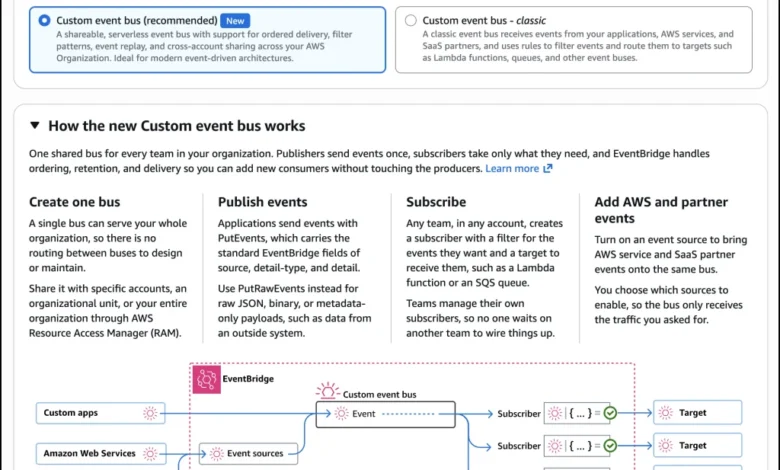
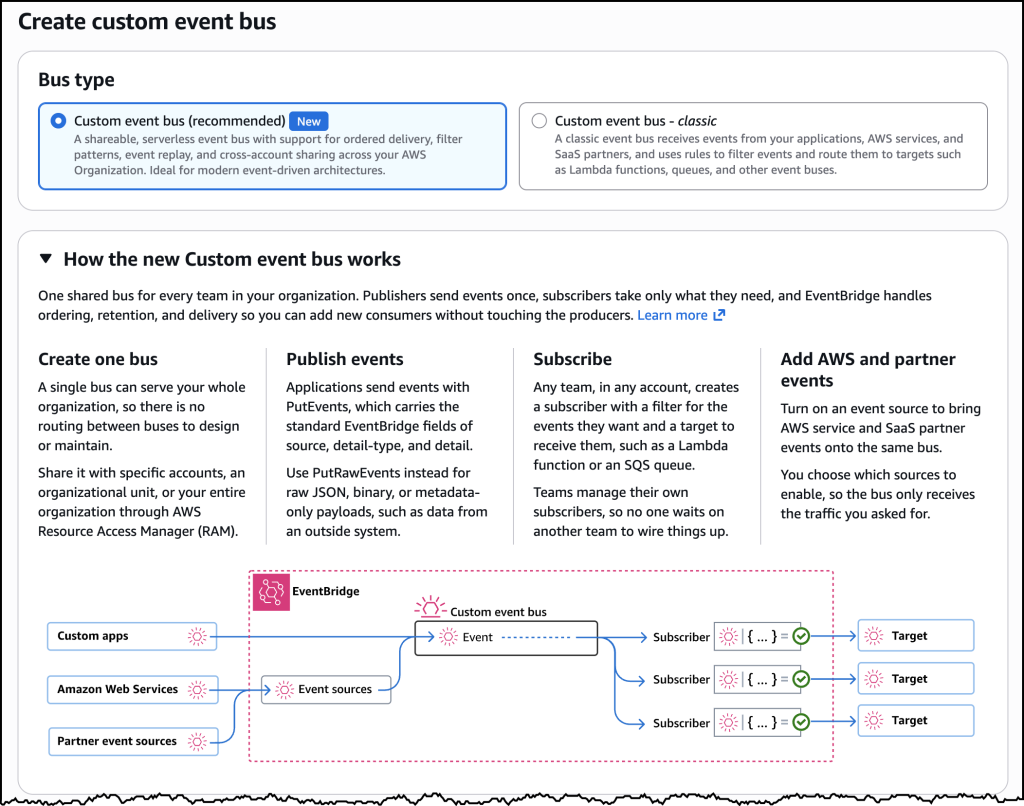
Addressing these foundational structural challenges, AWS has officially announced the launch of an enhanced custom event bus within Amazon EventBridge. Purpose-built to support large-scale organizations navigating complex, multi-account event-driven ecosystems, the newly introduced architecture permits the deployment of a centralized, unified event bus shared transparently across all AWS accounts within an enterprise organization. Featuring native ordering guarantees, a consolidated Subscriber resource model, advanced content-based deduplication, and a modernized throughput-based pricing structure, this release marks a substantial evolution in how enterprises manage asynchronous, decoupled cloud workloads.
Chronology and Architectural Evolution of Event Routing
The trajectory of cloud-native event routing has traced a steady path toward deeper administrative control and reduced infrastructural complexity. When Amazon EventBridge first emerged as a serverless event bus capable of ingesting data from SaaS applications, custom apps, and AWS services, it operated primarily on a classic model. In this traditional paradigm, every custom event bus existed as an isolated entity.
As enterprises embraced multi-account frameworks to satisfy security isolation and compliance mandates, the limitations of isolated event buses became increasingly pronounced. Between 2021 and 2024, platform teams expended significant engineering hours writing custom AWS Identity and Access Management (IAM) policies, managing resource-based access controls via AWS Resource Access Manager (RAM), and configuring target rules to transport events across account boundaries. These manual interventions frequently created brittle data pipelines that were difficult to audit, prone to permission misconfigurations, and challenging to troubleshoot during production incidents.

The introduction of the enhanced custom event bus represents a decisive turning point in this evolutionary timeline. By integrating deep, native support for organization-wide sharing via AWS RAM, AWS has effectively bridged the administrative divide separating individual accounts. Rather than forcing platform engineers to construct elaborate, brittle webs of bus-to-bus routes, the new architecture allows a single bus to act as a universal enterprise backbone. Publishers transmit events onto the shared resource without needing to identify or coordinate with downstream consumers, while individual teams autonomously subscribe to precisely the data streams they require.
Core Architectural Enhancements and Technical Specifications
The newly launched enhanced custom event bus introduces several critical technical capabilities designed to resolve longstanding pain points in enterprise serverless design.
Consolidated Subscriber Management
Under the legacy EventBridge architecture, configuring event consumption required managing a fragmented constellation of separate rules, target definitions, retry policies, and dead-letter queue (DLQ) destinations across multiple distinct resources. The enhanced event bus streamlines this workflow by introducing a unified entity known as the Subscriber resource. A single Subscriber consolidates filtering logic, target endpoint configuration, error handling parameters, and retry frameworks into one manageable operational unit. This consolidation significantly lowers the cognitive load for application developers and simplifies infrastructure-as-code (IaC) templates.
Additionally, the new resource supports variable start time options, streamlining the process of onboarding newly provisioned consumer applications or replaying historical event data to recover from downstream software errors or hydrate data warehouses.
Native Event Ordering and Synchronous Processing
While asynchronous, out-of-order event consumption remains an architectural best practice for maximizing throughput and system resilience, certain business domains demand strict sequential processing. For example, in real-time logistics tracking systems, vehicle location updates and status transmissions must be processed in exact chronological sequence; otherwise, analytical engines and routing algorithms risk making critical operational decisions based on stale or out-of-order telemetry data.
The enhanced custom event bus addresses this requirement by supporting both ordered and unordered consumption patterns simultaneously on the same bus. Publishers can attach an optional EventGroupId metadata tag to outgoing payloads. EventBridge guarantees that events sharing an identical EventGroupId are delivered in strict sequence to subscribers configured for ordered delivery, while other consumers on the same bus continue to process events asynchronously without artificial bottlenecks.

To reinforce this capability, the enhanced bus supports synchronous invocation models for downstream targets such as AWS Lambda. In synchronous mode, EventBridge confirms successful execution by the target service before acknowledging receipt of the event. This native capability eliminates the historically common anti-pattern of positioning an Amazon Simple Queue Service (Amazon SQS) queue between an event bus and a compute target merely to guarantee sequential reliability.
Advanced Event Evaluation, Deduplication, and Serialization
Data hygiene and payload transformation represent crucial requirements for enterprise data integration. The enhanced custom event bus introduces robust mechanisms to address these challenges directly at the routing layer:
- Content-Based Deduplication: When transient network timeouts or partial execution failures cause publishers to transmit duplicate event payloads, EventBridge can automatically evaluate the contents of the message. By hashing the meaningful parameters of the event and collapsing identical arrivals occurring within a five-minute window, the system achieves true exactly-once delivery semantics for retried payloads, sparing developers from the burden of generating and tracking custom deduplication tokens.
- Payload Reshaping via JSONata: Downstream consumer applications frequently require specific JSON schemas that differ from the structural format generated by event publishers. Using integrated JSONata expressions, subscribers can dynamically reshape, filter, rename, or compute values within event payloads before delivery, eliminating the need for intermediate translation microservices.
- Format Deserialization: Organizations utilizing binary serialization protocols such as Apache Avro or Protocol Buffers can configure EventBridge to natively deserialize incoming payloads into standard JSON. This enables subscribers to execute fine-grained filtering and routing logic across the full event payload without investing in independent deserialization infrastructure.
Modernized Pricing Economics at Scale
Financial predictability has historically been a complex variable when scaling multi-bus architectures. Under legacy pricing models, organizations incurred compounding expenses as messages traversed multiple buses and crossed account boundaries through intricate routing rules.
The enhanced custom event bus debuts a restructured ingress and egress throughput pricing model designed to align financial outlays with actual data utilization. Under this framework, publishers remit costs based strictly on the volume of events ingested into the central bus, while subscribers pay for the volume of events delivered to their respective endpoints. This transparent cost allocation model eliminates hidden cross-account routing penalties and provides finance and platform engineering teams with clear visibility into resource consumption metrics across organizational units.
Industry Implications and Technical Analysis
Independent cloud architects and enterprise technology analysts have noted that the release of the enhanced custom event bus directly addresses the structural friction inherent in hyperscale cloud adoption. As large enterprises migrate thousands of microservices to serverless foundations, governance and observability frequently emerge as primary bottlenecks.
By centralizing event streaming onto a shared organizational backbone while preserving granular team-level autonomy, AWS has effectively bridged the dichotomy between centralized platform governance and decentralized application development. Platform teams retain absolute visibility into organizational event flows and enforce stringent security boundaries via AWS RAM, while individual product squads enjoy the agility to provision subscribers and ingest data streams without waiting for centralized ticketing queues.
Furthermore, the default provisioning quota of 10,000 distinct Subscribers per event bus—with options for upward adjustments upon request—significantly alleviates the architectural fragmentation that previously forced organizations to deploy dozens of redundant, siloed event buses merely to bypass subscriber limitations.
Availability and Regional Rollout
The enhanced custom event bus is generally available starting today across a wide global footprint of AWS Regions, including US East (N. Virginia, Ohio), US West (Oregon), Europe (Ireland, Frankfurt, Stockholm, Spain), and Asia Pacific (Hong Kong, Malaysia, Mumbai, Singapore, Sydney, Thailand, Tokyo).
Existing legacy workloads will experience no disruption; traditional custom event buses remain fully supported and will automatically be designated in management consoles and API responses as classic resources. Organizations can adopt the new enhanced event bus architecture incrementally at their own operational pace.
Engineering teams can provision and configure the new event-routing infrastructure immediately using the AWS Management Console, the AWS Command Line Interface (AWSCLI), or standard infrastructure-as-code deployment tools. Comprehensive technical documentation and configuration guidelines are currently accessible via the official Amazon EventBridge developer portal.