Court-Ordered Seizure of Radaris.com Exposes the Complex Underworld of Commercial Data Brokers and Daniel’s Law Enforcement


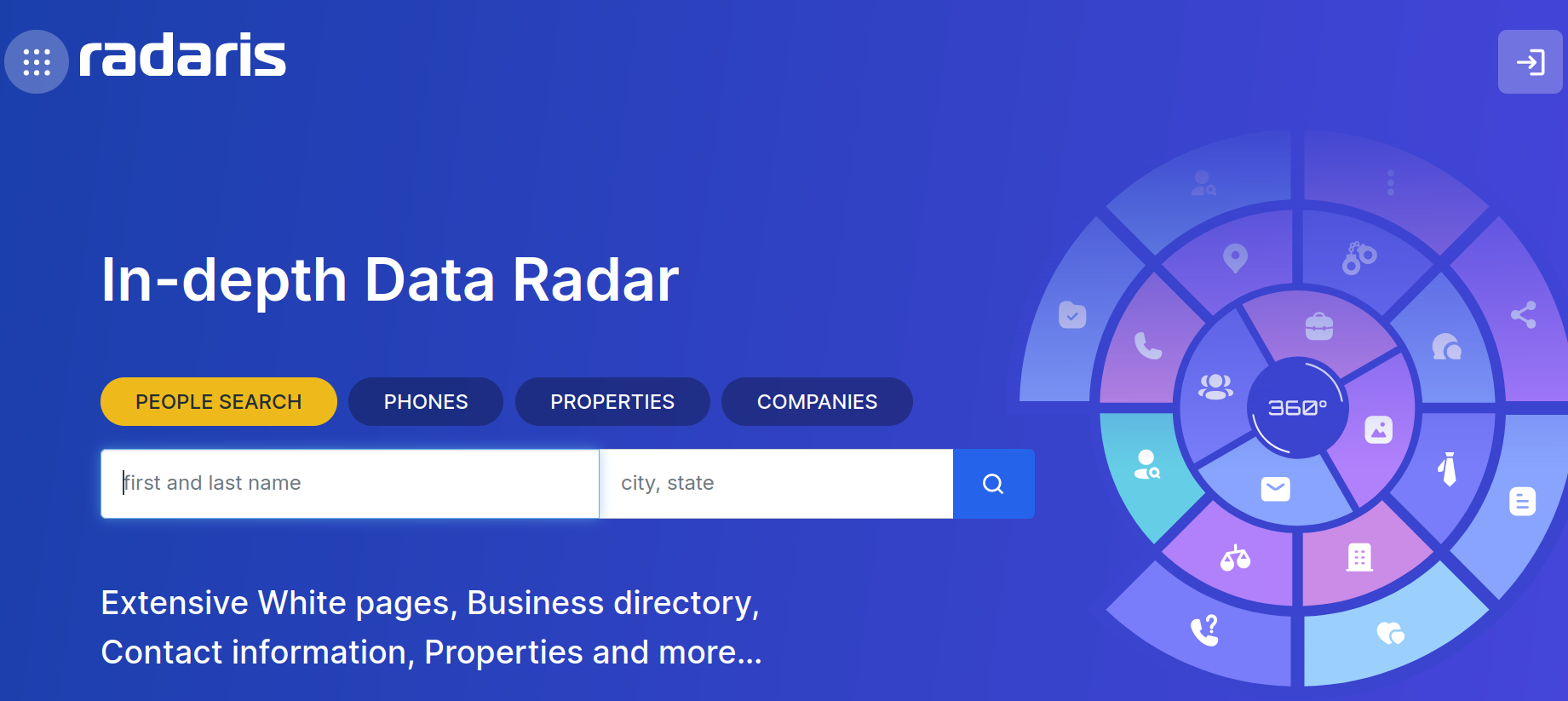
The digital architecture of the modern consumer data-broker industry has suffered a historic blow following a federal and state legal reckoning that culminated in the seizure of the high-traffic people-search domain Radaris.com. For more than a decade, the consumer data-broker platform operated with a persistent reputation for ignoring requests to remove personal information from its vast network of online search services. That operational impunity finally caught up with the company in a landmark lawsuit alleging direct violations of a New Jersey privacy statute. Faced with prolonged stonewalling, jurisdictional shell games, and aggressive legal maneuvers by defense attorneys, a state judge ordered that Radaris.com—along with more than a dozen associated data broker domains—be legally transferred directly to the plaintiffs.
The unprecedented forfeiture marks a watershed moment in the ongoing battle between privacy advocates, state regulators, and a secretive, highly lucrative industry that commercializes the intimate details of everyday citizens. At the center of this legal earthquake is Daniel’s Law, a New Jersey statute designed to protect public servants, but whose enforcement has inadvertently triggered a nationwide constitutional showdown over digital privacy, data scraping, and the boundaries of the First Amendment.
Anatomy of a Lawsuit and the Genesis of Daniel’s Law
In February 2024, data privacy enforcement firm Atlas Data Privacy Corp initiated legal action against Radaris. The company had dedicated its resources to holding data brokers accountable for violating New Jersey’s stringent statute, commonly known as Daniel’s Law. Named in honor of the late Daniel Anderl—the son of U.S. District Judge Esther Salas, who was tragically murdered at her home in 2020 by an aggrieved litigant who easily found the family’s residential address online—the statute provides robust protections for state law enforcement officials, government personnel, judges, and their immediate families.
Under the provisions of Daniel’s Law, covered individuals possess the absolute right to demand the complete removal of their personal information from commercial people-search directories and data-broker databases. Crucially, the statute arms these mandates with severe financial penalties, levying fines of $1,000 per violation against companies that ignore, delay, or reject removal requests.
Rather than complying with the statute, Radaris and its network of sister companies allegedly relied on a familiar playbook of evasion. According to Atlas President and CEO Matt Adkisson, the defendants repeatedly delayed court proceedings, hiding behind an intricate web of international shell corporations designed to obscure their true ownership and frustrate legal service.
The Shadowy Operators: Unmasking the Founders
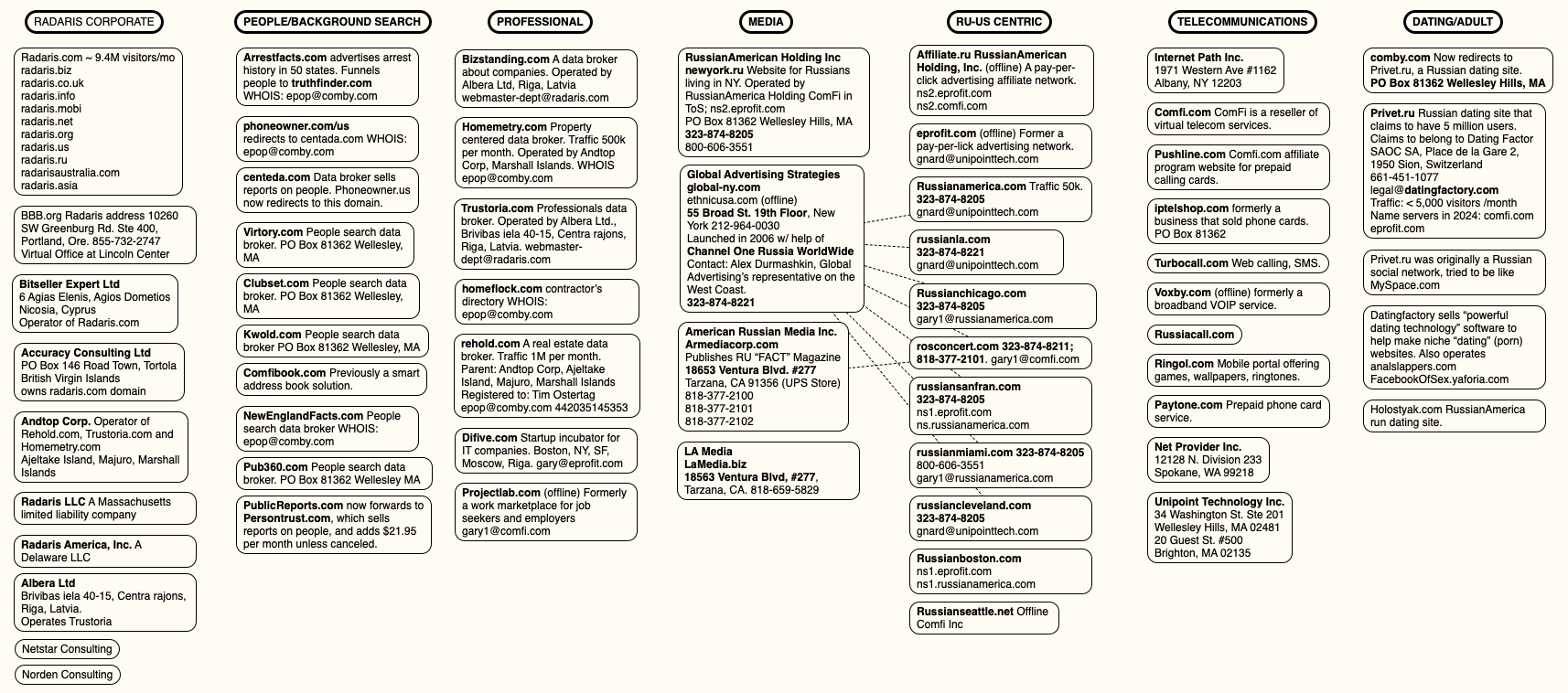
The legal pressure on Radaris intensified significantly shortly after the initial February 2024 lawsuit, when investigative reporting shed light on the elusive co-founders of the enterprise: Igor and Dmitry Lubarsky (also documented as Lybarsky). The Russian-born brothers, residing in Massachusetts, have long operated a dizzying portfolio of people-search companies alongside a network of Russian-language dating services and digital affiliate marketing programs.
When investigative journalists exposed their central role in the Radaris empire, legal representatives for the Lubarsky brothers threatened aggressive defamation litigation unless the reports were retracted and apologies issued. Defense attorneys initially insisted the reporting was wildly inaccurate, claiming instead that the true owners of the multi-million-dollar operation were Ukrainian citizens living in Ukraine.
Subsequent investigations dismantled these claims, demonstrating that the Radaris network routinely employed corporate subterfuge—including the invention of a fictitious CEO named "Gary Norden." Attorney Val Gurvits of the Boston Law Group, representing Radaris, later conceded in court filings that his clients had indeed manufactured the "Gary Norden" pseudonym. The fake identity had been utilized for years in corporate press releases and promotional materials to court potential investors while shielding the true operators from personal liability.
A Decade of Procedural Shell Games and International "Island-Hopping"
The legal battle against Radaris is rooted in a history of procedural evasion that stretches back nearly a decade. In 2017, the company temporarily lost a class-action lawsuit, styled as Huebner v. Radaris, LLC, after failing to mount a defense in court. When plaintiffs attempted to collect on a resulting $7.5 million default judgment, they discovered the corporate entity was effectively judgment-proof. The court subsequently ordered domain registrar Verisign to transfer the Radaris.com domain to the plaintiffs.
However, Radaris attorneys successfully appealed that verdict, arguing that the lawsuit had failed to name the actual owner of the domain—a Cyprus-registered entity known as Bitseller Expert Limited—thereby violating due process rights. The court halted the domain transfer and instructed plaintiffs to refile their complaint.
Instead of facing a renewed legal challenge, the operators of Radaris engaged in what Atlas legal counsel describes as an "island-hopping" corporate restructuring phase. Control of the platform shifted from Bitseller to Andtop Company, an entity established in the Marshall Islands in October 2020. Over the ensuing years, privacy policies changed constantly, and new corporate entities continuously materialized across offshore tax havens, including the British Virgin Islands, the Seychelles, and the Marshall Islands.
Raj Parikh, a partner at PEM Law in New Jersey who manages the Daniel’s Law litigation for Atlas, noted that this strategy of attrition had successfully protected the data brokers for a decade. Plaintiffs typically grew exhausted by the endless jurisdictional games and abandoned their claims. However, recognizing the acute physical threat that these directories posed to law enforcement and judicial officials in New Jersey, Atlas committed the necessary long-term resources to pierce the corporate veil.
The Expanding Web: Documentary Evidence and Financial Scale
In June 2025, Atlas re-filed and dramatically expanded its lawsuit, naming a much broader constellation of corporate entities allegedly tied to the Radaris family. Through the course of litigation, Atlas subpoenaed and secured more than 10,000 internal emails, financial records, and operational documents.
According to legal filings and summaries provided by Atlas, this document corpus established definitively that nominal legal vehicles—including Radaris America Inc., Bitseller Expert Limited, Digital Orbit Corp., Core Solutions Group Inc., Lucky Solutions Inc., Virtura Corp., Veripages Inc., Nuform Solutions Inc., Growth Data Advisors Inc., and Property Experts Inc.—were not independent enterprises. Rather, they were centralized operations managed by the same small core of individuals out of the Boston area. These entities shared administrative, financial, and technical infrastructure, utilizing centralized mail domains and unified banking and payment processing mechanisms.
The uncovered financial records illuminated the immense scale of the people-search enterprise. Documentation revealed that Radaris.com generated approximately $42,000 per month in direct revenue, while sister site Veripages.com pulled in roughly $45,000 monthly through lucrative partnerships with major marketing conglomerates such as the Lifetime Value Company—the parent organization behind brands like PeopleLooker, PeopleSmart, NumberGuru, and vehicle history tracker Bumper.

Furthermore, disclosures showed that the Radaris network collected up to $25,000 monthly through commercial partnerships with Onerep, a prominent privacy-management company that purportedly helps consumers scrub their data from people-search directories. Investigations previously revealed that Onerep’s founder had similarly launched and operated numerous people-search websites concurrently, effectively profiting from both the publication of sensitive data and the services offered to remove it.
Court-Ordered Seizure and the Defense Response
On August 26, observing that the defendants had repeatedly failed to mount a substantive defense despite multiple opportunities, the New Jersey state judge ruled in favor of the plaintiffs and ordered the immediate transfer of 14 domain names associated with the Radaris family.
Radaris.com no longer serves as a searchable database of personal dossiers. Instead, visitors to the domain are greeted by a formal notice issued by Atlas detailing the court-ordered forfeiture, alongside links documenting the investigative history of the site’s operators.
Legal representation for the defendants has shifted to attorney Victor Worms, who has challenged the validity of the proceedings. Worms asserted that the New Jersey court erred by transferring Radaris.com as part of a default judgment against a domain name rather than a recognized legal entity.
"We have made a motion to vacate that default judgment on the grounds that it is void since a non-entity has no legal capacity to sue or be sued," Worms stated, adding that the defense intends to pursue comprehensive appeals on the grounds that the domain transfer constitutes an unconstitutional forfeiture.
Broader Legal Implications: Daniel’s Law Under Constitutional Fire
While the seizure of Radaris.com marks a milestone for plaintiffs, the broader future of Daniel’s Law hangs in the balance. The statute is currently facing an aggressive, coordinated constitutional challenge from a coalition of approximately 150 consumer data-broker firms that have been targeted by Atlas.
The data broker industry has successfully removed at least 70 of these lawsuits to federal court, arguing that Daniel’s Law is overly broad and represents a direct violation of commercial speech protections under the First Amendment. While the U.S. Court of Appeals for the Third Circuit weighs the constitutional viability of the statute, legal experts anticipate that the case will ultimately be appealed to the U.S. Supreme Court.
The legal uncertainty extends beyond New Jersey. At least 14 other states have introduced or passed legislation modeled after Daniel’s Law, signaling a growing legislative appetite for consumer privacy protections. However, these statutes face formidable judicial hurdles; in August 2025, a federal district court ruled West Virginia’s iteration of Daniel’s Law facially unconstitutional under the First Amendment.
The Systematic Failure of U.S. Data Privacy Policy
Privacy researchers and policy experts argue that state-level statutes, while crucial for protecting public officials, are ultimately stopgap measures against a systemic regulatory failure at the federal level.
Justin Sherman, a data privacy expert and author of the upcoming book The Middlemen, which examines the mechanics of the modern data broker economy, points out that the technology and data industries have spent decades lobbying against comprehensive federal privacy legislation. According to Sherman, opposition has only intensified with the inclusion of major social media corporations, cryptocurrency enterprises, and artificial intelligence proponents who argue that restricting data scraping and collection will cripple technological innovation.
Sherman emphasizes that people-search companies will continue to thrive in a legal gray area until Congress enacts comprehensive, 21st-century data protection laws. Existing state-level privacy frameworks routinely exempt records categorized as "public" or "government" documents—such as voting registries, property deeds, marriage licenses, motor vehicle registrations, criminal records, and professional licensures. Because data brokers scrape and aggregate these legally mandated public records, they operate within technical compliance of many existing statutes while systematically stripping away practical obscurity.
The absence of federal oversight extends into adjacent technological sectors, such as age-verification mandates. While at least 25 states require digital age verification to access certain online content, no federal standard governs how third-party vendors handle, retain, or secure sensitive identification documents like scanned driver’s licenses. The risks of this regulatory vacuum were underscored by major security breaches, such as the exposure of more than 153 million American driver’s license records through vulnerable third-party verification infrastructure—data that was subsequently weaponized on the dark web.
"The average person can look at Daniel’s Law and have a perfectly normal reaction, which is that everyone should be covered, not just police and judges," Sherman noted. "But we don’t need more wake-up calls. We’ve had eight million wake-up calls already on the need for better privacy laws. The lack of comprehensive federal privacy law is not for a lack of knowledge, and anyone claiming otherwise is either not reading the news or kidding themselves."
As the legal battles over Daniel’s Law wind their way toward the highest courts in the country, the successful seizure of Radaris.com demonstrates that determined litigants can pierce the complex corporate structures of the data-broker underworld. Yet, until structural legislative reforms catch up with the realities of modern digital surveillance, the fundamental vulnerability of consumer personal data will remain an unresolved crisis of the digital age.