A persistent and evolving campaign orchestrated by North Korean threat actors, identified as BlueNoroff, has been meticulously documented for its deployment of a sophisticated phishing kit. This kit capitalizes on typosquatted domains mimicking popular videoconferencing platforms like Zoom and Microsoft Teams, integrating advanced social engineering tactics, AI-generated content, and cryptocurrency wallet reconnaissance to deliver malware and compromise high-value targets within the Web3 and finance sectors. The operation, characterized by its "ClickFix-style campaigns," represents a significant escalation in state-sponsored cybercrime, demonstrating a refined approach to victim acquisition and exploitation.
The Anatomy of a Highly Targeted Cyber Offensive
The cybersecurity firm JUMPSEC has unveiled extensive details of BlueNoroff’s ongoing operations, labeling the campaign an "operator-driven victim acquisition platform." At its core, the strategy hinges on "trust abuse," a multi-layered approach that combines the exploitation of compromised industry contacts, intricate social engineering, meticulous cryptocurrency wallet reconnaissance, and tailored malware delivery. This integrated pipeline is designed for repeatable victim acquisition, emphasizing a selective targeting methodology for individuals with substantial cryptocurrency holdings.
Initial access for these attacks typically originates from compromised trusted contacts, often individuals with whom the target has previously interacted in real life. This crucial first step bypasses many traditional security measures by leveraging pre-existing relationships. Attackers achieve this by hijacking legitimate Telegram accounts belonging to individuals within the cryptocurrency space. Once control is established, these compromised accounts are used to message high-ranking employees of major companies, sharing seemingly innocuous Calendly meeting links.
JUMPSEC’s research highlights the self-propagating nature of this attack chain. If a victim interacts with the malicious payload while Telegram Web is open or Telegram Desktop is installed, their Telegram session becomes a prime candidate for theft. This stolen session is then reused against the victim’s own contacts, creating a continuous loop of compromise that fuels the campaign’s expansion. "Every victim who runs the payload with Telegram Web open or Telegram Desktop installed is a candidate for their Telegram session to be stolen and reused against their own contacts," JUMPSEC stated, underscoring how each account compromise can lead to further compromises, amplifying the reach and impact of the campaign exponentially.
Sophisticated Impersonation: Fake Meetings and AI Deception

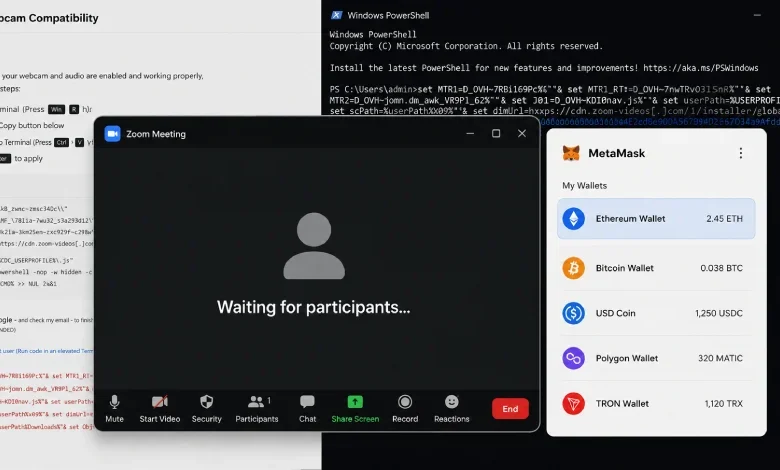
The journey from a seemingly legitimate Calendly link leads victims to a meticulously crafted phishing page that masquerades as a genuine Zoom meeting URL. These fake domains are expertly typosquatted, closely resembling authentic videoconferencing platform addresses to deceive unsuspecting users. Upon landing on this page, victims are prompted to enter their name and grant permissions for webcam access. Unbeknownst to them, granting these permissions initiates a stealthy stream of their webcam feed directly to the attackers’ control panel via mediasoup WebRTC, a technology typically used for real-time communication. This immediate visual reconnaissance provides the threat actors with crucial intelligence and adds a layer of psychological manipulation, making the subsequent stages of the attack more convincing.
Following the initial webcam compromise, victims are guided to another page, giving the impression that they have joined a Zoom call. However, they appear to be the sole participant, greeted by a message stating, "waiting for other participants." This cleverly engineered waiting period sets the stage for the next, more insidious phase of the attack, creating a plausible scenario for the victim while the operators prepare their next move.
During this waiting period, the phishing kit executes a crucial fingerprinting step on the victim’s web browser. This process inventories all cryptocurrency wallets installed on the browser, allowing BlueNoroff to identify and selectively target high-value victims. Only after this reconnaissance is complete and a target is deemed sufficiently lucrative does the "admin" (the threat actor) appear to join the fake meeting.
The appearance of the "admin" is where the campaign’s sophistication reaches new heights. The video stream the victim sees is not a live feed but a pre-edited video, featuring AI-generated headshots superimposed over authentic body movements captured during previous successful attacks. This ingenious technique means that "each successful attack feeds source material into the composites used against the next target," as JUMPSEC meticulously detailed. Combined with the initial Telegram account takeover, this method ensures that the fake meeting presents a plausibly familiar-looking face, exhibiting the natural body language of someone previously recorded on camera. This deepfake element significantly enhances the credibility of the impersonation, making it exceptionally difficult for victims to discern the deception.
Once the victim is "in the meeting," the operator leverages their control panel to manipulate the session. They can send fabricated messages, such as "your mic isn’t working," to further disorient the victim and prompt them into specific actions. Crucially, the operators can trigger a fake "Zoom SDK Update," which ultimately delivers the "ClickFix payload"—the malware designed to compromise the victim’s system.
Evolution of a Threat: Phishing Kit Development and Actor Identification
The campaign’s ongoing evolution is evident in the continuous refinement of its phishing kit. JUMPSEC’s analysis identified two distinct lure variants, one for Zoom and another for Microsoft Teams. The Teams variant, in particular, demonstrated a higher degree of polish, incorporating features like emoji reactions, mobile/tablet blocking, and more advanced wallet probes prior to malware delivery, indicating a targeted optimization for different platforms. The ClickFix attack chains themselves are robust, compatible with both Windows and macOS operating systems, broadening the potential victim pool.

Further investigation into the campaign’s infrastructure revealed active development and fine-tuning efforts, with five distinct versions of the phishing kit discovered between May 31 and July 14, 2026. This rapid iteration underscores BlueNoroff’s commitment to improving their attack methodologies and adapting to potential countermeasures.
A significant breakthrough in tracking the actors came from analyzing the Telegram exfiltration function, which hard-codes the bot token and chat ID within the stealer binary. Querying the Telegram API with this bot token led to the identification of an operator using the alias "John" (@alchemy_john_mac). As recently as May 2026, this individual was observed actively engaging with administrators of the MAIV cryptocurrency group, inquiring about vesting contracts and fund withdrawals, indicating a direct interest in cryptocurrency assets and a potential role in the wider BlueNoroff network.
Strategic Platform Choices: Zoom and Microsoft Teams
A notable characteristic of this campaign is its specific focus on Zoom and Microsoft Teams, conspicuously omitting other popular videoconferencing services like Google Meet. Sean Moran, Head of Threat Research and Enablement at JUMPSEC, provided insights into this strategic choice, outlining three primary reasons: the "ClickFix pretext," target application fit, and the available typosquatting surface.
"The whole hook is the ‘Zoom/Teams SDK out of date’—that only lands on platforms that victims believe have somewhat of a heavyweight desktop client (like Teams and Zoom have)," Moran explained. This pretext is less effective for platforms like Google Meet, which are primarily browser-based and do not typically involve a desktop application update prompt.
Furthermore, Zoom and Teams are prevalent communication tools within the finance world, particularly among cryptocurrency investors, venture capitalists, and founders. Moran noted, "Zoom and Teams are the default for a lot of crypto/venture capitalist/founders in the finance world—whereas Google Meet feels more of a customer calling platform rather than an ‘investor/partnership call.’" This observation suggests a careful selection of platforms that align with the professional communication habits of their target demographic.
Lastly, the structure of Zoom and Teams domains lends itself more readily to effective typosquatting. Moran highlighted that "the entire domain scheme being ‘us.zoom.06webin.us’ and such makes it really easy for someone to fall for their fake links because they are so similar to real Zoom links with all the sub-domains, whereas ‘meet.google.com’ is harder to typosquat/spoof." The complexity and sub-domain usage in typical Zoom links provide more opportunities for subtle variations that can easily deceive users.

While the current phishing kit primarily features Zoom and Teams lure pages, Moran pointed out the existence of an unimplemented Google Meet equivalent as a stub in the source code. This suggests that while the capability exists, BlueNoroff has made a deliberate choice to focus on the more effective avenues, indicating a pragmatic and data-driven approach to their operations.
Broader Implications for Cybersecurity and Web3
The BlueNoroff campaign underscores a critical shift in the threat landscape, particularly concerning Web3 and digital assets. As these sectors mature and gain mainstream adoption, threat actors are increasingly recognizing the immense value in compromising the individuals who control access to these assets, often finding this more fruitful than directly attacking the underlying infrastructure. This approach leverages human vulnerabilities rather than purely technical ones, making it exceptionally challenging to defend against.
BlueNoroff is widely understood to be a subgroup of the Lazarus Group, a notorious state-sponsored hacking collective from North Korea. Their cyber activities are intrinsically linked to the Democratic People’s Republic of Korea’s (DPRK) efforts to generate revenue for its illicit weapons programs and to circumvent international sanctions. By targeting high-value cryptocurrency professionals, BlueNoroff directly contributes to these national objectives, making their operations a matter of national security for affected nations and a significant concern for global financial stability. The sophistication of these attacks, including the use of AI-generated content and multi-stage social engineering, highlights the advanced capabilities of state-sponsored actors and their continuous innovation in cyber warfare.
JUMPSEC’s conclusion serves as a stark warning: "BlueNoroff’s continued refinement demonstrates that organisations must consider identity, relationships and communication channels as critical parts of their security posture." Traditional perimeter defenses are insufficient when the attack vector is a trusted contact or a seemingly legitimate meeting link. The self-sustaining nature of the Telegram account takeover, combined with the plausible deepfake video meetings, creates a highly insidious and scalable threat.
Organizations and individuals operating in the cryptocurrency and finance sectors must adopt a holistic security approach. This includes not only robust technical controls but also comprehensive security awareness training that emphasizes vigilance against sophisticated social engineering. Verifying the authenticity of meeting links independently, using multi-factor authentication for all accounts, and exercising extreme caution with unsolicited requests for software updates or permissions are paramount. The campaign serves as a powerful reminder that in the age of advanced digital impersonation, trust can be easily weaponized, and the human element remains the most vulnerable link in the cybersecurity chain. The ongoing development of BlueNoroff’s phishing kit signals that this threat is dynamic and will continue to evolve, necessitating continuous adaptation and vigilance from the global cybersecurity community.
Related posts: