Snapchat Introduces New Plans Feature to Seamlessly Bridge In-App Chats with Real-Life Meetups

In an era where digital communication often risks replacing physical interaction, social media platforms are increasingly looking for ways to encourage real-world socialization among their user bases. Snapchat, developed by Snap Inc., has officially announced the rollout of a brand-new feature designed specifically to transition users effortlessly from digital conversations to in-person gatherings. Dubbed "Plans," this new tool allows users to set up calendar events, coordinate schedules, and send invitations directly within their existing chat streams, eliminating the friction that often accompanies organizing outings across multiple applications.
The introduction of the Plans element marks a significant step forward in Snapchat’s long-term strategy to foster genuine human connections rather than simply driving endless in-app engagement. By streamlining the event creation process, the company aims to capture a behavior that is already prevalent among its core demographic, turning passive digital messaging into active, real-world socialization.
How the Snapchat Plans Feature Works
The mechanics of the new Plans feature have been meticulously designed to integrate smoothly into the daily habits of Snapchat users. According to official details provided by Snap Inc., the tool allows event creators to initiate gatherings directly within a group or one-on-one chat interface.
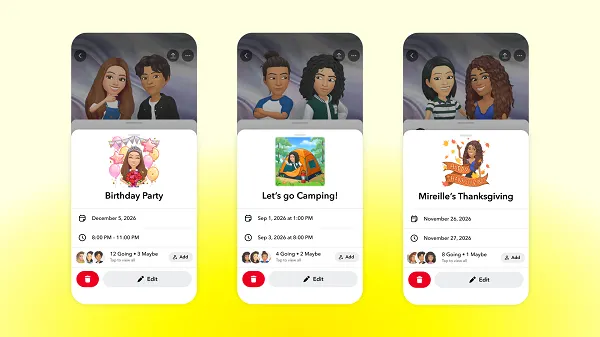
When establishing an event, a user can assign a specific title, designate a precise date and time, and invite up to 200 friends simultaneously. One of the standout customization options is the integration of dynamic, Bitmoji-powered cover art. This graphic automatically updates and evolves as the details of the plan come together and more friends RSVP, adding a personalized, visually engaging touch to the invitation process.
Once an event is created, invitations are delivered directly into the chat streams of the invited participants. Guests can respond instantaneously by selecting one of three RSVP statuses: "Going," "Maybe," or "Can’t Go." Crucially, this response mechanism functions within the conversation flow without disrupting the ongoing dialogue.
To help attendees keep track of their social calendars, event organizers can monitor all details via a dedicated "My Plans" section located directly on their user profile. Additionally, participants can view logistical information for any accepted events by visiting the profiles of their friends. To ensure that nobody misses out, Snapchat’s system automatically dispatches reminder notifications to all confirmed attendees exactly one hour before the scheduled start time of the event.
A Strategic Focus on Real-World Engagement

The launch of the Plans feature is not an isolated update; rather, it is the latest in a concerted series of efforts by Snapchat to play a more active role in facilitating real-life engagement. Over the past several years, the company has steadily expanded its ecosystem to include tools that bridge the gap between virtual maps and physical locations.
At the center of this strategy is the Snap Map, a popular feature that allows users to share their geographic locations with friends. Snapchat has continuously updated the Snap Map to include location listings, robust sharing tools, and localized utilities. Earlier this year, the platform rolled out loyalty badges for specific locations on the Snap Map, further encouraging users to explore their physical surroundings and visit popular venues together.
Furthermore, the introduction of Plans builds upon previous iterative features, such as the Countdown tool, which enables friends to set up shared countdown reminders for upcoming milestones or gatherings. By weaving these utilities together, Snapchat is positioning itself as a comprehensive social utility rather than a mere entertainment or broadcasting platform.
A Long-Term Development Journey
While the official rollout of the Plans feature represents a major milestone for the platform, the concept has actually been in development for several years. Tech analysts and data miners first caught wind of Snapchat’s experimental event-organizing tools as early as 2021, when preliminary references and back-end code elements were discovered within the application’s architecture.
For years, the company deliberated on how best to implement an events framework that would feel native to Snapchat’s fast-paced, ephemeral communication style. By taking the time to refine the user interface and test underlying systems, Snap Inc. has ensured that the final feature integrates harmoniously with its existing messaging architecture. The years of behind-the-scenes development culminated in the recent announcement, providing users with a polished, highly functional tool that reflects modern mobile UX standards.
Data-Driven Rationales and User Behavior
Snapchat’s decision to launch the Plans feature is firmly rooted in empirical data regarding how its community actually uses the app. According to recent internal usage surveys conducted by the company, an impressive 35% of U.S. Snapchatters aged 13 to 24 routinely utilize the platform’s group chat functions specifically to organize events and make social arrangements.
This demographic insight revealed a clear market demand. Rather than forcing young users to jump between Snapchat and external calendar applications, text messaging threads, or third-party invitation platforms, Snapchat has chosen to capture this internal utility. By centralizing the planning process within the app where conversations are already taking place, the company removes structural barriers to socialization, thereby increasing the likelihood that digital chats will successfully culminate in physical meetups.

Corporate Philosophy: Connection Over Retention
The rollout of the Plans feature aligns seamlessly with Snapchat’s overarching corporate philosophy, which increasingly emphasizes meaningful interpersonal connection over mindless content consumption. In an industry dominated by algorithmic feeds designed to maximize screen time, Snapchat has carved out a distinct identity centered around close friends and family.
This philosophy was underscored during recent milestones for the platform. In a comprehensive public letter marking the 15-year anniversary of the app, Snap CEO Evan Spiegel reflected on the company’s trajectory and enduring success. Spiegel emphasized that Snapchat’s primary differentiator has always been its focus on real friends rather than public followers. He reiterated that the platform’s ultimate mission is to bring people together in the real world rather than keeping them endlessly scrolling through a centralized algorithmic feed.
Industry analysts have noted that this philosophical stance insulates Snapchat from some of the criticisms leveled at other major social media networks, which are often accused of exacerbating social isolation and digital addiction. By explicitly designing features that encourage users to log off and meet face-to-face, Snapchat is successfully reframing its societal impact.
Broader Implications for the Social Media Landscape
The introduction of the Plans feature carries several notable implications for the broader social media and technology sectors. First, it highlights a continuing trend toward feature convergence among messaging apps. Platforms are no longer isolated silos for text and media exchange; instead, they are evolving into all-in-one lifestyle utilities that manage logistics, commerce, and communication.
Second, by facilitating real-world meetups, Snapchat creates powerful downstream benefits for local businesses, hospitality venues, and event organizers. When groups of friends successfully use the Plans feature to coordinate dinners, parties, or outings, they drive foot traffic into the physical economy. The synergy between the Snap Map’s location features and the new event-planning tools creates an ecosystem where digital coordination directly stimulates physical commerce.
Finally, this update serves as a masterclass in listening to core user behavior. By identifying that a significant portion of its younger demographic was already attempting to organize events within chat threads, Snapchat did not try to redirect them elsewhere; instead, it built the infrastructure to support their existing habits.
As the digital landscape continues to mature, features like Snapchat Plans demonstrate that the future of social media may lie not in keeping users trapped inside virtual environments, but in using technology as a bridge to enhance our lives offline. With its seamless blend of chat integration, dynamic visual elements, and practical reminders, Snapchat has equipped its community with a powerful tool to turn casual conversations into lasting real-world memories.
Related posts: