Inside Meta’s Infrastructure Lab: The Hardware Architectures Powering the Future of Artificial Intelligence

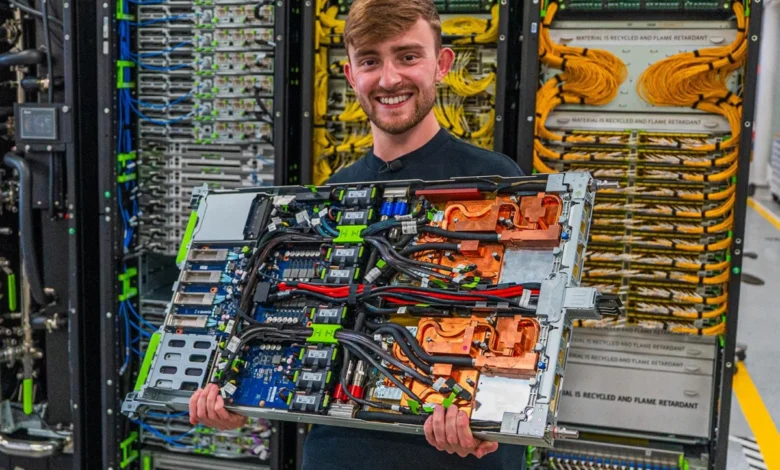
Deep within Meta’s Menlo Park headquarters lies a facility that represents the physical backbone of the company’s digital ambitions: the Infrastructure Lab. As the demand for generative AI, large language models (LLMs), and complex machine learning workloads continues to skyrocket, the challenge for technology giants has shifted from software optimization to radical hardware innovation. Developer and creator Tom Shaw recently provided an exclusive, behind-the-scenes look at this clandestine hub, where engineers are busy architecting the custom silicon, server racks, and cooling solutions required to sustain the next decade of AI development.
The Evolution of Meta’s Infrastructure Strategy
For years, Meta—formerly Facebook—relied on off-the-shelf components to build its data centers. However, as the company pivoted toward the "AI-first" strategy announced by CEO Mark Zuckerberg in 2023, it became clear that standard hardware could not meet the extreme efficiency and power requirements of models like Llama 3 and its successors.
The Infrastructure Lab serves as a prototyping ground for the company’s "disaggregated" hardware philosophy. By separating compute, storage, and networking into modular blocks, Meta aims to scale its data centers with greater agility. The hardware currently under development focuses on high-bandwidth memory (HBM) integration and specialized AI accelerators that prioritize power efficiency over raw, general-purpose processing speed.
A Chronology of Infrastructure Expansion
Meta’s journey toward internal hardware design began in earnest over a decade ago with the founding of the Open Compute Project (OCP) in 2011. This initiative, which encouraged the open-source sharing of data center designs, transformed how the industry approached server efficiency.
- 2011: Meta launches the Open Compute Project, setting the stage for standardized, efficient data center hardware.
- 2019: The company begins integrating custom ASIC (Application-Specific Integrated Circuit) development into its research pipeline to handle recommendation algorithms.
- 2022: With the explosion of generative AI, Meta accelerates its focus on GPU-heavy clusters, specifically targeting the deployment of massive NVIDIA-based fleets.
- 2024: Meta unveils the MTIA (Meta Training and Inference Accelerator) v2, marking a significant step toward reducing dependence on third-party silicon providers for inference workloads.
- 2026: The current state of the Infrastructure Lab reflects a shift toward total system optimization, where hardware is custom-built to match specific model architectures.
The Physics of AI: Cooling and Power Consumption
One of the most significant hurdles discussed within the Infrastructure Lab is the sheer thermal density of modern AI servers. The racks housing the latest generation of accelerators generate heat levels that traditional air-cooling systems can no longer mitigate.
Data provided by Meta’s engineering teams indicates that liquid-to-chip cooling systems are now becoming the standard for their high-performance computing clusters. These systems circulate coolant directly over the processors, allowing for higher clock speeds without the catastrophic failure risks associated with traditional air-flow methods. Furthermore, the power demands of these clusters necessitate a complete redesign of the electrical distribution within the data centers, shifting from traditional AC power to highly efficient, high-voltage DC distribution networks.
Implications of Custom Silicon
The shift toward custom silicon, such as the MTIA, is not merely a cost-saving measure; it is a strategic necessity. By designing chips specifically for the transformer architectures that power modern AI, Meta is able to optimize for memory bandwidth and latency in ways that general-purpose GPUs cannot.
Industry analysts observe that Meta’s move mirrors similar trajectories taken by Google with its Tensor Processing Units (TPUs) and Amazon with its Inferentia chips. The objective is to achieve a higher "performance-per-watt" metric, which is the ultimate currency in a world where AI energy consumption is under intense regulatory and environmental scrutiny.
Official Perspectives and Industry Reaction
While Meta has remained relatively tight-lipped regarding the specific performance benchmarks of its newest prototypes, internal documentation and statements from Meta’s infrastructure leadership highlight a clear trajectory. "We are moving away from the era of ‘buying everything off the shelf’ and toward a future where our software requirements define the very silicon we build," a spokesperson noted during a recent technical briefing.
The broader tech community has reacted with cautious optimism. Independent hardware analysts suggest that while Meta’s move to internalize hardware design increases R&D overhead, it provides a crucial hedge against supply chain volatility—particularly given the global shortage of high-end GPUs like the NVIDIA H100 and its successors.
Broader Impact on the Global AI Landscape
The work being conducted in Menlo Park has profound implications for the global AI ecosystem. As Meta continues to open-source parts of its hardware designs via the Open Compute Project, it effectively sets the standard for how other companies will build their data centers. This "democratization" of infrastructure design allows smaller players to adopt enterprise-grade efficiency standards, effectively raising the bar for the entire industry.
Furthermore, the focus on hardware innovation is a direct response to the "compute wall." As models continue to scale, the traditional methods of doubling compute power every 18 months are failing to keep pace with the exponential growth in model parameters. Meta’s Infrastructure Lab is attempting to circumvent this wall through heterogeneous computing—a method that uses a mix of CPUs, GPUs, and custom ASICs to perform specific tasks simultaneously rather than sequentially.
Looking Toward the Future: The Next Decade of Compute
As the facility in Menlo Park continues to churn out prototypes, the long-term goal remains clear: to build an infrastructure that can support Artificial General Intelligence (AGI). This requires not just faster processors, but a total redesign of the data center fabric, including ultra-fast, low-latency interconnects that allow thousands of chips to act as a single, unified brain.
The videos and technical insights coming out of Meta’s Infrastructure Lab provide a rare glimpse into the "hard" side of software. In an industry often characterized by ephemeral code and digital interfaces, the hardware lab is a reminder that the future of intelligence is rooted in silicon, copper, and the rigorous laws of physics. Whether Meta’s custom-built solutions will successfully outpace the rapid evolution of the broader hardware market remains to be seen, but the investment and engineering rigor currently on display suggest a company fully committed to controlling its own destiny in the age of AI.
The lab is not merely a manufacturing site; it is a research institution where the failures of today inform the breakthroughs of tomorrow. As engineers continue to iterate on cooling solutions, power distribution, and silicon architecture, they are essentially writing the blueprint for the next industrial revolution—one fueled by data and executed by machines designed from the ground up for the task.
Related posts: