X Integrates Grok AI into Ads Manager to Pioneer Automated Advertising Solutions and Enhanced Campaign Guidance

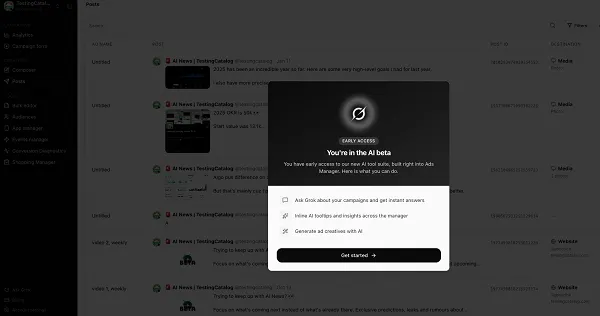
X, the social media platform formerly known as Twitter, has officially commenced beta testing for its latest artificial intelligence integration, embedding the Grok chatbot directly into its Ads Manager interface. This strategic move is designed to provide advertisers with sophisticated, AI-driven guidance for campaign development, creative brainstorming, and performance optimization. By leveraging the computational power of xAI’s large language model, X aims to simplify the complexities of digital marketing, potentially moving the platform toward a future of fully autonomous advertising.
The integration represents a significant milestone in the company’s broader "AI-first" transformation, initiated under the leadership of owner Elon Musk. The beta rollout follows a comprehensive overhaul of the platform’s advertising infrastructure earlier this year, signaling a shift away from traditional manual targeting toward a system governed by machine learning and real-time data analysis.
The Mechanics of the Grok Ads Integration
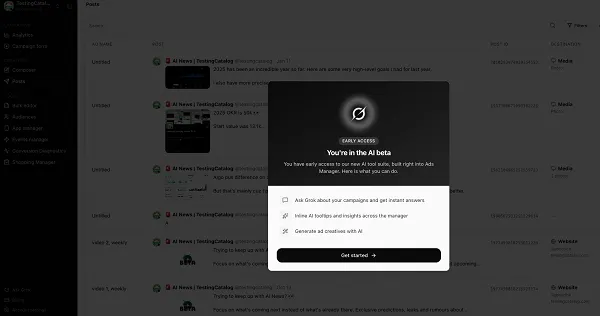
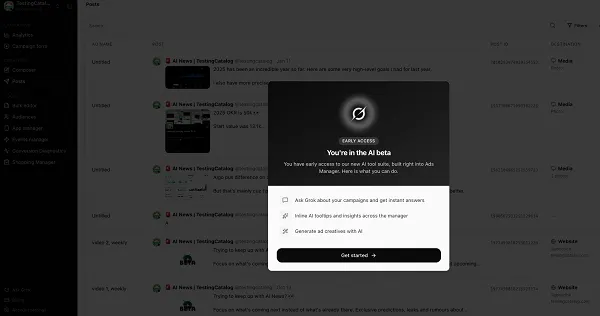
The new beta feature, initially identified by industry observers and shared via social media, allows advertisers to interact with Grok as a virtual consultant. Within the Ads Manager dashboard, users can prompt the chatbot for specific advice on ad strategy, such as identifying the most effective demographics for a particular product or determining the optimal timing for a campaign launch.
Beyond conversational advice, the integration introduces a suite of assistive tools. These include enhanced tooltips that provide context-specific guidance during the ad creation process and generative capabilities that suggest creative assets—such as copy and visual concepts—based on current platform trends. The goal is to reduce the "friction of entry" for new advertisers, particularly small and medium-sized businesses (SMBs) that may lack the resources of large-scale marketing agencies.
By building the chatbot into its ad platform, X is advancing toward what industry experts call "agentic ad generation." In this model, AI agents do not merely provide suggestions; they possess the capacity to construct and manage entire campaigns based on a high-level understanding of the brand’s objectives and the platform’s unique audience behavior.
A Chronology of X’s Advertising Evolution
To understand the significance of the Grok integration, it is essential to view it within the context of X’s recent technological trajectory. Since the acquisition of the platform by Elon Musk in late 2022, the company has undergone a radical restructuring of its monetization and engineering departments.
- April 2024: The Infrastructure Rebuild. X launched a completely redesigned Ad Manager platform. At the time, the company described this as the most significant update to its ad system in its history. The update replaced legacy code with modern neural networks designed to better understand user intent and improve the relevance of promoted content.
- August 2024: The Vision for Automation. In discussions regarding the future of the platform, Elon Musk outlined a roadmap where AI would eventually handle the entirety of the advertising lifecycle. Musk stated that the long-term vision involves Grok managing everything from creative production to brand safety checks.
- Late 2024: Grok Beta Launch. The current phase involves integrating xAI’s Grok directly into the workflow of marketers, transitioning the AI from a consumer-facing chatbot to a business-critical tool.
This timeline illustrates a focused effort to catch up with and potentially surpass the AI capabilities of competitors like Meta and Google, both of which have invested heavily in automated campaign tools like Advantage+ and Performance Max.
Data Utilization and Persona Matching at Scale
The efficacy of any AI-driven advertising tool is fundamentally dependent on the quality and volume of the data it processes. X currently boasts a user base of over 550 million monthly active users, generating a massive repository of real-time conversational data, trend signals, and engagement metrics.
AI tools are uniquely suited to analyze this data at a scale impossible for human marketers. For example, Grok can perform "persona matching" by analyzing the traits of users who have previously converted or engaged with a brand. By identifying subtle patterns in profile indicators, post history, and interests, the AI can build highly accurate lookalike audiences.
Furthermore, because Grok is developed by xAI—a company closely integrated with X’s data firehose—it has the advantage of processing information in real-time. This allows advertisers to align their promotions with viral trends as they emerge, rather than reacting days later. This "real-time relevance" is a key selling point for X as it attempts to reclaim market share in the competitive digital ad space.
Addressing Brand Safety and Content Matching
One of the primary challenges X has faced in recent years is the concern over brand safety—the assurance that advertisements will not appear alongside controversial or harmful content. The integration of Grok is intended to address this issue through automated content matching and sentiment analysis.

Elon Musk has indicated that the AI-led future of X advertising includes sophisticated safety checks. Grok’s ability to understand context and nuance allows it to evaluate the environment in which an ad is placed with greater precision than traditional keyword filters. By automating brand safety, X hopes to provide a more secure environment for major corporate advertisers, many of whom have expressed caution regarding the platform’s content moderation policies.
The system is designed to ensure that the "tone" of the advertisement matches the "tone" of the surrounding user-generated content, creating a more seamless and less intrusive experience for the end user. This alignment is critical for maintaining high engagement rates and minimizing "ad fatigue."
Strategic Implications for the Advertising Industry
The shift toward full advertising automation on X carries significant implications for the broader marketing industry. For agencies, the rise of agentic AI tools may change the nature of their work, shifting the focus from manual campaign management to high-level strategy and creative direction.
For X, the successful deployment of Grok in Ads Manager is a vital component of its financial recovery strategy. Following the acquisition, the platform saw a fluctuations in ad revenue as the company transitioned through various policy changes. By offering "state-of-the-art" AI tools, X is positioning itself as a technologically superior alternative to other social media giants.
Potential Benefits for Advertisers:
- Efficiency: Drastic reduction in the time required to set up and iterate on campaigns.
- Optimization: Continuous, AI-driven adjustments to bidding and targeting to maximize Return on Ad Spend (ROAS).
- Accessibility: Lowering the technical bar for entry, allowing non-experts to run sophisticated marketing operations.
Potential Challenges:
- Transparency: As systems become more automated, advertisers may have less visibility into exactly why certain targeting decisions were made.
- Accuracy: While LLMs are powerful, they are not immune to "hallucinations" or errors in judgment, requiring a degree of human oversight during the beta phases.
Market Context and Competitive Landscape
X’s move comes at a time when the entire social media landscape is being redefined by generative AI. Meta (parent company of Facebook and Instagram) has integrated AI to help advertisers generate image backgrounds and varied text options. Google has implemented AI to automate search and YouTube placements.
What distinguishes X’s approach is the integration of a singular, pervasive AI entity—Grok—across both the user experience and the advertiser experience. This creates a feedback loop where the AI learns from how users interact with the platform and applies those lessons directly to the advertising engine.
The company’s focus on "real-time" data is its primary differentiator. While other platforms rely on historical data and long-term interest profiles, X’s strength lies in the "now." Grok’s integration into Ads Manager is the mechanism by which X intends to monetize the immediate pulse of global conversation.
Future Outlook: Toward Full Automation
As the beta testing continues, the industry will be watching closely to see how Grok’s presence influences campaign performance metrics. If the integration proves successful in driving higher conversion rates and lower costs per acquisition, a wider rollout is expected in 2025.
The ultimate goal, as articulated by X leadership, is a platform where an advertiser can simply state a goal—such as "sell 500 units of this product to tech enthusiasts in Europe"—and the AI handles the creative development, audience selection, budget allocation, and safety monitoring without further human intervention.
While the platform is still in the early stages of this transition, the Grok beta in Ads Manager is a clear statement of intent. X is betting its future on the premise that the most successful advertising platform will not be the one with the most manual controls, but the one with the most intelligent automation. In the high-stakes world of digital advertising, the integration of Grok marks the beginning of a new era where the "agent" is just as important as the "ad."
Related posts: