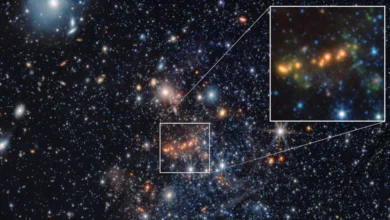
For over a decade, astronomers have been captivated by a celestial enigma located 29 million light-years away in the spiral galaxy NGC 4559. Known as AT 2016blu, the object has been characterized by violent, periodic outbursts that mirror the signature behavior of a star on the precipice of a catastrophic supernova. However, groundbreaking research recently published in The Astrophysical Journal has effectively debunked the theory of an impending explosion. Instead of a dying star’s final scream, scientists have discovered that AT 2016blu is a high-mass X-ray binary system where a massive Luminous Blue Variable (LBV) star is being systematically drained by a compact, invisible companion.
The Anatomy of an Impostor
AT 2016blu is no ordinary star. Boasting a mass approximately 33 times that of our Sun, it belongs to the rare and volatile class of Luminous Blue Variables. These stars are among the most massive and luminous in the universe, characterized by their instability and massive outflows of stellar material. Because stars of this magnitude are destined to end their lives in dramatic supernova explosions, the repeated, supernova-like outbursts of AT 2016blu—recorded 27 times since its initial identification in 2012—led many in the astronomical community to believe they were observing the final, frantic death throes of a giant.
As the years progressed, however, the regularity of these outbursts began to raise questions. Supernovae are, by definition, terminal events. A star that erupts repeatedly, only to return to a baseline state, is clearly not undergoing a single, irreversible collapse. Researchers began referring to AT 2016blu as a "supernova impostor," a designation reserved for transient events that mimic the light curves and spectra of supernovae but are driven by less destructive, albeit still highly energetic, physical processes.
Chronology of a Scientific Breakthrough
The investigation into AT 2016blu represents a masterclass in modern multi-messenger and multi-wavelength astronomy. The timeline of discovery began in 2012 with the detection of the star’s initial outbursts. Between 2012 and June 2026, astronomers logged 27 quasi-periodic outbursts, occurring roughly every 113 days.
The pivotal shift in understanding occurred when lead author Mojgan Aghakhanloo and her team at the University of Virginia began to suspect that the system’s behavior was dictated by orbital mechanics rather than stellar instability. This hypothesis was bolstered by preliminary research in 2023 and 2025, which pointed toward a binary interaction model. However, conclusive evidence remained elusive until the team successfully orchestrated a high-stakes observational campaign in early 2026.

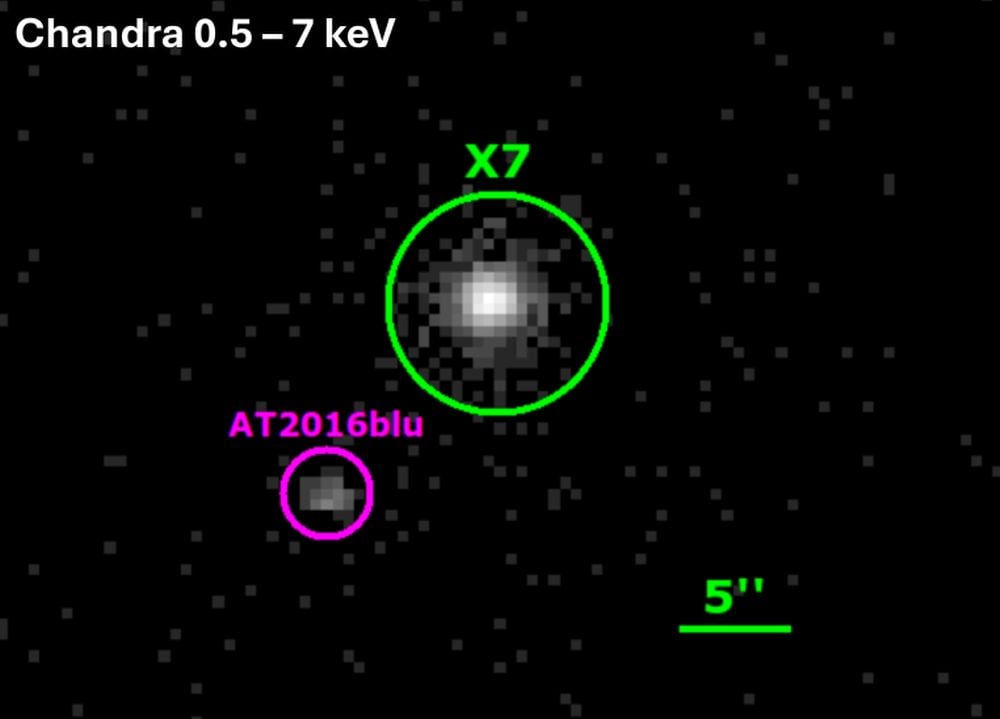
By precisely calculating the expected date of the next outburst, Aghakhanloo’s team mobilized a global network of professional and amateur astronomers. The culmination of this effort occurred in March 2026, when the team triggered a "Target of Opportunity" (ToO) request for the Chandra X-ray Telescope. This maneuver required the telescope to interrupt its pre-planned observational schedule to focus on the coordinates of AT 2016blu during the predicted peak of its outburst.
The results were definitive. Chandra captured clear evidence of X-ray emissions during the outburst, whereas archived data from the same coordinates taken between 2001 and 2002—before the current cycle of outbursts began—showed no such activity. This contrast confirmed that the X-rays were a direct consequence of the periodic events, effectively linking the outbursts to an accretion-powered mechanism.
The Physics of the Accretion Process
The research team concluded that AT 2016blu is, in fact, a high-mass X-ray binary (HMXB). In this system, the primary star—the 33-solar-mass LBV—is locked in an eccentric orbit with a compact object, likely a black hole or a neutron star.
The mechanism driving the outbursts is relatively straightforward in terms of high-energy astrophysics: as the compact object reaches periastron—the point in its orbit where it is closest to the primary star—it strips material from the outer layers of the LBV. This stolen stellar matter forms an accretion disk around the compact companion, heating up to extreme temperatures and emitting high-energy X-rays in the process. The "outbursts" observed by optical telescopes are the visible manifestation of this massive transfer of energy and matter.
"We therefore conclude that AT 2016blu is the first known case of an LBV supernova impostor whose outbursts are driven by intermittent accretion onto a compact object," the researchers wrote in their study. This discovery provides a long-sought explanation for the quasi-periodic nature of the system, which perfectly matches the 113-day orbital period of the binary components.
Broader Implications for Stellar Evolution
The identification of AT 2016blu as an HMXB has profound implications for how astronomers model the lifecycles of the universe’s most massive stars. Luminous Blue Variables are vital to galactic evolution; through their powerful stellar winds and eventual supernova explosions, they enrich the interstellar medium with heavy elements, including those necessary for the formation of planets and, ultimately, life.
By demonstrating that binary interactions can mimic pre-supernova activity, the study forces a reassessment of existing transient data. It is highly probable that other "supernova impostors" currently cataloged in the night sky are not dying stars, but rather overlooked binary systems undergoing similar accretion-powered phenomena.
"It’s like having a front-row seat to seeing what the star is doing before it dies," said Aghakhanloo. By observing the interplay between the LBV and its compact companion, researchers gain rare insights into the mass-loss processes that define the final stages of a massive star’s life. Understanding these pathways is essential for predicting which stars will go supernova and how they will alter their host galaxies in the process.
Future Research and the Vera Rubin Observatory
The discovery of the AT 2016blu system is expected to act as a catalyst for future research. Aghakhanloo has already secured additional time on the Chandra X-ray Telescope to conduct a comparative survey of other known supernova impostors. The goal is to determine how many of these systems share the binary characteristics observed in AT 2016blu.
Furthermore, the scientific community is bracing for the influx of data from the Vera Rubin Observatory. The observatory’s upcoming 10-year Legacy Survey of Space and Time (LSST) is designed to detect thousands of transient events every night. With a larger sample size of observed transients, researchers will be better equipped to distinguish between true impending supernovae and the complex, binary-driven "impostors" that have historically clouded our understanding of stellar death.
The study concludes on a note of cautious optimism. While the mystery of AT 2016blu has been solved, it has opened a new, more nuanced chapter in the study of massive stars. "We know a lot about them, but also there are a lot of open questions," Aghakhanloo noted. "We still don’t fully understand how they evolve or how they die." By linking AT 2016blu to a growing class of models involving compact-object binaries, the researchers have provided a vital new framework for future investigations into the violent, beautiful, and often deceptive nature of the cosmos. As the next generation of telescopes comes online, the ability to peer deeper into these binary systems will likely continue to reshape our fundamental understanding of how the most massive objects in the universe reach their dramatic, if sometimes misunderstood, conclusions.
Related posts: