NASA and its international partners are finalizing preparations for the next phase of human spaceflight as they prepare to discuss the upcoming SpaceX Crew-13 mission to the International Space Station (ISS). In a series of news conferences scheduled for Monday, Aug. 3, at the Johnson Space Center in Houston, mission leadership and the four-person flight crew will provide the public and the press with a comprehensive overview of the objectives, training, and technical milestones associated with this high-stakes orbital rotation. The events mark a critical juncture for the mission, serving as the final major media engagement before the crew departs for the Kennedy Space Center in Florida to begin the terminal countdown to launch.
The Crew-13 mission represents a continuation of the successful Commercial Crew Program, a public-private partnership designed to provide reliable, cost-effective transportation to and from the orbiting laboratory. The mission is currently slated for launch no earlier than mid-September, with the crew lifting off from Space Launch Complex 40 at Cape Canaveral Space Force Station. This launch is significant as it highlights the increasing operational flexibility of SpaceX’s launch facilities in Florida, utilizing the recently upgraded crew-capable infrastructure at SLC-40 alongside the historic Launch Complex 39A.
Mission Briefing Schedule and Media Access
The scheduled events on Aug. 3 will be divided into two primary segments. At 12 p.m. EDT, NASA and SpaceX leadership will convene for a Mission Overview News Conference. This briefing is expected to cover the technical health of the Falcon 9 rocket and the Dragon spacecraft, the specific scientific payload designated for this mission, and the logistical coordination required for the crew handover on the ISS. Participants will discuss the trajectory of the mission, from the initial ascent to the autonomous docking sequence with the Harmony module.
Following the leadership briefing, the four crew members will participate in a dedicated Crew News Conference at 2 p.m. EDT. This session offers a more personal look at the human element of the mission, as the astronauts and cosmonaut discuss their rigorous training regimens, which have spanned several continents and various simulation facilities. This will be the last opportunity for the media to engage with the full crew in a formal setting before they enter pre-flight quarantine, a standard health stabilization period designed to prevent the introduction of terrestrial illnesses to the ISS environment.
NASA has emphasized that these briefings will be streamed live on the agency’s official platforms, ensuring global access to the proceedings. For media representatives, strict accreditation deadlines have been established to manage the logistics of the event. International media were required to submit credentials by July 21, while U.S.-based media have until July 30. These protocols reflect the heightened security and organizational requirements of the Johnson Space Center, which serves as the hub for all NASA human spaceflight operations.
Meet the Crew: A Blend of Experience and New Horizons
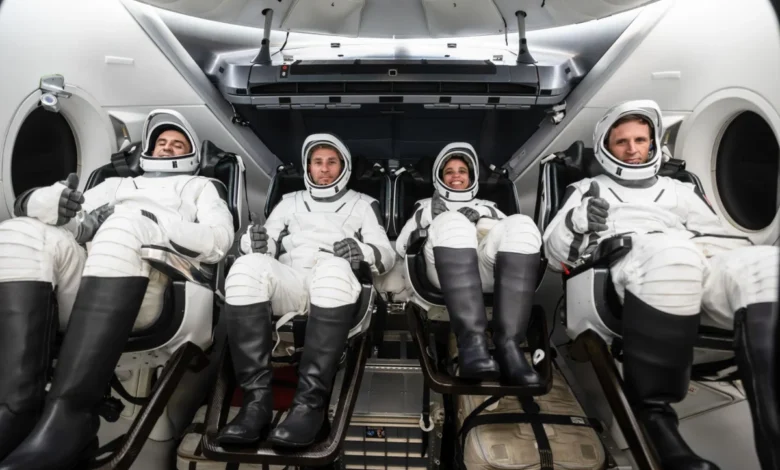
The Crew-13 manifest features a diverse group of professionals representing three different space agencies, embodying the spirit of international cooperation that has defined the ISS program for over two decades. The crew consists of NASA astronauts Jessica Watkins and Luke Delaney, Canadian Space Agency (CSA) astronaut Joshua Kutryk, and Roscosmos cosmonaut Sergey Teteryatnikov.
Dr. Jessica Watkins, serving as a mission specialist, is a veteran of the orbital laboratory and a pioneer in the field of space exploration. A geologist by training, Watkins earned her doctorate from the University of California, Los Angeles, and previously served on the science team for the Mars Science Laboratory rover, Curiosity. This mission marks her second flight to the ISS, following her 170-day stay during the Crew-4 mission in 2022. Notably, Watkins will make history as the first NASA astronaut to launch aboard a SpaceX Dragon spacecraft twice, a testament to the vehicle’s reusability and her expertise as an orbital researcher. Her background in Martian geology is particularly valuable as NASA looks toward future manned missions to the Red Planet, using the ISS as a testbed for long-duration spaceflight effects.
Joining Watkins is Luke Delaney, who will be making his first trip into space. A retired Major in the United States Marine Corps and a distinguished naval aviator, Delaney brings an extensive background in flight testing and aerospace engineering. With over 3,700 flight hours in dozens of aircraft types, his transition from research pilot at NASA’s Langley Research Center to astronaut highlights the agency’s reliance on elite aviators to manage the complex systems of the Dragon spacecraft. Delaney’s experience in evaluating developmental aircraft systems will be instrumental during the dynamic phases of the mission, including launch and reentry.
The mission also marks a significant milestone for the Canadian Space Agency with the inclusion of Joshua Kutryk. A native of Fort Saskatchewan, Alberta, Kutryk is a former fighter pilot and experimental test pilot with the Royal Canadian Air Force. His academic background is equally impressive, holding master’s degrees in space studies, flight test engineering, and defense studies. As the first Canadian to fly under the Commercial Crew Program, Kutryk’s participation underscores the deepening ties between NASA and the CSA, particularly as the two agencies collaborate on the upcoming Artemis missions to the Moon.
Rounding out the crew is Sergey Teteryatnikov, a test cosmonaut from Roscosmos. An engineer by trade with a background in naval power plant operations, Teteryatnikov represents the continued technical exchange between the United States and Russia. His selection for the Gagarin Research and Test Cosmonaut Training Center in 2021 led to his certification as a test cosmonaut in 2023. This mission will be his first orbital flight, where he will serve as an integrated member of the Expedition 71/72 crew, responsible for maintaining the Russian Segment of the station and assisting with joint scientific endeavors.
Technical Specifications and Launch Chronology
The Crew-13 mission will utilize the SpaceX Falcon 9, a two-stage-to-orbit launch vehicle that has become the workhorse of the American space industry. The Falcon 9 is powered by nine Merlin 1D engines in its first stage, which burn a combination of liquid oxygen and rocket-grade kerosene (RP-1). A key feature of this mission is the expected attempt to land the first-stage booster on a drone ship stationed in the Atlantic Ocean, allowing for future refurbishment and flight.
The Dragon spacecraft, which will house the crew during their journey, is a fully autonomous vehicle designed to dock with the ISS without the need for the station’s robotic arm. The interior of the Dragon is outfitted with touchscreen displays and a life-support system capable of sustaining the crew for several days in the event of a delayed docking. Once the vehicle reaches the station, it will perform a series of phasing maneuvers to align its orbit with the ISS, culminating in a precision approach and docking.
The chronology for the mission follows a well-established pattern:
- L-Minus 2 Months: Final integrated training simulations and mission readiness reviews.
- August 3: Mission overview and crew news conferences at Johnson Space Center.
- L-Minus 2 Weeks: Crew arrives at Kennedy Space Center and enters final quarantine.
- L-Minus 3 Days: Static fire test of the Falcon 9 rocket at SLC-40.
- Launch Day: Crew ingress, leak checks, and liftoff.
- Launch + 24 Hours (Approximate): Docking with the ISS and hatch opening.
Scientific Objectives and Orbital Research
While the primary goal of Crew-13 is to facilitate the rotation of personnel on the ISS, the crew will also be responsible for a vast array of scientific experiments. The microgravity environment of the station provides a unique laboratory for research that cannot be conducted on Earth. During their six-month stay, the crew will participate in studies ranging from human physiology to material science.
One of the key areas of focus will be the "CIPHER" suite of experiments, which investigates how long-duration spaceflight affects the human body across multiple systems, including vision, bone density, and cardiovascular health. Given Dr. Watkins’ geological expertise, she is also expected to contribute to Earth observation studies, using the station’s unique vantage point to monitor climate change, volcanic activity, and coastal erosion.
Furthermore, the crew will oversee several commercial payloads, helping private companies develop new technologies in orbit. This "low-Earth orbit economy" is a central pillar of NASA’s long-term strategy, as the agency seeks to transition the ISS to commercially operated platforms by the end of the decade.
Strategic Implications and International Cooperation
The Crew-13 mission arrives at a time of complex geopolitical dynamics, yet the ISS remains a rare example of stable international cooperation. The "seat swap" agreement between NASA and Roscosmos, which ensures that at least one American astronaut and one Russian cosmonaut are on board the station at all times, remains in effect. This policy ensures that the station can continue to operate safely even if one nation’s transport vehicle is grounded.
From a strategic standpoint, the mission reinforces the United States’ leadership in space. By maintaining a continuous human presence in orbit, NASA and its partners are gathering the data necessary to send humans back to the Moon under the Artemis program. The lessons learned by the Crew-13 team—regarding life support, radiation protection, and crew psychology—will directly inform the design of the Gateway station that will orbit the Moon and the habitats that will eventually be built on the lunar surface.
Moreover, the inclusion of a Canadian astronaut in a commercial mission signals the broadening of the "commercial" umbrella to include international partners. This shift allows agencies like the CSA to increase their flight opportunities beyond the traditional government-led shuttle or Soyuz missions of the past.
Final Preparations and Public Engagement
As the mid-September launch window approaches, the focus at both NASA and SpaceX remains on safety and mission assurance. The upcoming briefings on Aug. 3 will provide the final public accounting of the mission’s readiness. Following these conferences, the crew will enter a period of relative seclusion to focus on their flight procedures and spend time with their families before their half-year journey away from Earth.
NASA’s commitment to transparency and public engagement is reflected in the wide availability of the mission’s progress through digital channels. The agency has encouraged students and space enthusiasts to follow the mission via the official Crew-13 webpage, which offers real-time updates, educational resources, and behind-the-scenes content.
The Crew-13 mission is more than just a routine crew exchange; it is a testament to human ingenuity and the enduring desire to explore the unknown. As Watkins, Delaney, Kutryk, and Teteryatnikov prepare to leave the planet, they carry with them the scientific ambitions and diplomatic hopes of their respective nations, continuing the legacy of the International Space Station as a beacon of peaceful exploration in the high frontier.
Related posts: