YouTube Ad Revenue Growth Moderates in Q3 2026 While Subscription and Living Room Streaming Surge

Alphabet Inc., the parent company of Google and YouTube, released its financial results for the third quarter of 2026, revealing a complex picture of growth, transformation, and evolving consumption habits for the world’s leading video platform. While YouTube’s core advertising revenue experienced a modest deceleration compared to previous quarters, the platform offset this through unprecedented momentum in subscription services, the expanding dominance of connected television (CTV) viewing, and aggressive integration of artificial intelligence across creation and advertising workflows.
According to the official Q3 2026 earnings release, YouTube advertising generated $11.2 billion for the period. This represents a 9% year-over-year increase, reflecting a slight cooldown from the 13% growth rate recorded in the second quarter of 2026. Despite the moderated ad intake, overall ecosystem metrics indicate that YouTube is successfully diversifying its revenue streams. The platform continues to solidify its position not only as a user-generated content hub but also as a primary entertainment destination rivalling traditional broadcast television.
The Evolution of Subscription Services and Connected TV Dominance
A major growth engine for Alphabet during the third quarter was YouTube’s subscription tier. YouTube contributed significantly to an 11% overall increase in Google’s subscription, platform, and device revenues, propelled largely by YouTube Music and YouTube Premium. The combined subscriber base for these paid offerings has now surpassed 150 million globally.
This milestone represents a staggering trajectory for the platform. YouTube first crossed the 100-million subscriber threshold for its combined music and premium services in early 2024. Reaching 150 million subscribers signals accelerated consumer willingness to pay for ad-free viewing, background play, and offline access, transforming YouTube from a purely ad-supported utility into a hybrid monetization model capable of recurring, predictable revenue generation.
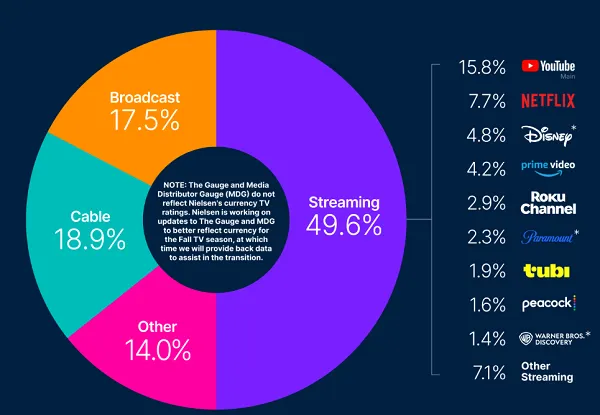
Alphabet’s leadership attributes a substantial portion of this subscription momentum to connected TV (CTV) adoption. During the company’s Q2 earnings call in July, executives noted a significant spike in Premium sign-ups among users watching YouTube on living room screens. This trend aligns directly with broader media consumption shifts. According to Nielsen’s closely watched "The Gauge" report for August 2026, YouTube retained its crown as the top streaming platform in the United States, outperforming traditional broadcast networks and rival subscription video-on-demand services in total television viewing time.
Capitalizing on this shift, Google’s Chief Business Officer, Philipp Schindler, emphasized during the Q3 earnings call that the "Living Room" experience is no longer just a driver for subscriptions, but a massive commercial engine for advertising. Living Room viewership now accounts for more than one-third of YouTube’s total advertising revenue. Advertisers are increasingly reallocating traditional linear television budgets to YouTube’s CTV inventory, viewing it as an essential touchpoint for reaching audiences who have abandoned cable packages.
Expanding E-Commerce Integration and Creator Economy Milestones
Beyond advertising and subscriptions, YouTube is rapidly embedding itself into the global digital commerce infrastructure. The platform’s partnership program has scaled to include more than three million creators worldwide, reflecting a maturing ecosystem where content creation functions as a viable, full-scale enterprise.
Simultaneously, YouTube’s push into social commerce has accelerated. Over 1.3 million channels are now actively enrolled in the platform’s shopping program. This retail push reached a major milestone recently when YouTube announced a strategic affiliate partnership with retail giant Amazon. This collaboration allows U.S.-based creators to tag Amazon products directly within their long-form videos, Shorts, and livestreams. By bridging the gap between inspiration and transaction, YouTube is positioning itself as a formidable competitor in the social commerce sector, giving creators new avenues for monetization while offering brands direct conversion pathways.

On the small-to-medium-sized business (SMB) front, Schindler noted that adoption rates for Google’s Demand Gen advertising products remain robust. Small businesses are increasingly leveraging automated, multi-format campaigns across YouTube, Gmail, and Discover to drive performance-based marketing outcomes with minimal friction.
Artificial Intelligence as a Creative and Operational Catalyst
Artificial intelligence remains at the core of Alphabet’s strategy to optimize both ad targeting and user engagement on YouTube. With over 20 million videos uploaded to the platform every day, maintaining content quality and helping creators scale their production output has become paramount.
Google is addressing this by deploying generative AI tools directly inside YouTube Studio, alongside conversational editing assistants tailored for Shorts and YouTube Create. These tools are designed to lower the technical barrier to entry for aspiring creators while helping established channels optimize their workflows.
The integration of AI features has evolved rapidly over the past year. In March, YouTube introduced an AI-powered "reimagine" option for Shorts, enabling viewers to generate alternative video variations based on existing creator clips. This was followed by trials of an "Extend with AI" feature, which allowed creators to automatically generate alternative video endings.
These iterative rollouts appear to be translating into high user adoption and enthusiasm. A internal data report published by YouTube last week revealed that 61% of individuals who uploaded videos to the platform over the preceding 12 months expressed keen interest in utilizing AI tools to seamlessly insert themselves into video content.
Implications for the Broader Digital Media Landscape
The Q3 2026 financial disclosures paint a picture of a mature platform successfully navigating a transitional phase. While the single-digit slowdown in ad revenue growth indicates that the digital advertising market is facing macroeconomic normalization, YouTube’s strategic pillars—subscriptions, connected TV, e-commerce partnerships, and generative AI integration—provide strong cushions.
The ascent of Living Room viewing cements YouTube’s status as a direct successor to traditional television, commanding prime-time attention from modern households. Meanwhile, the Amazon affiliate integration and the expansion of the creator shopping network signal that social commerce is moving from an experimental feature to a core revenue driver.
However, challenges remain. As generative AI tools become ubiquitous, platforms like YouTube will inevitably face scrutiny regarding content authenticity, copyright management, and the proliferation of low-quality or automated "AI slop." Yet, for now, engagement metrics and creator sentiment suggest that YouTube’s measured deployment of AI-assisted creation is striking the right chord with its audience.
As Alphabet looks toward the final quarter of 2026 and into 2027, the company’s ability to harmonize its massive ad network with burgeoning subscription models and e-commerce capabilities will likely serve as a bellwether for the entire digital media and technology sector.
Related posts: