Meta Launches Standalone Seller App to Empower the Next Generation of Facebook Marketplace Power Users

The digital landscape is witnessing a significant strategic pivot as Meta officially launches "Seller," a standalone mobile application specifically designed for the high-volume vendors who drive the Facebook Marketplace ecosystem. Released on Friday, the application represents a maturation of Facebook’s e-commerce strategy, transitioning from a secondary feature within a social networking site to a professionalized utility capable of competing with dedicated platforms like eBay and Etsy. By decoupling the selling experience from the main Facebook interface, Meta aims to streamline the workflow for "power users" while reinforcing the platform’s burgeoning reputation as the modern-day successor to Craigslist.
The Seller app is currently available for download, allowing users to log in directly with their existing Facebook credentials. This rollout follows a pattern of "unbundling" core features into specialized environments, a strategy previously seen with the launch of the "Forum" app for Facebook Groups administrators. As the primary Facebook app continues to evolve under the leadership of Tom Allison, the Head of Facebook, the company is increasingly focusing on catering to specific niches that have remained vibrant despite the broader migration of social interaction toward short-form video platforms like TikTok and Instagram.
A Comprehensive Suite for the Modern Vendor
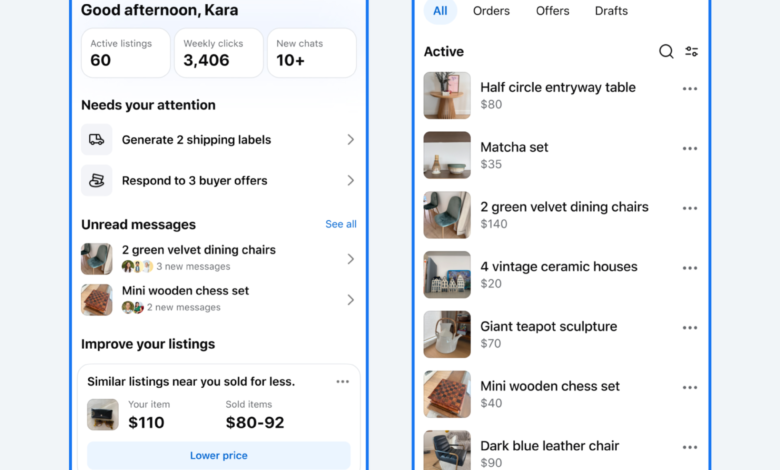
At its core, the Seller app serves as a centralized command center for individuals who manage dozens or even hundreds of listings simultaneously. While the standard Facebook Marketplace interface was built for casual, one-off sales, Seller is engineered for efficiency and scale. The application provides four primary pillars of functionality: a streamlined listing tool, a centralized management dashboard, a dedicated communication hub, and a sophisticated analytics suite.
The listing tool is perhaps the most significant upgrade, utilizing Meta’s latest advancements in artificial intelligence. Sellers can now use their smartphone cameras to scan a physical product, after which the app’s AI identifies the item and automatically populates relevant fields such as category, brand, and technical specifications. This reduces the friction of creating new listings, a common pain point for high-volume vendors. Once a listing is live, the dashboard offers a granular view of inventory, allowing users to update prices, mark items as sold, or renew listings with a single tap.
Communication, which has long been a source of frustration due to the cluttered nature of Facebook Messenger, has been redesigned within the Seller app. The in-app inbox is dedicated exclusively to Marketplace inquiries, separating business transactions from personal messages. This ensures that prospective buyers receive faster responses, potentially increasing the conversion rate for sellers. Furthermore, the analytics suite provides historical data on listing performance, showing vendors which items garner the most "saves" and "clicks," enabling them to make data-driven decisions about their pricing and inventory.
The Strategic Vision: Facebook as a Utility
The introduction of Seller is not merely a technical update but a reflection of a broader shift in Meta’s corporate philosophy regarding the Facebook brand. In an interview with the New York Times, Tom Allison characterized the Seller app as the e-commerce equivalent of a professional video editing tool. Just as creators require specialized software like CapCut or Premiere to produce high-quality content, Marketplace power users require a dedicated environment to manage their micro-businesses.
"We are seeing a segment of our community that uses Facebook primarily as a tool for their livelihoods or their communities," Allison noted. This recognition marks a departure from the "everything app" approach that dominated the previous decade. By creating standalone products for Groups administrators and Marketplace sellers, Meta is acknowledging that the "power user" experience is fundamentally different from the "passive scroller" experience.
This strategy also addresses the competitive pressure from specialized re-commerce platforms. While Facebook Marketplace has the advantage of a massive built-in user base, it has often lagged behind competitors like Poshmark, Depop, and Mercari in terms of professional seller tools. The Seller app is Meta’s attempt to close that gap and retain users who might otherwise migrate to platforms that offer better inventory management and data insights.
Chronology of the Marketplace Evolution
The journey toward the Seller app began in 2016 when Facebook Marketplace was first introduced as a formal replacement for the informal "Buy and Sell" groups that had cropped up organically on the platform.

- 2016: Facebook Marketplace launches in four countries, integrating a dedicated tab within the main app.
- 2018: The platform expands to include professional automotive and real estate listings, signaling an intent to move beyond yard-sale-style transactions.
- 2020: Amid the global pandemic, Marketplace saw a surge in usage as "thrifting" and local pick-ups became a primary method of shopping. Meta introduced shipping options and online payments to facilitate non-local transactions.
- 2022: Meta began testing "Marketplace for Business" features, allowing smaller retailers to sync their catalogs directly to the platform.
- May 2024: The launch of the "Forum" app for Groups administrators serves as the blueprint for the "power user" standalone app strategy.
- July 2024: The official release of the "Seller" app marks the latest phase in this specialization.
This timeline illustrates a steady progression from a community feature to a robust commercial ecosystem. The decision to keep the app free—maintaining the model where Meta monetizes through advertising rather than transaction fees—remains a key differentiator that attracts sellers who are wary of the high commission rates found on eBay or Amazon.
Market Data: The Power of Re-commerce
The scale of Facebook Marketplace is often underestimated by those who view the platform solely through a social lens. According to internal Meta data, more than 420 million items are listed on the platform every single month. This volume of trade creates a massive "circular economy" that appeals particularly to younger demographics.
Current statistics indicate that one-third of young adults (Gen Z and Millennials) who use Facebook do so specifically for the Marketplace. For this demographic, the platform is less about "status updates" and more about sustainability and economic necessity. The rise of "re-commerce"—the selling of previously owned goods—has become a multi-billion dollar industry, fueled by environmental concerns and the rising cost of living.
By empowering the sellers who provide this inventory, Meta is securing the supply side of its marketplace. High-quality, frequent sellers attract more buyers, which in turn creates more data and more opportunities for Meta to serve targeted advertisements. Although Meta does not take a cut of the sales, the time spent within the ecosystem and the wealth of consumer intent data generated by Marketplace is invaluable for its core advertising business.
Implications for the Competitive Landscape
The launch of the Seller app sends a clear signal to other players in the e-commerce space. For years, Facebook Marketplace was seen as a "wild west" of local listings—unorganized and prone to "Is this still available?" spam. With professional tools and AI-assisted listings, Meta is moving to legitimize the platform as a serious business tool.
Traditional e-commerce giants like eBay may find their market share threatened by the "zero-fee" model of Facebook Marketplace, especially if the Seller app successfully addresses the platform’s historical lack of professional features. Meanwhile, social commerce challengers like TikTok Shop are focusing on new goods and influencer-driven sales. Meta, by contrast, is doubling down on the peer-to-peer and small-scale professional market, leveraging its existing social graph to provide a level of trust and identity that anonymous platforms struggle to match.
However, challenges remain. Safety and trust continue to be the primary hurdles for Marketplace. While the Seller app improves the backend experience for vendors, it does not inherently solve the issues of fraudulent listings or the logistical risks of in-person meetups. Industry analysts suggest that future updates to the Seller app may include more robust verification systems for vendors to build "reputation scores," similar to those found on Airbnb or Uber.
Looking Ahead: The Future of the Facebook Ecosystem
The release of Seller is likely not the end of Meta’s unbundling strategy. As the main Facebook app becomes increasingly focused on an AI-driven "Discovery Engine" (similar to the Instagram Explore page or the TikTok "For You" feed), the utility-based features of the platform are being moved to the periphery to ensure they do not clutter the primary user experience.
We can expect Meta to continue investing in AI for the Seller app, potentially including features like automated price suggestions based on market trends, AI-generated background removal for product photos, and automated customer service bots to handle initial inquiries.
Ultimately, the Seller app represents a bet that Facebook’s future lies in being a "platform of platforms." By providing the infrastructure for commerce, community management, and communication, Meta ensures that even if users stop posting personal photos to their newsfeeds, they will remain tethered to the ecosystem to run their businesses, manage their hobbies, and furnish their homes. The "modern-day Craigslist" has officially gone professional, and the Seller app is the tool intended to lead that charge.
Related posts: