X Integrates Grok AI into Ads Manager to Advance Automation and Campaign Optimization

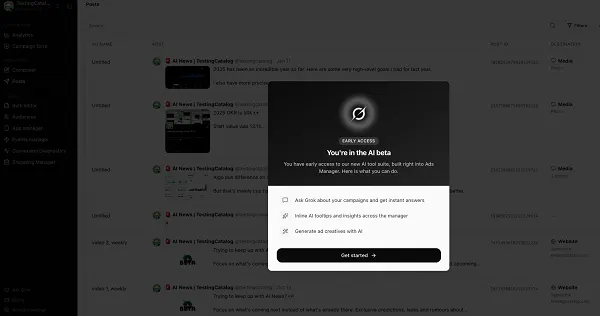
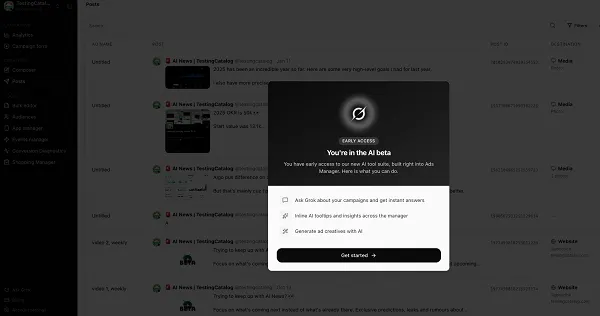
X, the social media platform formerly known as Twitter, has officially entered the beta testing phase for integrating Grok, the artificial intelligence chatbot developed by xAI, directly into its Ads Manager platform. This move marks a significant milestone in Elon Musk’s overarching strategy to transform the social platform into an AI-centric ecosystem, potentially leading to a future where advertising campaigns are fully automated from conception to execution. The integration is designed to offer advertisers real-time, data-driven guidance, helping them navigate the complexities of digital marketing through a conversational interface that leverages the platform’s vast stream of live data.
The rollout of the Grok beta within the Ads Manager follows a series of updates aimed at modernizing X’s advertising infrastructure, which has faced significant headwinds over the past two years. By embedding xAI’s large language model into the professional dashboard, X provides some advertisers with the ability to ask for strategic advice, generate creative copy, and receive tooltips that assist in the technical setup of promotional campaigns. This shift toward "agentic" advertising—where AI acts as an active assistant or agent rather than a passive tool—represents a fundamental change in how the platform intends to compete with industry giants like Meta and Google.
The Evolution of X’s AI-Driven Advertising Strategy
The integration of Grok is not an isolated event but the latest step in a comprehensive timeline of technological overhauls initiated after Elon Musk’s acquisition of the company in late 2022. To understand the current beta test, it is essential to look at the trajectory of X’s ad tech development over the last eighteen months.
In July 2023, Musk announced the formation of xAI, an independent artificial intelligence company intended to work in close "synergy" with X. By November 2023, Grok was introduced to Premium+ subscribers, touted as an AI with a "rebellious streak" and real-time access to the platform’s information. However, the application of this technology to the revenue-generating side of the business—advertising—took longer to materialize.
The most significant precursor to the current Grok integration occurred in April 2024, when X launched a completely rebuilt Ad Manager platform. At the time, the company described this as the "biggest ad system update in the company’s history." The primary goal of the April update was to replace legacy algorithms with neural networks capable of better understanding user interests and real-time trends. This foundational change allowed the system to improve ad relevance and delivery, setting the stage for the chatbot-led interface being tested today.
Technical Capabilities and the Concept of Agentic Generation
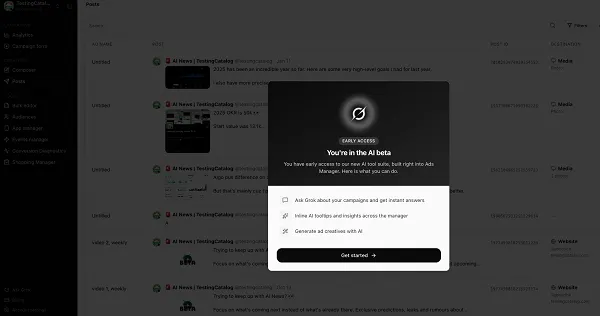
The integration of Grok into the Ads Manager introduces several key features that aim to lower the barrier to entry for new advertisers while providing sophisticated insights for seasoned marketers. According to reports from early beta testers, the interface allows users to engage in a dialogue with the AI to refine their targeting parameters. For example, an advertiser could describe their product and target demographic, and Grok would suggest specific interest categories, keywords, and even the optimal time of day for deployment based on current platform activity.
Beyond simple advice, the integration includes tooltips and "in-stream" creative generation. This means the AI can assist in drafting the text for posts, suggesting imagery, and ensuring that the content aligns with the aesthetic and linguistic trends currently dominating the platform. This is a direct response to the "creative fatigue" often cited by digital marketers, where the need for constant new content becomes a bottleneck for campaign performance.
The long-term vision, as articulated by Elon Musk in statements to industry publications like Digiday in August 2024, is the realization of "full advertising automation." This concept, often referred to as agentic AI, involves the system taking over the manual labor of campaign management. In this future state, an advertiser might simply provide a budget and a goal—such as "sell 500 units of this coffee maker"—and the AI would handle the audience segmentation, creative testing, bidding strategy, and brand safety checks without further human intervention.
Leveraging Data Scale and the xAI Infrastructure
One of the primary advantages X holds in the AI race is its massive repository of real-time human conversation. With more than 550 million monthly active users, the platform generates a staggering amount of data regarding public sentiment, emerging trends, and consumer behavior. Grok is uniquely positioned to capitalize on this because, unlike other large language models that rely on static training data or delayed web crawling, Grok has a direct pipeline to the X "firehose."
This data scale is supported by a massive investment in hardware. In 2024, xAI brought the "Colossus" supercomputer online in Memphis, Tennessee. Powered by 100,000 Nvidia H100 GPUs, Colossus is widely considered one of the most powerful AI training clusters in the world. The sheer compute power available to xAI ensures that the models powering the Ads Manager can process complex data signals—such as likes, reposts, follows, and even the duration of time spent viewing specific content—at a scale that was previously impossible.
For advertisers, this translates to improved "persona matching." AI tools are adept at identifying patterns across disparate data points. If a brand has a small group of existing customers on the platform, the AI can analyze those users’ profiles and behaviors to find "lookalike" audiences with a high degree of accuracy. This predictive capability is expected to increase the Return on Ad Spend (ROAS) by reducing the amount of budget wasted on users unlikely to convert.

Addressing Brand Safety and Content Matching
A critical component of the Grok integration is its role in brand safety, an area where X has faced significant scrutiny and pushback from major global advertisers. Since 2022, several high-profile brands have paused spending on the platform due to concerns about their ads appearing alongside controversial or harmful content.
Musk has asserted that AI is the solution to this challenge. By using Grok and associated xAI models to perform real-time content matching, the platform aims to create a more sophisticated "brand suitability" engine. Traditional brand safety tools often rely on crude keyword blocking, which can inadvertently prevent ads from appearing next to harmless news content. In contrast, an AI-driven approach can understand context, sentiment, and nuance.
The goal is to ensure that a family-friendly brand’s advertisement is never placed in a thread containing toxic discourse, while simultaneously identifying "positive" contexts where the ad might perform best. If Grok can prove to be a reliable arbiter of brand safety, it could be the key to winning back the confidence of enterprise-level advertisers and organizations like the World Federation of Advertisers, whose relationship with X has been strained.
Industry Context and Competitive Landscape
X’s move toward AI-driven ad automation mirrors a broader trend across the social media landscape. Meta has seen significant success with its "Advantage+" suite, which automates various aspects of ad creation and placement on Facebook and Instagram. Similarly, Google’s "Performance Max" campaigns use AI to determine the best way to allocate budgets across Search, YouTube, and Gmail.
However, X is positioning Grok as a more interactive and "conversational" assistant compared to the relatively opaque "black box" systems used by its competitors. By allowing advertisers to talk to the AI, X is betting that transparency and ease of use will attract small-to-medium-sized businesses (SMBs) that may not have the resources to hire dedicated social media agencies.
Furthermore, the integration represents a tightening of the bond between Musk’s various ventures. The use of xAI technology to bolster X’s revenue model creates a feedback loop where the success of the social media platform provides more data for the AI, which in turn makes the platform more profitable.
Implications and Future Outlook
While the beta test is currently limited to a subset of advertisers, the implications of a successful rollout are profound. For the advertising industry, it signals a shift away from manual "media buying" toward a more strategic, oversight-oriented role. Marketers may find themselves spending less time adjusting bids and more time defining high-level objectives for the AI to achieve.
However, the transition to full automation is not without risks. Critics of AI-driven advertising point to the potential for "hallucinations"—where the AI provides incorrect or misleading advice—and the loss of human intuition in creative storytelling. There are also ongoing debates regarding data privacy and how user information is utilized to train the very models that then target those same users with ads.
For X, the stakes are high. As the platform seeks to diversify its revenue streams and achieve financial stability, the performance of its ad tech is paramount. If the Grok integration can demonstrably improve campaign results and simplify the advertising process, it could provide the necessary momentum to revitalize the platform’s commercial prospects.
The current beta test is expected to expand in the coming months, with a wider release likely scheduled for early 2025. As xAI continues to iterate on the Grok model—with Grok 2.0 and beyond already in development—the capabilities of the Ads Manager will likely evolve in tandem. For now, the industry is watching closely to see if Musk’s vision of an AI-managed advertising ecosystem can deliver on its promise of efficiency and safety in an increasingly complex digital world.
Related posts: