AWS Announces General Availability of AWS Glue 6.0 Featuring 30 Percent Price Reduction and Apache Iceberg v3 Support

Amazon Web Services (AWS) has officially announced the general availability of AWS Glue 6.0, marking a significant milestone in the evolution of its fully serverless data integration and extract, transform, and load (ETL) service. Designed to meet the escalating demands of enterprise-scale data engineering, the latest version introduces a substantial 30 percent reduction in pricing compared to previous iterations while incorporating comprehensive support for Apache Iceberg v3 specifications. Built on a modernized runtime stack comprising Apache Spark 4.1, Python 3.13, and Scala 2.13, AWS Glue 6.0 aims to deliver accelerated execution times, simplified data pipelining, and enhanced processing capabilities for semi-structured and real-time streaming data workloads.
The launch addresses growing enterprise requirements for cost-efficient data processing frameworks capable of handling increasingly complex data lakes. By combining serverless infrastructure with cutting-edge open-source software updates, AWS seeks to lower the total cost of ownership for data-driven organizations while simultaneously boosting query performance and developer productivity.
Main Facts and Architectural Enhancements
At the core of AWS Glue 6.0 is its transition to a fully modernized runtime environment. By adopting Apache Spark 4.1, Python 3.13, and Scala 2.13, the service provides developers and data engineers with access to the latest language features, performance optimizations, and security enhancements available in the broader open-source big data ecosystem.
The standout technical feature of this release is the implementation of the complete Apache Iceberg v3 specification, built upon Iceberg version 1.11.0. This makes AWS Glue 6.0 the most complete Iceberg v3 implementation available on any fully serverless managed Spark service. Central to this integration is the introduction of the VARIANT data type, complete with native shredding support.
Traditionally, processing semi-structured data—such as JSON documents, application logs, and clickstream event streams—required storing data in string format, flattening nested schemas, maintaining duplicate data copies, or writing custom parsing logic. These approaches frequently introduced maintenance overhead and caused data pipelines to break whenever upstream schemas evolved. The VARIANT data type with shredding support changes this dynamic by allowing organizations to ingest, store, and query semi-structured data directly at scale. By avoiding schema flattening and eliminating duplicate copies, teams can achieve significantly faster query read performance while insulating downstream analytics from sudden schema modifications.
Furthermore, the release introduces advanced capabilities designed to simplify ETL authoring, optimize PySpark execution performance, and facilitate real-time streaming workloads achieving single-digit millisecond latency.
Background Context and Industry Evolution
The release of AWS Glue 6.0 arrives against the backdrop of a rapidly transforming data management landscape. Over the past several years, the data engineering community has experienced a profound shift away from proprietary data warehouses toward open table formats, with Apache Iceberg emerging as a leading standard for building open data lakes on cloud object storage like Amazon Simple Storage Service (Amazon S3).

Open table formats enable ACID (Atomicity, Consistency, Isolation, Durability) transactions, time travel, and efficient schema evolution on top of standard cloud storage files. As enterprises increasingly centralize their data architectures around open formats to avoid vendor lock-in, cloud providers are under mounting pressure to offer native, high-performance tooling that seamlessly integrates with these standards. AWS has progressively aligned its data analytics portfolio—including Amazon Athena, Amazon EMR, and AWS Glue—to support Apache Iceberg, making today’s release of Glue 6.0 a critical component of that broader strategic roadmap.
Concurrently, economic pressures have driven organizations to scrutinize cloud infrastructure expenditures closely. The 30 percent price reduction introduced in AWS Glue 6.0 reflects a direct response to enterprise demands for cost optimization without sacrificing processing power or reliability.
Chronology of AWS Glue Development
To understand the significance of the version 6.0 release, it is helpful to examine the evolutionary trajectory of AWS Glue since its inception.
AWS initially launched Glue as a fully managed, serverless ETL service designed to simplify the process of discovering, preparing, and combining data for analytics, machine learning, and application development. Over successive years, AWS introduced continuous improvements to runtime engines, job bookmarking, and developer tooling.
- AWS Glue 2.0: Introduced job runtimes that started up to ten times faster than previous versions, significantly reducing idle wait times for batch data processing.
- AWS Glue 3.0: Upgraded the underlying runtime to Apache Spark 3.1, bringing improved performance and native support for Python 3.7.
- AWS Glue 4.0: Advanced the platform further by incorporating Apache Spark 3.3 and Scala 2.12, alongside early integrations with open table formats like Apache Iceberg.
- AWS Glue 6.0 (Current Release): Represents a generational leap forward by skipping nomenclature adjustments to align directly with Apache Spark 4.1, introducing the Apache Iceberg v3 specification, implementing the
VARIANTdata type, and reducing pricing by 30 percent.
Supporting Data and Economic Implications
The financial structure of AWS Glue 6.0 maintains the platform’s predictable pay-as-you-go model while lowering baseline costs. Users continue to pay an hourly rate, billed by the second, for crawlers used to discover data and for ETL jobs that process and load data. For the AWS Glue Data Catalog, pricing remains anchored to a simplified monthly fee for storing and accessing metadata, with a generous free tier that includes the first million objects stored and the first million accesses at no charge.
By lowering the compute pricing by 30 percent, AWS has shifted the economics of large-scale data transformation. For enterprises running thousands of daily Spark jobs and maintaining petabyte-scale data lakes, this reduction translates into substantial annualized savings. When combined with the storage and compute efficiencies gained through Apache Iceberg v3’s VARIANT shredding—which reduces unnecessary data duplication and accelerates query scans—organizations can realize compounding performance and cost advantages.
Official Responses and Ecosystem Reactions
While specific direct quotes from external enterprise customers are contingent on ongoing deployments, industry analysts and data architecture experts have widely anticipated the convergence of serverless Spark and advanced open table format support.
Cloud infrastructure observers note that AWS’s aggressive pricing strategy for Glue 6.0 places competitive pressure on alternative cloud data platforms. By positioning Glue as both more affordable and more technically advanced regarding Iceberg v3 adoption, AWS strengthens its value proposition for enterprises weighing multi-cloud or hybrid data strategies.

Furthermore, database and open-source contributors have lauded the inclusion of the VARIANT data type within the Iceberg ecosystem. Handling semi-structured data efficiently has long been a computational bottleneck in big data pipelines; standardizing this capability through an open specification ensures broader interoperability across different query engines and processing frameworks.
Migration, Getting Started, and Developer Experience
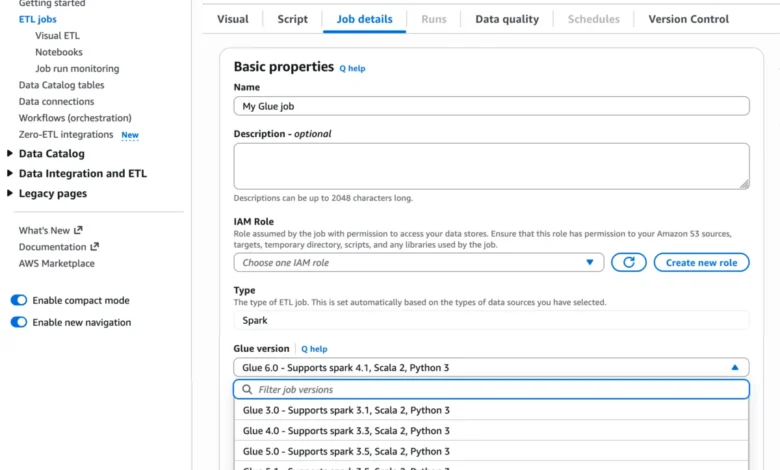
AWS has engineered Glue 6.0 to ensure a smooth transition path for existing workloads, minimizing the administrative burden typically associated with major software upgrades. No API changes are required to adopt the new version. Developers and data engineers can select AWS Glue 6.0 using the standard --glue-version parameter via the AWS Command Line Interface (AWS CLI), AWS SDKs, AWS Glue Studio, Amazon SageMaker Unified Studio, or integrated development environments.
Within the AWS Glue Studio console, users can navigate to the Job Details tab of an existing or new job and select the version labeled Glue 6.0 – Supports Spark 4.1, Scala 2, Python 3. For interactive exploration and notebook-based development, data scientists can specify version 6.0 using the %glue_version magic command in AWS Glue Studio notebooks or Jupyter interactive sessions.
To assist organizations with migration, AWS has provided the Spark upgrade agent directly within AWS Glue Studio. This utility helps identify potential compatibility adjustments required when moving from older versions (such as Glue 3.0 or 4.0) to the Spark 4.1 runtime. Alternatively, teams can utilize the platform’s auto-upgrade features to transition eligible jobs seamlessly.
Broader Impact and Industry Implications
The general availability of AWS Glue 6.0 signals a maturing market for serverless data engineering. As data volumes continue to expand exponentially, traditional approaches to ETL and data warehousing are increasingly constrained by cost and architectural rigidity.
By unifying serverless execution, open table standards like Apache Iceberg v3, and aggressive cost reductions, AWS is establishing a new benchmark for enterprise data integration. The elimination of schema-flattening overhead for semi-structured data empowers developers to build more resilient pipelines that adapt automatically to changing business requirements. Meanwhile, the lower cost structure removes financial barriers that previously forced organizations to compromise on data freshness or analytical depth.
AWS Glue 6.0 is generally available immediately across all commercial AWS Regions where the service operates. Regional availability specifics and future capability roadmaps can be tracked through official AWS capability documentation and the AWS MCP Server toolkit, enabling development teams to integrate the new features smoothly into their automated infrastructure and AI-assisted workflows.