Snap Inc. Q3 2026 Earnings Reveal Stalled Growth in Key Markets and Rising AI Reliance


Snap Inc. released its financial results for the third quarter of 2026, presenting a complex picture of a major social media company navigating regional stagnation, shifting global regulations, and evolving technological bets. While the company posted a steady year-over-year increase in overall revenue, user growth on Snapchat has largely stalled, particularly within its most lucrative Western markets. The earnings report illuminates the growing challenges Snap faces as it attempts to balance domestic market saturation with international expansion, alongside ambitious hardware ventures like augmented reality (AR) spectacles and enterprise-focused monetization strategies.
Main Facts and Financial Performance Overview
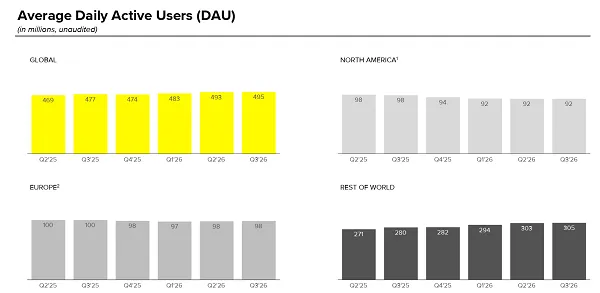
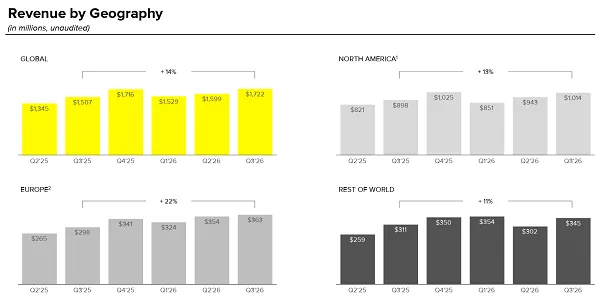
For the third quarter of 2026, Snap Inc. reported total revenue of $1.72 billion, marking a 14% increase compared to the same period in the previous year. This revenue growth defied expectations given the sluggish pace of user acquisition. Snapchat’s total global daily active users (DAUs) reached 495 million, representing a marginal increase from the 493 million reported in the second quarter of 2026.
The division of revenue growth across global markets revealed stark disparities. North American revenue climbed 13% year over year to $1.01 billion, while European revenue experienced a notable 22% jump to $363 million. The Rest of World segment grew by 11% to reach $345 million.
Despite the top-line revenue expansion, the underlying user growth metrics exposed structural vulnerabilities. Zero user growth was recorded in either the North American or European markets during the quarter. Consequently, all net user additions came exclusively from the Rest of World segment—regions where monetization yields significantly lower returns. For instance, Snapchat generated an average revenue per user (ARPU) of $11.07 in North America during Q3, compared to just $1.13 per user in the Rest of World category. This massive discrepancy underscores the platform’s reliance on Western markets for its financial survival, even as user acquisition in those territories hits a plateau.

Chronology and Regulatory Pressures on Teen Demographics
Snapchat’s growth trajectory in recent quarters has increasingly collided with an evolving global regulatory landscape targeting youth digital consumption. According to data published by Pew Research, approximately 55% of U.S. teens aged 13 to 17 utilized Snapchat, positioning it as the fourth most popular social media platform among adolescents behind YouTube, TikTok, and Instagram.
However, the international regulatory environment has begun to aggressively reshape youth demographics on social apps. In December 2025, Australia implemented strict social media usage restrictions prohibiting children under the age of 16 from maintaining accounts on major platforms. In response to these legislative mandates, Snapchat reported that it locked or disabled more than 415,000 user accounts in Australia alone. These actions were taken based on explicit user age declarations and advanced platform detection technology.
Comparing these figures to Snap’s August 2023 milestone of over 8 million users in Australia, the enforcement of teen bans appears to have cost the platform roughly 5% of its total user base in that specific market within less than a year. As similar legislative proposals regarding teen social media access gain traction across multiple U.S. states and European nations, industry analysts warn that compliance could trigger wider adoption friction and structural user attrition for platforms heavily favored by younger demographics.
Supporting Data and Engagement Metrics
Even with stagnant user expansion, internal platform engagement metrics presented several bright spots for the company. In his prepared remarks accompanying the Q3 financial disclosures, Snap CEO Evan Spiegel highlighted healthy growth in core communication and content consumption habits.
Average daily messages sent within the application increased by 8% year over year during the third quarter. Simultaneously, the volume of individuals participating in two-way communication grew by 6% year over year over the same timeframe, indicating that Snapchat remains a primary communication utility for its existing user base.
Content creation and consumption on Spotlight, Snap’s short-form video platform, exhibited even sharper acceleration. The number of unique creators posting to Spotlight grew by an impressive 130% year over year, while daily active viewers surged by 40% year over year. This underscores the enduring viability and engagement power of short-form video formats within the application’s ecosystem.
Furthermore, the company’s "Other Revenue" segment experienced an 84% year-over-year surge, propelled largely by robust adoption of subscription and premium digital offerings. Snap surpassed a combined total of 30 million active subscribers across its monetization tiers, including Snapchat+, Lens+, and expanded Memories Storage options.
Official Responses and Strategic Pivots
Snap executives emphasized that artificial intelligence (AI) has become a transformative operational advantage, driving efficiencies across internal development teams and enhancing the core advertising infrastructure. In the official earnings release, Spiegel credited AI integration with improving ad targeting precision and maximizing advertiser return on investment.
To diversify its revenue streams away from traditional direct-response advertising, Snap has aggressively restructured its commercial offerings. The company introduced upgraded creator partnership structures designed to retain top-tier talent and recently launched targeted pitch campaigns aimed at business-to-business (B2B) advertisers.
Concurrently, hardware initiatives remain a central pillar of Snap’s long-term vision. The company’s advanced AR Specs, which officially launched for pre-order in September, are currently priced at $2,200 and available to consumers in the United States, France, and the United Kingdom. Designed to pioneer advanced digital connectivity through wearable digital overlays, the spectacles represent a high-stakes, future-facing bet for the company.
However, initial financial disclosures suggest that physical hardware has yet to make a meaningful impact on Snap’s immediate balance sheets. Neither Spiegel nor CFO Doug Hott mentioned specific pre-order volumes or revenue contributions from the AR Specs during their statements, indicating that the product remains in a preparatory adoption phase rather than serving as an immediate financial driver.
Broader Impact and Industry Implications
The Q3 2026 earnings report paints a nuanced portrait of a mature tech enterprise working to offset slowing user acquisition through increased operational efficiency and premium monetization. While Snap has proven adept at extracting higher yields per user in saturated Western markets—evidenced by rising ARPU in North America despite flat user counts—the long-term viability of this strategy remains constrained.
Relying entirely on growth in lower-yielding international territories creates an inherent revenue bottleneck. Furthermore, the compounding effect of international teen social media restrictions introduces regulatory risk that could erode the platform’s core demographic appeal. While subscription initiatives like Snapchat+ and burgeoning AI ad capabilities provide a healthy financial cushion, the ultimate success of Snap’s next-generation hardware investments remains unquantifiable without transparent hardware sales data.
As Snap looks toward the remainder of the decade, the company must successfully navigate international compliance hurdles, prove consumer appetite for high-cost wearable technology, and sustain engagement among younger demographics if it hopes to accelerate past its current plateau.