NASA’s James Webb Space Telescope reveals intricate structures within the Cat’s Head Nebula in new mid-infrared imagery.

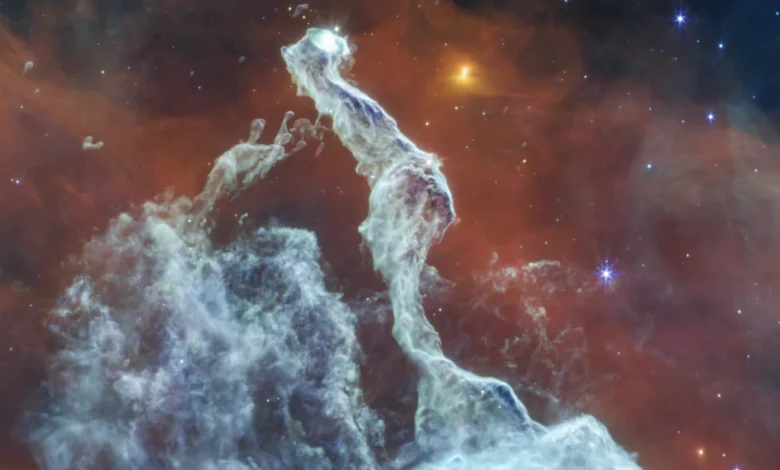
On October 29, 2026, the National Aeronautics and Space Administration (NASA) unveiled a striking new mid-infrared observation of the Cat’s Head Nebula, captured by the James Webb Space Telescope (JWST). This high-resolution imagery provides unprecedented detail into the complex mechanisms of stellar feedback, offering astronomers a clearer window into how massive stars sculpt their surrounding environments. The observation, which highlights the nebulosity in the mid-infrared spectrum, reveals a celestial formation that has captivated both the scientific community and the public due to its distinct, feline-like morphology.
The Anatomy of the Cat’s Head Nebula
The centerpiece of the new JWST image is a bluish-gray filament of dust that stretches vertically across the frame, forming the core of the nebula. The structure’s irregular, narrow shape bears a remarkable resemblance to a cat sitting with its back turned to the observer, complete with a tail that tapers into a triangular peak of dense dust in the lower third of the composition. Perhaps most striking is the "head" of the formation, which is turned toward the right, punctuated by a white, glowing eye—a manifestation of the intense infrared radiation emanating from the region.
Surrounding this central pillar is a complex environment dominated by red hues, representing the warm, diffuse dust that fills the background. To the left of the "cat," a dome-shaped grouping of faint filaments provides a contrast to the dense central pillar. The entire scene is punctuated by an array of yellow and blue stars, many of which exhibit the iconic eight-point diffraction spikes that have become a signature visual trait of the Webb telescope’s optical design.
Stellar Feedback and Galactic Sculpting
The Cat’s Head Nebula is situated within the broader Carina Nebula complex, one of the most prolific star-forming regions in the Milky Way. According to findings released alongside the image, the distinctive shape of the nebula is not a static accident of nature but the result of ongoing "stellar feedback." Massive stars in the vicinity release intense ultraviolet radiation and high-velocity stellar winds, which act as a cosmic chisel, eroding the surrounding gas and dust.
In this region, the dense material that forms the feline shape has proven to be more resistant to these erosive forces than the surrounding diffuse gas. This phenomenon is a classic example of differential erosion: the less dense material is stripped away by radiation pressure, leaving behind the more robust, pillar-like structures. Astronomers analyze these shapes to understand the lifespan of star-forming clouds. Eventually, even the dense "cat" pillar will succumb to the relentless pressure of the surrounding massive stars, but for now, it remains a temporary monument to the violent, creative processes occurring within the galaxy.
Chronology of Webb’s Galactic Observations
The release of this image marks another milestone in the James Webb Space Telescope’s ongoing mission to map the evolution of star-forming regions. Since its commissioning and the release of its first deep-field images in 2022, the JWST has consistently pushed the boundaries of infrared astronomy.
- December 2021: Launch of the James Webb Space Telescope from French Guiana.
- July 2022: Release of the first full-color images, demonstrating the telescope’s ability to peer through dust clouds that obscure the view of traditional optical telescopes.
- Late 2023 – 2025: A series of observational campaigns focused on the Carina Nebula, documenting the life cycles of protostars and the impact of radiation on planetary disks.
- October 2026: Official release of the high-resolution mid-infrared Cat’s Head Nebula imagery, processed by the Space Telescope Science Institute (STScI).
Each of these observations contributes to a growing database of stellar evolution. By observing in the mid-infrared, the telescope detects thermal radiation from dust, allowing researchers to see what is hidden from the Hubble Space Telescope’s visible-light perspective.
Supporting Data and Technical Context
The data for this image was processed by Joseph DePasquale of the STScI. The MIRI (Mid-Infrared Instrument) aboard the JWST was instrumental in capturing this view. Unlike shorter wavelengths that scatter off dust, mid-infrared light passes through the thick, obscuring curtains of gas, revealing the internal structure of the pillar.
Data metrics from the imaging campaign indicate that the pillar is several light-years in height, with the "head" of the nebula representing a region of particularly dense, cold molecular gas. The glowing "eye" is likely an area where the internal temperature is slightly higher, or where radiation is reflecting off the interior walls of a cavity carved into the dust. The signature diffraction spikes are an artifact of the telescope’s hexagonal mirror segments and the struts supporting the secondary mirror, confirming the high degree of precision in the capture.
Official Perspectives and Scientific Impact
While the imagery is visually arresting, its primary value lies in its scientific utility. Researchers at NASA, ESA (European Space Agency), and CSA (Canadian Space Agency) utilize these observations to refine models of star formation.
In a statement regarding the mission, representatives from the STScI noted that the interaction between massive stars and their parental molecular clouds is a critical factor in determining the efficiency of star formation. If the feedback is too intense, it can prematurely disperse the gas, cutting off the supply of material needed for further star birth. If it is too weak, the nebula may stagnate. The Cat’s Head Nebula serves as a laboratory for testing these models of "feedback-driven evolution."
Furthermore, the longevity of these structures provides a timeline for the star-forming process. By comparing the density and composition of the Cat’s Head pillar to other regions in the Carina Nebula, astronomers can estimate the age of the local star clusters and the intensity of the radiation field currently acting upon the nebula.
Broader Implications for Astrophysics
The study of nebulas like the Cat’s Head has implications far beyond the immediate neighborhood of the Milky Way. These processes are observed in distant, high-redshift galaxies, where the formation of stars occurs on a much larger scale. By understanding the local mechanics of stellar feedback, scientists can better calibrate their interpretations of distant galaxies that appear as mere smudges in the deepest reaches of the JWST’s vision.
The Cat’s Head Nebula is also a reminder of the dynamic nature of our galaxy. The sky is not a static canvas; it is a chaotic, evolving environment where stars are born, consume their surroundings, and eventually perish in explosions that enrich the interstellar medium with heavy elements. These elements are the building blocks of future solar systems, planets, and, potentially, life.
As the mission progresses, the scientific community anticipates that the James Webb Space Telescope will continue to uncover such "sculptures" in the sky, each offering a unique piece of the puzzle regarding how the universe transforms raw gas into the complexity of the stellar lifecycle. The image of the Cat’s Head, while fleeting in cosmic terms, provides a vital snapshot of this ongoing process, ensuring that the legacy of the JWST will be measured not just in images, but in the fundamental shifts in our understanding of the cosmos.
The collaboration between international space agencies—NASA, ESA, and CSA—ensures that the data collected from these observations is disseminated globally, supporting a wide range of academic research. As these agencies look toward future observational cycles, the techniques used to image the Cat’s Head will likely be applied to more distant and obscured regions of the universe, continuing the search for the origins of stars and the fundamental physical laws that govern their existence.