Microsoft introduces the Copilot harness in Foundry Agent Service to streamline enterprise AI development and deployment.

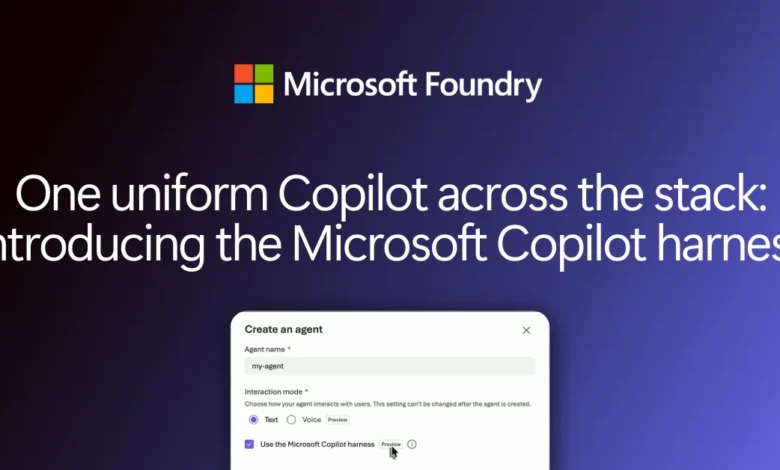
The integration of artificial intelligence into enterprise workflows has moved beyond simple question-and-answer interactions toward complex, autonomous agentic systems. To support this evolution, Microsoft has unveiled the Microsoft Copilot harness within its Foundry Agent Service, now available in public preview. This strategic release represents a significant shift in how developers approach the orchestration of AI agents, providing a managed foundation that handles the intricate "plumbing" of model execution, tool coordination, and state management. By abstracting away the underlying infrastructure, Microsoft aims to enable engineering teams to focus their resources on domain-specific expertise and business logic rather than the repetitive machinery of agent lifecycle management.
The Evolution of Agentic Frameworks
Historically, developers building AI agents have been forced to custom-build the "agent loop"—the logic that determines when a model should use a tool, how it maintains context over time, and how it handles errors during multi-step reasoning. This duplication of effort across the industry has created a high barrier to entry for businesses attempting to deploy reliable, long-running AI assistants.
The Microsoft Foundry platform was designed to address these friction points. By offering a unified harness strategy, Microsoft provides a consistent execution foundation that allows developers to select a preferred model while benefiting from a standardized operational environment. This "opinionated" approach to agent development is designed to reduce the time-to-market for complex AI projects. In practice, this means a developer can define an agent’s purpose and capabilities declaratively, leaving the heavy lifting of sandbox management and execution flow to the platform’s managed harness.
Chronology of the Foundry Ecosystem
The announcement of the Copilot harness is the latest milestone in a broader roadmap for Microsoft’s AI infrastructure. Since the inception of Microsoft Foundry, the company has focused on providing a modular experience for developers.
- Initial Launch Phase: Microsoft Foundry introduced the core concepts of prompt-based agent creation, allowing developers to define agent behavior through natural language instructions.
- Expansion of Capability: The platform grew to include advanced debugging tools, model evaluation frameworks, and integration with the Azure Developer CLI (azd).
- The Resilience Milestone: A critical advancement occurred alongside the new harness, with the general availability of "long-running resilience for hosted agents." This feature allows agents to survive system interruptions, a prerequisite for tasks that span hours or even days.
- Current State: With the Copilot harness now in public preview, the platform moves into a phase of enterprise-grade reliability, where agents are expected to handle complex, multi-step tasks with human-in-the-loop oversight.
Technical Architecture: The Copilot Harness
The architecture of the Copilot harness is built upon four primary pillars: managed execution, context management, tool integration, and policy enforcement. By utilizing a managed loop, the system coordinates model calls and tool execution without requiring the developer to rewrite orchestration logic.
A notable aspect of this release is the support for reusable skills. By defining a procedure—such as a research brief or a data analysis task—in a modular format, developers can ensure consistency across multiple agent deployments. The provided example of a research-based agent demonstrates this: by specifying a SKILL.md file and an azure.yaml configuration, an agent can perform complex, evidence-backed research while adhering to strict safety protocols, such as not including confidential data in external web queries. This structured approach allows for a "plug-and-play" capability, where skills can be swapped or updated without disrupting the entire agent framework.
Industry Perspectives and Practical Application
Early adopters of the Microsoft Copilot harness have reported significant gains in development efficiency. Chris Evans, CTO of Confluence Technologies, noted that the harness allowed his team to transition from concept to functional solution in less than a week, a timeline that would have been unattainable with custom-built infrastructure. This sentiment is echoed by Orlando Ribas Fernandes, CEO of Fashable, who highlighted the importance of "governed, measurable agent workflows." For Fashable, the ability to automate complex sourcing and negotiation processes—while maintaining human oversight—is a key competitive advantage.
These testimonials underscore a critical trend in the AI market: the transition from "experimental" AI to "operational" AI. Businesses are no longer interested in demos; they require platforms that can handle real-world tasks like contract negotiation, supply chain logistics, and long-term research, all while ensuring that decisions remain subject to corporate governance and human accountability.
Addressing Long-Running Resilience
A major technical hurdle for AI agents has been the fragility of long-running workflows. If an agent is halfway through a 24-hour analysis and the underlying service encounters a momentary interruption, the process typically crashes, resulting in lost work. The newly announced general availability of long-running resilience for hosted agents solves this by allowing developers to define checkpoints.
In this system, the Foundry platform manages the state of the agent, and the application logic defines what needs to be saved. This collaborative model ensures that if a failure occurs, the agent can resume precisely where it left off. This is particularly vital for enterprise applications that integrate with external systems, such as ERP or CRM platforms, where duplicate actions—such as submitting an order twice—could have significant financial or operational consequences.
Strategic Implications for Developers
The introduction of these tools poses a strategic choice for engineering teams. Microsoft has categorized the development approach into three distinct tiers:
- Prompt agents without the harness: Suitable for lightweight, task-specific operations where minimal orchestration is required.
- Prompt agents with the Copilot harness: The "sweet spot" for most enterprise applications that require multi-step reasoning, file management, and tool coordination.
- Hosted agents: The most flexible tier, intended for developers who require deep control over the agent loop, middleware, and specific runtime environments.
This tiered structure allows organizations to choose the level of abstraction that fits their specific needs, avoiding the "over-engineering" trap. By providing a managed path, Microsoft is essentially commoditizing the infrastructure layer of AI agents, effectively pushing the industry toward a higher standard of reliability and interoperability.
Economic and Operational Outlook
As of the latest update, the financial framework for the Copilot harness is clearly defined, with a move toward consumption-based pricing starting December 1, 2026. This predictability is essential for enterprise budget planning. By charging for sandbox compute and memory usage—at $0.0994 per vCPU-hour and $0.0118 per GiB-hour—Microsoft is aligning the cost of the agent with its actual computational consumption.
The broader implication of this release is a maturation of the AI agent landscape. The "Wild West" era of custom-coded agents is giving way to standardized platforms that emphasize observability, security, and persistence. For developers, the focus is shifting away from the "how" of building an agent and toward the "what"—the specific business logic, expertise, and value that the agent provides to the organization. As these tools become more accessible through the Microsoft Foundry portal and integrations with development environments like Visual Studio Code, the adoption rate of sophisticated, autonomous agents is expected to accelerate across the enterprise sector, marking a fundamental change in how corporate workflows are constructed and executed.