Global WordPress Installations Under Siege: The "wp2shell" Vulnerability Chain Unveiled

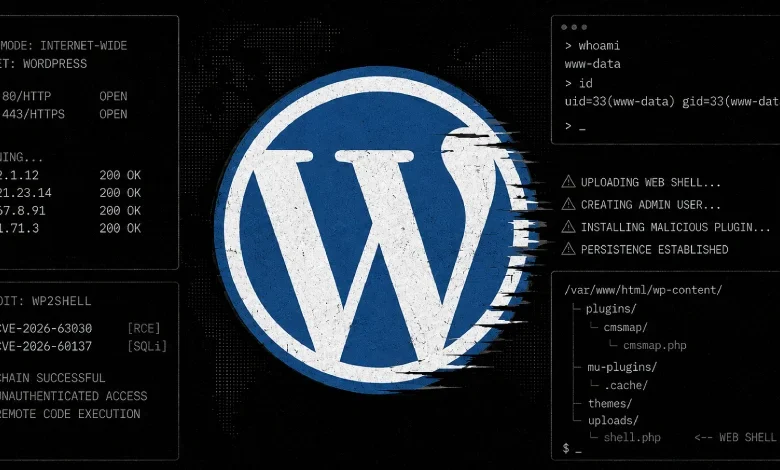
Attackers have begun to exploit two critical vulnerabilities in WordPress that, when combined together, enable unauthenticated remote code execution (RCE) and complete compromise of vulnerable websites, posing an immediate and severe threat to a vast segment of the internet. The security flaws, meticulously tracked as CVE-2026-63030 and CVE-2026-60137, have been collectively codenamed "wp2shell," signifying their combined potential to grant attackers a powerful shell-like control over affected systems. This sophisticated exploit chain targets one of the internet’s most ubiquitous content management systems, powering over 40% of all websites globally, from personal blogs to enterprise-level platforms. The widespread nature of WordPress installations makes these vulnerabilities particularly dangerous, as a successful exploit can lead to data theft, website defacement, malware distribution, and the establishment of persistent backdoors for future malicious activities.
The immediate aftermath of the public disclosure saw rapid weaponization of these vulnerabilities. "By the early hours of Saturday morning (UTC), successful exploitation was already well underway, initially using public exploit code to exfiltrate hashed credentials, with remote code execution following once additional details were made public," stated Jake Knott, principal security researcher at watchTowr, in an urgent communication to The Hacker News. This swift transition from disclosure to active exploitation underscores the critical nature of the threat and the agility of malicious actors in leveraging newly revealed weaknesses. Knott further emphasized the profound scope of the ongoing attacks, adding, "From our vantage point across a global client base, we are seeing widespread impact of this vulnerability across organizations of every size and every vertical." This assessment paints a grim picture, indicating that no sector or organizational scale is immune to the potential fallout, necessitating immediate and thorough defensive measures. The incident highlights the perennial challenge of securing widely adopted software, where even minor flaws can have cascading effects across the digital landscape.
The Anatomy of "wp2shell": CVE-2026-63030 and CVE-2026-60137
The "wp2shell" exploit chain is a two-part attack that meticulously bypasses authentication and executes arbitrary code. The first vulnerability, CVE-2026-60137, is a critical SQL injection flaw, while the second, CVE-2026-63030, enables unauthenticated remote code execution under specific conditions. Understanding the technical interplay between these two flaws is crucial for appreciating the severity of the threat.
Ben Marr, a security engineer at Intruder, provided a detailed explanation of the exploit’s mechanics: "This exploit utilizes a two-part vulnerability chain to achieve unauthenticated SQL injection on a stock WordPress installation with a single HTTP request." He clarified that "CVE-2026-60137 is the entry point – a route confusion bug in the REST API batch endpoint that bypasses authentication, allowing an attacker to invoke internal handlers without any permission check." This "route confusion" essentially tricks the WordPress system into believing an unauthenticated request is legitimate or authorized, allowing it to proceed to sensitive internal functions. The vulnerability further arises from "the improper sanitization of the ‘author__not_in’ parameter within ‘WP_Query’ when untrusted data is passed to it by a plugin or theme. This vulnerability allows crafted input to alter a database query, potentially leading to unauthorized access or manipulation of data." SQL injection, at its core, involves injecting malicious SQL code into input fields to manipulate database queries, often to extract sensitive information or alter data. In this case, it’s used as a stepping stone to gain further control.
The second vulnerability, CVE-2026-63030, leverages the SQL injection to achieve unauthenticated remote code execution. Cloudflare’s analysis corroborates that this RCE is only possible "when persistent object cache is not in use." Persistent object caching is a mechanism used by WordPress to store frequently accessed data in memory, reducing the need for repeated database queries and improving performance. When this caching is absent or disabled, WordPress directly interacts with the database for every request. This direct interaction becomes the Achilles’ heel, as the SQL injection (CVE-2026-60137) can then be used to manipulate database query results in a way that allows an attacker to inject and execute arbitrary code on the server. The RCE affects WordPress versions from 6.9 onwards, while the underlying SQL injection vulnerability (CVE-2026-60137) is present from version 6.8 onwards, indicating a slightly broader range of impact for the initial entry point. The combination of these two distinct, yet interconnected, flaws creates a potent attack vector that circumvents standard security controls.
Discovery and Disclosure: The Role of AI in Unearthing Critical Flaws
The discovery of the "wp2shell" exploit chain presents a fascinating and somewhat concerning aspect of modern cybersecurity: the increasing role of artificial intelligence. Searchlight Cyber, a prominent cybersecurity firm, revealed that the exploit chain was "discovered by Searchlight Cyber using OpenAI GPT 5.6 Sol in over 10 hours." This detail highlights a significant shift in vulnerability research, where advanced AI models are being deployed to accelerate the identification of complex security weaknesses that might elude human researchers or traditional automated scanning tools. The mention of "OpenAI GPT 5.6 Sol" suggests a specialized version or application of OpenAI’s large language models tailored for security research, capable of analyzing vast amounts of code and identifying subtle logical flaws or exploitable patterns.
The financial incentive behind such discoveries also underscores their criticality. Searchlight Cyber’s report alluded to exploit brokers reportedly paying $500,000 for a WordPress RCE, demonstrating the high market value of such vulnerabilities on the cyber black market. This substantial figure reflects the potential for immense illicit gains that can be derived from compromising widely used platforms like WordPress. In light of the extreme severity of the issue, technical details surrounding the precise methods of exploitation have been responsibly withheld. This common practice in the cybersecurity community aims to prevent further widespread abuse by giving system administrators time to patch their systems before full exploit instructions become public knowledge. The vulnerability impacts "default WordPress installations in any WordPress version released since December 2025," implying that even recently updated systems are at risk if not patched against these specific CVEs. Searchlight Cyber further stressed the ease of exploitation, stating, "The attack has no preconditions and can be exploited by an anonymous user in a stock install of WordPress with no plugins." This ‘zero-precondition’ nature makes the "wp2shell" exploit exceptionally dangerous, as it requires no prior access, specific configurations, or additional software to be present on the target system.
Rapid Weaponization: A Global Wave of Exploitation
The transition from vulnerability disclosure to active exploitation was remarkably swift, indicative of highly organized and opportunistic threat actors. Security researchers observed the immediate weaponization of the wp2shell flaws shortly after their details began to circulate within the cybersecurity community. Jake Knott’s statement about "successful exploitation already well underway by the early hours of Saturday morning (UTC)" paints a picture of attackers working quickly to leverage the new information. Initially, public exploit code was utilized to exfiltrate hashed credentials, a common first step to gain deeper access, followed rapidly by full remote code execution once more detailed exploit methodologies became available. This suggests a tiered approach by attackers, starting with easily implementable credential harvesting and then escalating to full system compromise.

The global reach of these attacks was quickly established. Telemetry data captured by KEVIntel, a security intelligence platform, "shows that 13 unique IP addresses from Switzerland, Germany, the U.K., Indonesia, Lithuania, the Netherlands, and Singapore have been linked to the exploitation of CVE-2026-63030." While 13 unique IP addresses might seem a modest number, it represents the observed origin points of initial exploitation attempts, often masking a larger network of compromised machines or proxy services used by attackers. The geographical diversity of these IPs suggests a global campaign rather than a localized effort, indicating a broad range of threat actors or a coordinated effort leveraging infrastructure across various jurisdictions. This rapid, global spread underscores the critical need for swift patching and robust security monitoring for any organization running WordPress.
Scale of Vulnerability and Remediation Efforts
The initial impact of the "wp2shell" vulnerabilities was staggering, highlighting the pervasive presence of WordPress across the internet and the inherent challenges in maintaining security for such a widely deployed platform. Data from Google-owned Wiz, a prominent cloud security subsidiary, provided sobering statistics on the scale of exposure. Wiz suggested that "60% of organizations using WordPress initially had at least one vulnerable instance at the time these CVEs were published, and 25% were exposing a vulnerable server to the Internet." These figures are alarming. A 60% vulnerability rate means that a significant majority of organizations relying on WordPress were immediately at risk, while the 25% internet exposure indicates a direct, easily accessible attack surface for opportunistic threat actors. For perspective, if WordPress powers 40% of the internet, then a quarter of those (10% of all websites) were directly vulnerable from the outset, representing millions of websites globally.
Fortunately, the cybersecurity community’s rapid response and the diligence of system administrators have initiated a mitigating trend. Wiz noted that "the figures have since dropped as organizations continue to apply the fixes." This indicates that WordPress core developers likely released an urgent patch (or patches) shortly after the vulnerabilities were identified, and many organizations are actively installing these updates. However, the initial widespread exposure emphasizes the "patch gap" – the critical period between a vulnerability’s disclosure and its widespread remediation, during which systems remain highly susceptible to attack. Even with patches available, the sheer volume of WordPress installations means that complete eradication of the threat takes time, leaving a window of opportunity for attackers. This situation also underscores the importance of automated update mechanisms and proactive security policies for organizations.
Post-Exploitation Landscape: From Web Shells to RATs
Once a system is compromised through the "wp2shell" exploit, attackers move swiftly to establish persistence and expand their control. Wiz researchers Shahar Dorfman and Gili Tikochinski detailed several post-exploitation activities observed in the wild. While the specific list of activities provided in the original text was empty, the subsequent paragraphs clarify the nature of these actions. A particularly concerning finding was the deployment of a "150 KB web shell that’s disguised as a legitimate WordPress security plugin called CMSmap." Web shells are malicious scripts uploaded to compromised web servers, providing attackers with remote administrative access through a web browser. Disguising it as a security plugin is a clever tactic to evade detection, leveraging a name that might appear innocuous to an unsuspecting administrator.
This particular web shell is described as a "full-featured attack platform," equipped with extensive capabilities:
- File management: Allowing attackers to upload, download, delete, and modify files on the server.
- Database access: Enabling direct interaction with the WordPress database, crucial for data exfiltration or manipulation.
- Port scanning: Facilitating the discovery of other open ports and services on the compromised server or within the internal network.
- Batch code injection: Permitting the injection of malicious code into multiple files or database entries simultaneously.
- Multiple privilege escalation modules: Providing tools to gain higher-level access within the system, potentially moving from a web server user to root.
- MySQL UDF exploitation: A specific technique to extend MySQL functionality to execute arbitrary commands, often used for privilege escalation or lateral movement.
The deployment of such a sophisticated web shell transforms a compromised WordPress site into a versatile launchpad for further attacks. WatchTowr also reported a significant increase in indiscriminate scanning activity, with their honeypots registering "tens of thousands of exploitation attempts" following the release of public exploit code. This high-volume scanning, as observed by Wiz, can be categorized into "opportunistic mass-scanning campaigns seeking to identify vulnerable targets alongside legitimate security scanning activity." The sheer volume indicates a race against time, with attackers attempting to compromise as many vulnerable sites as possible before they are patched.
Further evidence of deep compromise includes the creation of "more than 100 backdoor administrator accounts" post-exploitation. These unauthorized accounts provide persistent access for attackers, even if initial entry points are closed. Attackers then leverage these accounts to "deploy fake WordPress plugins to gain code execution or download secondary tools to further compromise the system." Fake plugins can masquerade as legitimate functionalities while embedding malicious code, making them difficult to spot without thorough inspection. In at least one documented instance, a threat actor was observed "repeatedly attempting to install Overlord RAT, a Golang-based remote access trojan." Overlord RAT, being Golang-based, is particularly insidious due to its cross-platform compatibility and often stealthy nature, making it harder for traditional antivirus solutions to detect. A RAT grants an attacker comprehensive control over a compromised machine, enabling remote surveillance, data theft, and further network penetration. While Wiz researchers noted, "We have yet to identify lateral movement or data exfiltration, but we continue to monitor and investigate," the observed post-exploitation activities clearly lay the groundwork for such severe outcomes.
The Peril of Popularity: Why WordPress Remains a Prime Target
WordPress’s immense popularity, while a testament to its flexibility and ease of use, simultaneously makes it a perennial magnet for cybercriminals. Powering well over a third of all websites, it presents an unparalleled attack surface. This ubiquity means that a single, critical vulnerability can potentially expose millions of sites, offering a high return on investment for threat actors. The open-source nature of WordPress, while fostering a vibrant developer community, also means its code is publicly available for scrutiny by both benevolent researchers and malicious actors.
The WordPress ecosystem, comprising thousands of themes and plugins, further complicates security. While these extensions enhance functionality, they also introduce additional potential entry points for vulnerabilities. Even if the WordPress core is secure, a flaw in a widely used plugin or theme can expose the entire site. The "wp2shell" vulnerabilities, however, directly target the WordPress core, making them particularly impactful as they affect default installations without any additional plugins required. This highlights the inherent risks associated with any widely adopted software platform, where the scale of deployment magnifies the potential consequences of security flaws.

Urgent Calls for Action: Mitigating the Threat
Given the severity and widespread nature of the "wp2shell" vulnerabilities, security experts are issuing urgent calls for action to all WordPress administrators and organizations. The primary recommendation is immediate patching. Although the original article does not explicitly state that WordPress has released an official patch, the observed "application of fixes" by organizations implies that an update addressing CVE-2026-63030 and CVE-2026-60137 is available. All WordPress installations, especially those on versions 6.8 and above, must be updated to the latest secure release without delay.
Beyond patching, defenders are strongly recommended to conduct thorough inspections of their WordPress instances, "regardless of whether they’ve been patched, to completely root out the threat." This proactive auditing is crucial because exploitation may have occurred before patches were applied, leaving behind malicious artifacts. Key areas for inspection include:
- Administrator Accounts: Scrutinize all user accounts, particularly administrator-level accounts, for any newly created or unfamiliar entries. Any suspicious accounts should be immediately disabled or removed.
- Malicious Plugins: Review the list of installed plugins for any unknown, recently installed, or suspicious plugins. Even legitimate-looking plugins could be trojanized. It is advisable to remove any plugins that are not essential or have not been updated recently.
- Suspicious Files: Perform a comprehensive scan for unusual files or modifications within the WordPress core directories, theme directories, and plugin directories. Attackers often drop web shells or other backdoors in obscure locations. Tools for file integrity monitoring can help detect unauthorized changes.
- Database Inspection: Check the WordPress database for any unauthorized changes, new users, or injected content that might indicate a compromise.
- Log Analysis: Review web server access logs and WordPress activity logs for any unusual IP addresses, repetitive failed login attempts, or suspicious requests to sensitive endpoints.
- Web Application Firewalls (WAFs): Implement or enhance WAF rules to detect and block common exploit patterns, including SQL injection attempts and known web shell signatures. A WAF can provide a crucial layer of defense, especially for systems awaiting patches.
- Regular Backups: Ensure that up-to-date backups of both the WordPress files and database are maintained off-site. In the event of a successful compromise, a clean backup can be used for restoration, minimizing downtime and data loss.
- Principle of Least Privilege: Ensure that all users, including WordPress itself, operate with the minimum necessary permissions. This limits the damage an attacker can inflict if an account is compromised.
- Disable Unnecessary Features: Turn off or remove any WordPress features, plugins, or themes that are not actively used, reducing the attack surface.
Broader Implications: Lessons for Web Security and AI’s Evolving Role
The "wp2shell" incident carries significant implications for the broader landscape of web security. Firstly, it underscores the persistent challenge of securing widely deployed open-source software. The collaborative nature of open-source development is a strength, but it also means that vulnerabilities, once discovered, can be rapidly analyzed and exploited by a global network of attackers. The speed with which wp2shell was weaponized serves as a stark reminder of the "time-to-exploit" gap, which is continuously shrinking.
Secondly, the role of AI, specifically OpenAI GPT 5.6 Sol, in discovering this critical exploit marks a new frontier in cybersecurity. While AI can significantly accelerate vulnerability research, enhancing defensive capabilities, it also raises concerns about its potential misuse by malicious actors. As AI tools become more sophisticated, they could be leveraged to automate the discovery and weaponization of zero-day vulnerabilities, intensifying the arms race between defenders and attackers. This dual-use nature of AI demands careful consideration and ethical guidelines for its development and deployment in security contexts.
Finally, the incident highlights the economic incentives driving the exploit market. The reported $500,000 bounty for a WordPress RCE underscores the lucrative nature of these vulnerabilities, fueling a sophisticated ecosystem of exploit brokers and cybercriminals. This economic reality means that high-value targets like WordPress will continue to be under constant scrutiny from those seeking to profit from their weaknesses. For website owners, this translates into an ongoing need for vigilance, proactive security measures, and a commitment to continuous patching and monitoring. The "wp2shell" saga serves as a potent case study, reinforcing the message that in the digital realm, security is not a one-time task but an ongoing, dynamic process.
Looking Ahead: Sustained Vigilance in a Dynamic Threat Environment
The "wp2shell" vulnerabilities represent a significant, but not isolated, event in the ongoing battle for cybersecurity. As the digital landscape continues to evolve, fueled by innovations like AI and the increasing interconnectedness of systems, the nature of threats will also become more sophisticated. The lessons learned from this incident—the importance of rapid patching, comprehensive post-compromise forensic analysis, robust security hygiene, and an awareness of emerging technologies like AI in vulnerability discovery—will be crucial for all stakeholders.
For WordPress users and administrators, sustained vigilance is paramount. This includes not only applying immediate patches but also regularly reviewing security configurations, auditing user accounts, monitoring for suspicious activity, and educating staff on best security practices. The cybersecurity community, including researchers, vendors, and platform developers, must continue to collaborate to identify and address vulnerabilities proactively, sharing threat intelligence swiftly and effectively. The digital economy relies heavily on platforms like WordPress, and ensuring their security is a collective responsibility. As the internet grows, so too does the imperative to protect its foundational components from relentless and evolving threats.
Related posts: