The Republic of Djibouti is poised to officially join the international community’s framework for civil space exploration by signing the Artemis Accords on Monday, September 14, 2026. The ceremony, to be held at NASA Headquarters in Washington, D.C., marks a significant milestone in the Horn of Africa nation’s diplomatic and scientific engagement with the United States. By becoming the 72nd nation to endorse these principles, Djibouti signals its commitment to the responsible, transparent, and peaceful exploration of the lunar surface and beyond.
NASA Deputy Administrator Matt Anderson will preside over the signing ceremony, representing the United States space agency. He will be joined by Mohamed Siad Douale, the Ambassador of Djibouti to the United States, and Frank Garcia, the U.S. State Department’s Assistant Secretary for African Affairs. This high-level diplomatic gathering underscores the increasing importance of space diplomacy as a pillar of international relations, particularly as the Artemis program moves toward sustained human presence on the Moon.
The Origins and Evolution of the Artemis Accords
The Artemis Accords were established in 2020 during the first administration of President Donald Trump. At that time, NASA and the U.S. Department of State collaborated with seven founding nations to create a set of non-binding principles designed to guide civil space exploration. The initiative was a direct response to the rapid proliferation of lunar activity, driven by both sovereign states and the burgeoning private space sector.
As lunar exploration transitions from a series of isolated scientific missions to a sustained, multi-stakeholder endeavor, the necessity for a shared set of "rules of the road" has become paramount. The Accords are built upon the 1967 Outer Space Treaty, serving as a practical, modern interpretation of international space law. They focus on key operational tenets, including the public release of scientific data, the interoperability of space systems, the mitigation of space debris, and the preservation of historic lunar sites.
Chronology of Global Expansion
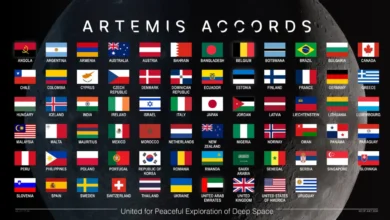
Since their inception, the Accords have seen a rapid expansion in membership, reflecting a broad international consensus on the necessity of responsible behavior in space.
- 2020: The United States, Australia, Canada, Italy, Japan, Luxembourg, the United Arab Emirates, and the United Kingdom sign as the founding members.
- 2021–2022: The Accords gain significant traction across Europe and South America, with nations such as Brazil, South Korea, and New Zealand joining the coalition.
- 2023–2025: Membership accelerates as the Artemis program successfully completes initial uncrewed testing and moves toward the first crewed lunar landings. The addition of nations from Africa, Southeast Asia, and Eastern Europe highlights the universal appeal of participating in the next era of human spaceflight.
- 2026: The inclusion of Djibouti as the 72nd signatory continues this momentum, reinforcing the message that space exploration is a global project requiring diverse perspectives and international cooperation.
Strategic Significance for Djibouti and the Region
For Djibouti, signing the Artemis Accords is more than a symbolic gesture; it represents a strategic alignment with the global space economy. As a nation located at a critical geopolitical junction between the Red Sea and the Gulf of Aden, Djibouti has been increasingly looking toward emerging technologies to diversify its economy and enhance its regional influence.
By aligning with the NASA-led framework, Djibouti gains a seat at the table in discussions regarding space situational awareness, orbital safety, and the development of lunar infrastructure. While Djibouti may not currently possess a domestic launch capability, the Accords facilitate capacity-building, technology exchange, and scientific collaboration. Analysts suggest that such partnerships are essential for developing nations to participate in the "new space" economy, which encompasses everything from satellite telecommunications to climate monitoring—fields that are of particular interest to African nations facing environmental challenges.
Analytical Implications: Transparency and Governance
The Artemis Accords operate on a foundation of "transparency and coordination." In an era where multiple nations and commercial entities are simultaneously targeting the lunar south pole—a region believed to contain water ice—the risk of operational interference is non-trivial.
The Accords address this by requiring signatories to commit to:
- Transparency: Providing public disclosure of national space policies and mission plans.
- Interoperability: Ensuring that diverse hardware—from different countries and private firms—can work together to ensure mission safety.
- Emergency Assistance: A commitment to provide aid to astronauts in distress, mirroring maritime and aviation law.
- Debris Mitigation: Adhering to guidelines that minimize the creation of harmful space junk in Earth and lunar orbit.
From a geopolitical perspective, the Accords act as a normative influence. While the framework is voluntary, the growing list of 72 signatories creates a "critical mass" of international law. Nations that choose to operate outside this framework find themselves increasingly isolated in their mission planning, particularly as NASA and its partners prioritize interoperability and data-sharing. By signing the Accords, Djibouti is choosing to anchor its future space activities within a transparent, rules-based international order.
The Role of NASA and the State Department
The involvement of both the NASA Deputy Administrator and the Assistant Secretary for African Affairs reflects the dual nature of these agreements. Space exploration is both a technical challenge and a diplomatic tool. NASA provides the technical expertise and the leadership in space science, while the U.S. State Department ensures that these activities align with broader foreign policy goals, such as fostering stability, economic development, and international security.
The upcoming ceremony is also a reminder of the logistical coordination required for such high-level events. NASA has maintained a rigorous media accreditation policy, ensuring that the global community is informed of these developments. The requirement for in-person attendance at the Washington headquarters highlights the significance of the event as a formal diplomatic milestone.
Future Horizons: Beyond the Moon
The Accords are not limited to the Moon. They are explicitly designed to govern exploration of Mars, asteroids, and other celestial bodies. As humanity moves toward the potential of deep-space exploration, the principles established in the Accords are expected to serve as the blueprint for future international space governance.
For countries like Djibouti, the benefits of signing are long-term. Participation in the Artemis community offers access to a global network of scientists, engineers, and policymakers. It provides a platform for education and human capital development, encouraging a new generation of students in Africa to pursue careers in Science, Technology, Engineering, and Mathematics (STEM).
Conclusion
As the ceremony on September 14 approaches, the international community continues to watch the growth of the Artemis Accords with interest. With 72 nations now committed to the same set of core values, the prospect of a collaborative and safe lunar environment appears more achievable than at any point in history.
The addition of Djibouti to this list is a testament to the fact that space exploration is no longer the exclusive domain of a few superpowers. Instead, it is becoming a shared human endeavor, characterized by broad participation and a commitment to the principles of peace and scientific progress. As Djibouti prepares to add its name to the growing list of signatories, the global space community looks forward to a future where the lunar frontier is explored for the benefit of all humanity, governed by the transparent and cooperative spirit of the Artemis Accords.
Related posts: