Destiny 2 Saved From The Brink As Bungie Reverses Course Following Unprecedented Community Campaign

In a move that has sent shockwaves through the gaming industry, Bungie has officially announced the reversal of its decision to place Destiny 2 into permanent end-of-life maintenance. The pivot comes just three months after the studio confirmed it would cease all future content updates for its flagship title, a decision that signaled the effective termination of the franchise’s live-service model. The announcement, which frames the game as “foundational” to the studio’s future, marks an extraordinary U-turn for a developer that had previously signaled a shift in its long-term strategic focus. As part of this reconciliation with its player base, Bungie has confirmed that it will begin the complex process of reintegrating legacy content that was previously removed under the controversial Destiny Content Vault (DCV) initiative.
A Chronology of the Crisis
The trajectory of Destiny 2 over the past six months has been defined by extreme volatility. In early June, following a series of internal restructuring efforts and layoffs at Bungie, leadership communicated that the game would enter a maintenance-only state. This effectively meant that the title would receive no further expansions, seasonal content, or narrative developments. The industry perceived this as a clear move by Bungie to pivot toward its new project, Marathon, and other unannounced titles.
The reaction from the player base was instantaneous and highly organized. Rather than fading away, the community initiated a multi-front campaign aimed at both Bungie and its parent company, Sony Interactive Entertainment. This campaign utilized social media spamming, direct inquiries during Sony’s live broadcasts, and the creation of digital petitions to force a reconsideration of the game’s status. By August, a Change.org petition demanding the development of a sequel or the continuation of Destiny 2 had eclipsed 400,000 signatures.
This agitation was not merely performative; it was backed by sustained engagement metrics. Despite the announcement of the game’s sunsetting, player concurrency remained remarkably stable, reportedly holding at approximately six times the active player count of Bungie’s upcoming shooter, Marathon. This disparity served as a powerful lever during the negotiations between the developer and its stakeholders.
The Power of Organized Community Pressure
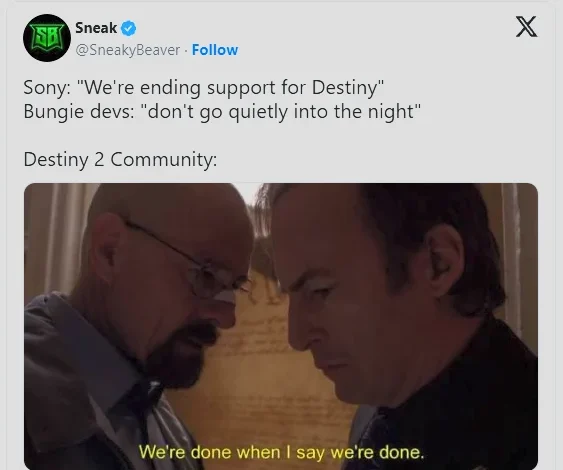
The victory declared by the community—a sentiment echoed by prominent content creators such as "My name is Byf," "Aztecross," and "Llama"—is rooted in the perception that the players successfully influenced corporate strategy. The movement’s momentum was bolstered by the adoption of a specific rallying cry: "We did not go quietly." This phrase, which references a poem by Dylan Thomas and a cryptic message posted by Bungie’s former principal communications manager, served as a psychological catalyst for the community.
The involvement of high-profile creators was instrumental. By leveraging their direct channels to the player base, these individuals maintained consistent pressure on Bungie’s social media presence. In many cases, these creators acted as conduits for information, with some hinting at internal shifts within Bungie weeks before the formal announcement was made. When the reversal was finally confirmed, the emotional responses captured during live streams highlighted the depth of the attachment players have to the Destiny ecosystem—a connection that clearly exceeded the expectations of corporate analysts.
Reversing the Destiny Content Vault
The most tangible aspect of Bungie’s "good faith" gesture is the commitment to restore content previously removed via the Destiny Content Vault. Introduced in 2020, the DCV was a controversial measure implemented to manage the game’s file size and technical complexity by rotating out older planets, raids, and story campaigns. While the policy was justified by developers as necessary for the game’s stability, it was a major point of contention for players who had purchased access to that content.
Restoring this content is a significant technical undertaking. Much of the legacy data was archived or deprecated to accommodate new engine updates and technical requirements. The logistical hurdle of bringing back large-scale environments and raids—while ensuring they function with the current sandbox—will likely require significant man-hours. This decision suggests that Bungie is prepared to commit resources to the game that were previously diverted elsewhere, signaling a potential shift in the studio’s operational budget.
Industry Implications and Skepticism
While the mood among the community is largely celebratory, there remains a palpable undercurrent of caution within the wider gaming industry. Critics and veteran players alike are pointing to the historical precedent of "uncancelled" projects, noting that the studio’s internal challenges—including significant layoffs and the loss of experienced personnel—remain unresolved.
Prominent figures in the Destiny community, such as Datto and Gladd, have expressed skepticism regarding the long-term feasibility of this reversal. Their concerns center on whether Bungie can genuinely sustain the game’s quality without the institutional knowledge that was lost during the recent staff reductions. The fear is that this could be a temporary reprieve rather than a long-term solution to the game’s fundamental issues, such as the constant struggle to balance content production costs with the technical demands of a massive, evolving world.
Furthermore, there is the question of corporate accountability. The decision to uncancel the game raises questions about the original decision-making process at Sony. For a AAA title to be marked for death and then revived within a single fiscal quarter suggests that the initial cost-benefit analysis failed to account for the "stickiness" of the Destiny community. The "thin-skinned" nature of corporate leadership, often sensitive to negative PR cycles during major showcases, may have played a larger role in the reversal than purely financial considerations.
The Path Forward: Stability vs. Ambition
The broader implications of this event extend beyond Destiny 2. It serves as a case study in the power of a modern, organized digital fanbase. By refusing to accept the "end-of-life" narrative, the Destiny community effectively forced a recalculation of the game’s value proposition to its corporate owners.
However, the path forward remains fraught with challenges. Bungie must now address the "bloat" that necessitated the vaulting system in the first place, while simultaneously providing enough content to satisfy a fanbase that has just flexed its political muscle. If the studio fails to deliver on these new promises, the disillusionment that follows will likely be far more severe than the anger seen during the initial cancellation.
For now, the Destiny universe remains an active, evolving space. The "Guardians," as they are known, have successfully repelled the threat of obsolescence. Yet, as the community discussions on platforms like Reddit have highlighted, the call for "cautious optimism" is the prevailing sentiment. Players are waiting to see if this reversal is a genuine return to form or merely a temporary pivot while the studio attempts to regain its footing in an increasingly competitive market.
Ultimately, the resurrection of Destiny 2 is an unprecedented event in modern live-service gaming. It highlights a unique dynamic where the perceived value of a game is no longer dictated solely by balance sheets, but by the resilience of the community that sustains it. Whether this new chapter will be defined by a resurgence of quality or a cycle of unfulfilled promises remains to be seen. What is clear is that the relationship between the developer and its players has been irrevocably altered, setting a new precedent for how fanbases interact with the studios that manage their digital worlds.
Related posts: