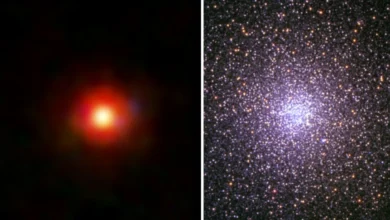
Cosmic Bullets and Stellar Cannibalism The Extraordinary Evolution of V445 Puppis the Milky Ways Only Known Helium Nova

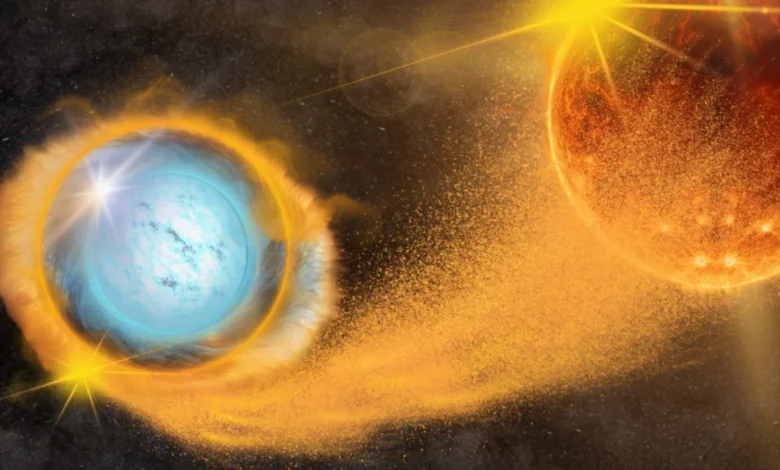
The vast expanse of the Milky Way galaxy continues to yield secrets that challenge our understanding of stellar evolution and the mechanics of cosmic explosions. Recently, an international team of astronomers, utilizing the combined power of NASA’s Hubble Space Telescope, the Transiting Exoplanet Survey Satellite (TESS), and the European Southern Observatory’s Very Large Telescope (VLT), has unveiled remarkable new data regarding a unique stellar system known as V445 Puppis. This system, located approximately 16,000 to 25,000 light-years away in the southern constellation of Puppis, has been revealed to be firing "cosmic bullets"—clumps of matter traveling at the staggering velocity of 20 million miles per hour. These findings not only shed light on the specific nature of the only known helium nova in our galaxy but also provide a critical link to understanding the progenitors of Type Ia supernovae, which serve as the universe’s most reliable distance markers.
The saga of V445 Puppis began in late 2000 when astronomers first detected a sudden and dramatic increase in its luminosity. While novae are relatively common occurrences in the local universe, V445 Puppis immediately stood out due to its unusual chemical signature. Unlike standard novae, which are fueled by the thermonuclear runaway of hydrogen on the surface of a white dwarf, V445 Puppis showed an almost total absence of hydrogen. Instead, the explosion was dominated by helium and carbon. This marked it as the first, and currently only, confirmed helium nova within the Milky Way. However, the immediate aftermath of the 2000 eruption created a significant hurdle for researchers: the explosion produced a massive, opaque cloud of carbon-rich dust that completely shrouded the central binary system for more than two decades.
As the dust finally began to dissipate in recent years, astronomers were granted their first clear look at the surviving system. The observations, presented at the Royal Astronomical Society’s National Astronomy Meeting in Birmingham, UK, describe a binary system of extreme rarity. V445 Puppis consists of a white dwarf—the dense, cooling core of a formerly sun-like star—and a "helium star" companion. The helium star is a stellar remnant that has already been stripped of its outer hydrogen envelope, leaving behind a core primarily composed of helium. This configuration is exceptionally rare; among the hundreds of billions of stars in our galaxy, only a few thousand helium stars are thought to exist.
The interaction between these two bodies is a violent display of stellar cannibalism. The white dwarf’s immense gravitational pull is actively stripping helium-rich matter from its companion. This material forms an accretion disk around the white dwarf before eventually spiraling down onto its surface. As the layer of stolen helium accumulates, the pressure and temperature at the base of the pile reach a critical threshold, triggering a thermonuclear explosion. This is the mechanism behind the helium nova observed in 2000.
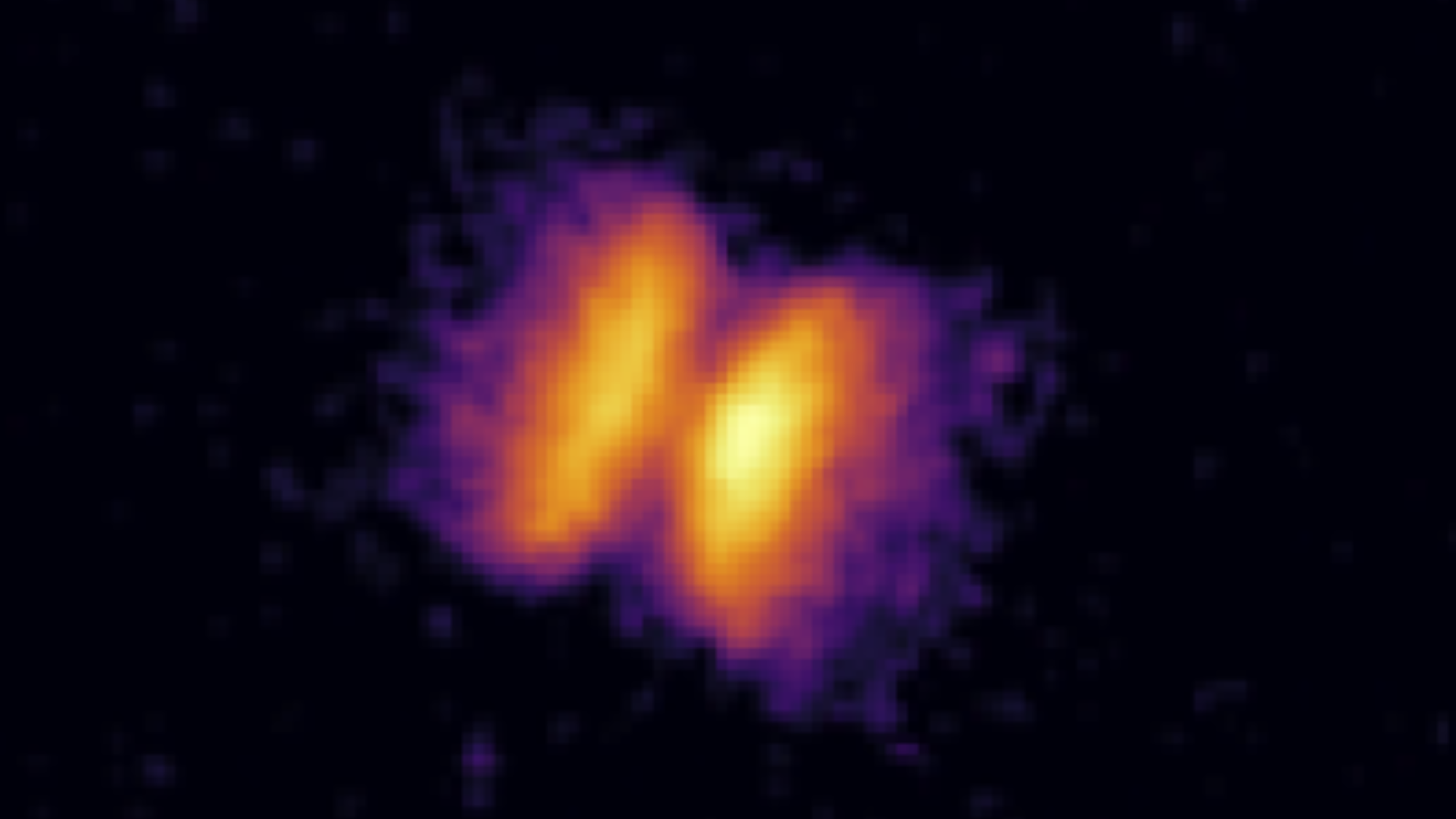
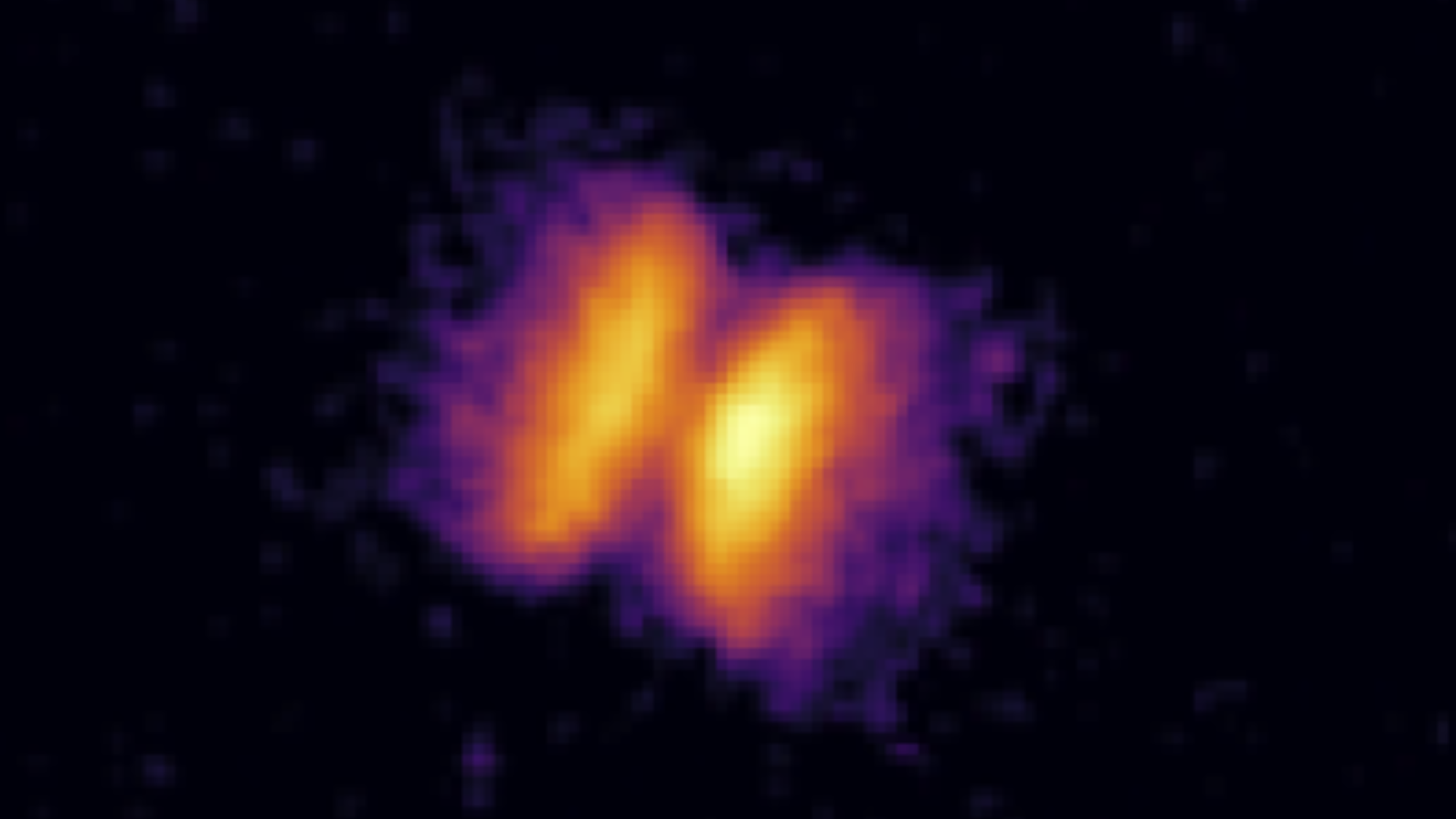
One of the most startling discoveries made by the team, led by researchers including John Mills from the University of Warwick, is the presence of "cosmic bullets." These are high-velocity clumps of gas, potentially rich in oxygen, that were ejected during or shortly after the initial outburst. Traveling at roughly 3% of the speed of light, these bullets represent a phenomenon never before documented in other types of novae. Their origin remains a subject of intense study, though researchers suspect they may be formed by the interaction of the nova’s shockwave with the pre-existing circumstellar environment or through complex magnetic field interactions during the peak of the explosion.
The physical structure of the debris field is equally complex. Initial infrared observations following the 2000 eruption revealed a bipolar outflow, characterized by two massive lobes of matter expanding in opposite directions, resembling the wings of a butterfly. These lobes stretch across more than a trillion miles of space. The recent data suggests that the "bullets" are embedded within or trailing these larger structures, providing a high-resolution map of the kinetic energy released during the eruption.
The significance of V445 Puppis extends far beyond its status as a celestial oddity. It serves as a vital laboratory for studying the "single-degenerate" model of Type Ia supernovae. For decades, astrophysicists have debated the exact nature of the stars that lead to these cataclysmic events. A Type Ia supernova occurs when a white dwarf exceeds the Chandrasekhar limit—approximately 1.4 times the mass of our sun—causing it to collapse and explode entirely. Because these explosions always occur at a specific mass threshold, they have a consistent intrinsic brightness, allowing astronomers to use them as "standard candles" to measure the distance to far-off galaxies and calculate the rate of the universe’s expansion (the Hubble Constant).
There are two primary theories for how a white dwarf reaches this critical mass: the "double-degenerate" model, involving the merger of two white dwarfs, and the "single-degenerate" model, where a white dwarf accretes matter from a companion star. V445 Puppis is a prime candidate for the latter. The team’s research indicates that despite the massive ejection of matter in 2000, the white dwarf in V445 Puppis survived and has already resumed feeding on its helium star companion. If the white dwarf is gaining more mass through accretion than it loses during its periodic nova eruptions, it will eventually reach the Chandrasekhar limit and culminate in a Type Ia supernova.
The timeline of observations for V445 Puppis highlights the importance of long-term monitoring in modern astronomy. Following the 2000 outburst, the system was monitored in radio, infrared, and optical wavelengths. The deployment of NASA’s TESS was particularly instrumental in recent years. While TESS is primarily known as an exoplanet hunter, its ability to monitor large swaths of the sky with high cadence allowed researchers to track the subtle fluctuations in the system’s brightness as the dust cleared. This provided the light curves necessary to confirm that the accretion process had restarted. Simultaneously, the Hubble Space Telescope’s high-resolution imaging and the VLT’s spectroscopic capabilities allowed the team to measure the velocity and composition of the "bullets" and the expanding butterfly-shaped nebula.
John Mills emphasized the excitement within the scientific community regarding these findings. "The culprits behind this galactic eruption have been an enduring mystery over the past 25 years," Mills stated. "It is very exciting to confirm that this helium nova was the result of a helium star accreting onto a white dwarf." He further noted that the discovery of the high-speed bullets adds a new layer of complexity to the physics of stellar outbursts, suggesting that our current models of nova ejecta may need to be revised to account for such extreme velocities and localized clumps of matter.
The implications for cosmology are profound. By studying V445 Puppis, scientists can better understand the chemical enrichment of the galaxy. Helium novae are thought to be significant producers of certain isotopes and heavy elements, such as carbon and oxygen, which are eventually dispersed into the interstellar medium to form the building blocks of future stars and planetary systems. Furthermore, refining the progenitor models for Type Ia supernovae will help reduce uncertainties in the measurements of dark energy—the mysterious force driving the accelerated expansion of the universe.
As V445 Puppis continues to evolve, it remains a high-priority target for future observations. Astronomers are particularly interested in whether the frequency of its eruptions will increase as the white dwarf approaches the critical mass limit. The possibility of witnessing the transition from a recurrent nova to a full-scale supernova is a rare opportunity that could provide the definitive evidence needed to resolve long-standing questions about the life and death of binary star systems.
In summary, the discovery of 20-million-mile-per-hour cosmic bullets and the confirmation of the white dwarf-helium star partnership in V445 Puppis represents a major milestone in stellar astrophysics. Through the coordinated use of ground-based and space-based observatories, researchers have pierced through a twenty-year shroud of dust to reveal a violent and transformative process. This system stands as a testament to the dynamic nature of our galaxy and serves as a crucial beacon for understanding the fundamental processes that govern the lifecycle of stars and the expansion of the cosmos itself. The ongoing study of V445 Puppis will undoubtedly continue to provide insights into the rarest and most energetic phenomena in the universe, ensuring its place as one of the most significant astronomical subjects of the 21st century.
Related posts: