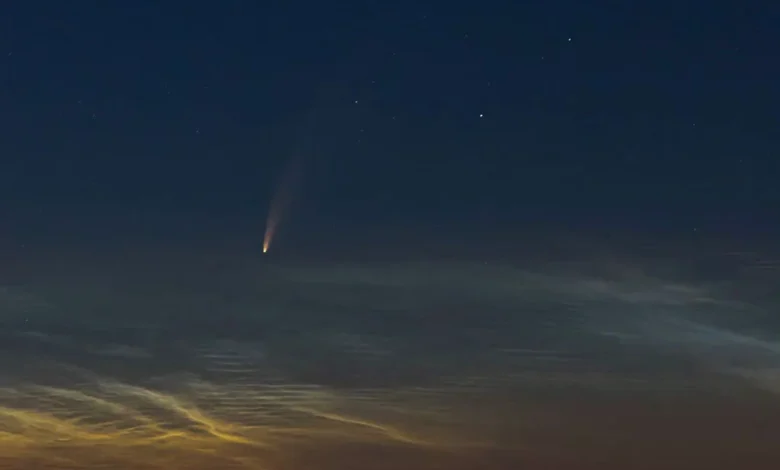
The celestial event that captivated the Northern Hemisphere in the summer of 2020 remains a hallmark of modern amateur astronomy. Comet C/2020 F3 (NEOWISE), an inner-Solar System visitor that achieved "Great Comet" status, provided a rare spectacle for observers worldwide. Captured in a striking time-lapse sequence by photographer Paolo Girotti over the Adriatic Sea in Italy, the comet’s emergence into the pre-dawn sky serves as a poignant reminder of the unpredictable and awe-inspiring nature of our cosmic neighborhood.
The Anatomy of a Rare Celestial Visitor
Comet C/2020 F3 was first detected on March 27, 2020, by NASA’s Near-Earth Object Wide-field Infrared Survey Explorer (NEOWISE) space telescope. At the time of its discovery, the object was approximately 1.7 astronomical units (AU) from the Sun. As it accelerated toward its perihelion—the point in its orbit closest to the Sun—the comet began to outgas, forming a spectacular coma and dual tail structure that would eventually define its legacy.
The comet’s nucleus, estimated to be approximately five kilometers in diameter, survived its close encounter with solar radiation remarkably well. While many comets disintegrate when passing through the inner solar system due to intense thermal stress, NEOWISE remained structurally intact. This resilience allowed it to develop a brilliant dust tail, composed of reflective debris, and a faint blue ion tail, created by ionized gas pushed away by the solar wind.
Chronology of the 2020 Appearance
The arrival of NEOWISE was a source of unexpected relief for many, occurring during a period of global uncertainty. The following timeline outlines the key stages of its observation:
- March 27, 2020: Discovery by the NEOWISE space telescope.
- July 3, 2020: The comet reached perihelion at a distance of 0.29 AU (roughly 43 million kilometers) from the Sun.
- Early July 2020: NEOWISE transitioned from a morning-sky object to an evening-sky object, increasing its visibility to a broader range of the public.
- July 23, 2020: The comet reached its closest approach to Earth, passing at a distance of 0.69 AU (approximately 103 million kilometers).
- August 2020: The comet began its long journey back into the outer solar system, fading significantly as it receded from the Sun’s illumination.
Technical Analysis: Capturing the Adriatic Ascent
The featured video documentation by Paolo Girotti, captured on July 8, 2020, represents a significant technical achievement in astrophotography. By stitching together over 240 individual frames recorded over a 30-minute duration, the time-lapse provides a high-fidelity look at the comet’s atmospheric transition.
One of the most notable features in the footage is the juxtaposition of the comet against noctilucent clouds. These rare, high-altitude clouds form in the mesosphere, approximately 80 kilometers above the Earth’s surface. They are only visible during twilight when the sun is positioned just below the horizon, illuminating the clouds from below. The interaction between the icy, ancient body of the comet and the fragile, ephemeral nature of noctilucent clouds created a visual contrast that has been widely studied by both photographers and meteorologists for its aesthetic and scientific interest.
Scientific Implications and NASA’s Role
For NASA, the appearance of Comet NEOWISE provided a unique opportunity to study the composition of long-period comets. Data collected during its flyby contributed to our understanding of the solar system’s formation. Because comets are essentially "dirty snowballs" comprised of frozen gases, rocks, and dust left over from the birth of the solar system, they act as time capsules.
The NEOWISE mission, originally designed as an infrared survey to detect near-Earth objects (NEOs), proved its versatility by tracking such a fast-moving, volatile target. NASA officials noted that the longevity of the comet’s brightness—lasting for over a month—allowed for an unprecedented number of ground-based observations. This collaborative data gathering between space-based telescopes and amateur astronomers worldwide helped refine models regarding how cometary nuclei behave under extreme solar heating.
The Shift in Public Outreach
As the Astronomy Picture of the Day (APOD) continues its evolution, the importance of platforms like the NASA-hosted site has become increasingly clear. With the recent transition of the APOD main site from the traditional apod.nasa.gov domain to science.nasa.gov/apod, the organization is modernizing its approach to public engagement.
This digital shift aims to integrate APOD more closely with broader scientific communication efforts. By consolidating the archive and providing enhanced metadata for images like the Girotti time-lapse, NASA is ensuring that the legacy of events like the 2020 NEOWISE appearance remains accessible to future generations of students and researchers.
Public and Professional Reaction
The reaction from the scientific community was overwhelmingly positive. Astronomers praised the comet for being one of the few "naked-eye" comets to appear in the 21st century, a stark contrast to more recent, fainter objects. For the general public, the comet became a cultural phenomenon, trending on social media platforms and driving interest in astronomy during a time when many were confined to their homes.
"The comet offered a rare moment of unity and wonder," noted one astronomy outreach coordinator. "When an object like NEOWISE appears, it strips away the complexity of the world and reminds us that we are all observing the same sky."
Broader Context of Cometary Observations
Comets are categorized by their orbital periods: short-period comets have orbital periods of less than 200 years, while long-period comets, like NEOWISE, originate from the Oort Cloud and can take thousands of years to orbit the Sun. NEOWISE’s orbital period is estimated at approximately 6,800 years. This means that the last time this object was visible from Earth, human civilization was in its relative infancy, predating many of the major historical records of antiquity.
The study of such objects is crucial for planetary defense. While NEOWISE did not pose a threat to Earth, the infrastructure used to track it—the Wide-field Infrared Survey Explorer—is the same technology employed to identify potentially hazardous asteroids. The ability to track a small, dark object moving at high speeds against a field of stars is a capability that NASA continues to refine through programs like the Planetary Defense Coordination Office.
Conclusion
The images and data provided by the 2020 appearance of Comet NEOWISE remain a definitive resource for those interested in celestial mechanics and photography. Whether viewed as a scientific data point regarding the composition of the Oort Cloud or as a beautiful display of the Adriatic sky, the comet’s legacy is secured. As we look toward future astronomical events, the techniques developed during the NEOWISE observation period will continue to guide the next generation of space explorers.
For enthusiasts, the archives of APOD remain the primary gateway to these historical moments. As the transition to the new NASA science portal concludes, the focus remains on maintaining the integrity of these records, ensuring that the intersection of art and science—as demonstrated by Paolo Girotti’s work—remains at the forefront of public consciousness. Tomorrow, as the cycle continues, the scientific community will turn its gaze once more toward the open space, waiting for the next visitor to emerge from the darkness.
Related posts: