China-Linked Espionage Group Exploits Tencent Sogou Input Method Flaw to Deploy GrayRabbit Backdoor


Cybersecurity researchers have uncovered an active espionage campaign in which a China-aligned threat actor is weaponizing a critical remote code execution vulnerability in Tencent’s immensely popular Sogou Input Method for Windows. The flaw, tracked as CVE-2026-51990, is being leveraged via sophisticated one-click social engineering attacks to install an advanced, modular backdoor known as GrayRabbit.
The security issue highlights the ongoing risks associated with third-party software components—specifically embedded, out-of-date web browsers—that operate with elevated privileges on millions of consumer and enterprise endpoints. As digital supply chains and peripheral software applications increasingly become prime targets for state-sponsored threat groups, this incident underscores the urgent need for rigorous vulnerability management, robust input validation, and secure sandboxing mechanisms in software design.
Anatomy of the Exploit Chain
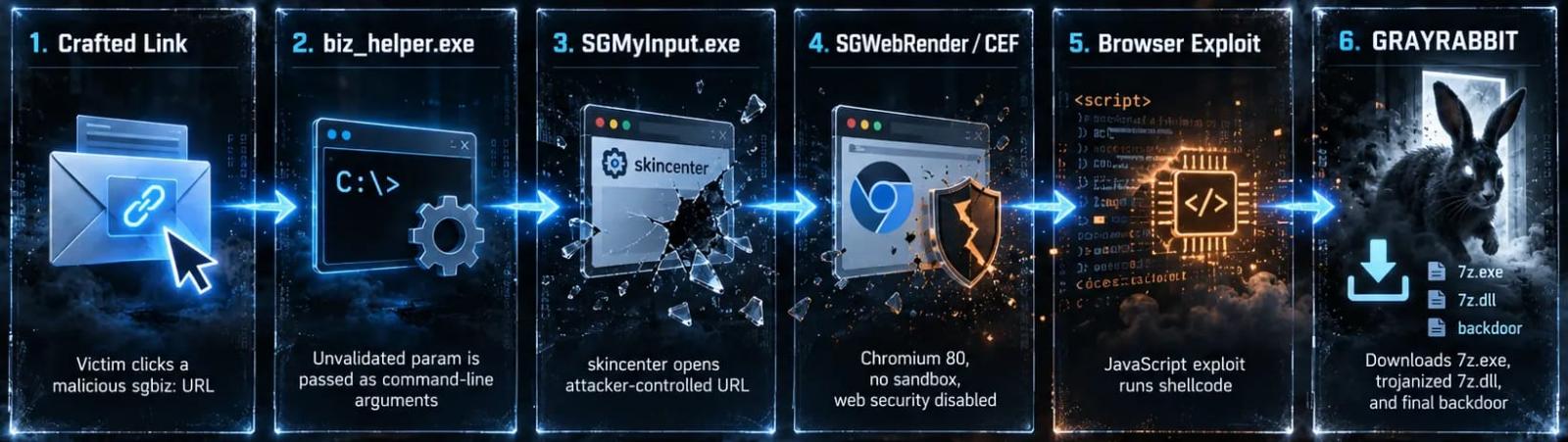
According to an in-depth technical analysis published by Gen Threat Labs, the exploitation mechanism relies on a sophisticated three-stage attack chain designed to bypass standard Windows security barriers. The campaign is attributed to UNC3569, a China-based threat actor known to operate across both conventional cybercrime ecosystems and state-sponsored cyber contractor-for-hire frameworks.
The attack commences when a targeted user clicks on a malicious, specially crafted custom URI utilizing the sgbiz: protocol scheme. This action forces the Windows operating system to invoke biz_helper.exe, a legitimate protocol handler native to the Sogou Input Method. Crucially, this handler fails to properly validate incoming data, passing attacker-controlled command-line arguments directly to the legitimate SGMyInput.exe executable without verifying their legitimacy.
In the second stage of the exploit, these injected arguments instruct the application’s native skin center component to initialize its embedded Chromium webview and navigate to an external, attacker-controlled URL. Investigators noted that the application historically maintained a lax security posture regarding this navigation, failing to restrict either the URL scheme or the ultimate destination domain.
The final phase of the compromise takes advantage of deep-seated architectural weaknesses within the Sogou application framework. The embedded browser instance operates on an outdated iteration of the Chromium engine—specifically version 80—running entirely devoid of a proper security sandbox. Furthermore, vital web-security mitigations are disabled within this context. Consequently, when the browser loads the malicious payload delivered by the threat actors, it successfully executes arbitrary code on the underlying operating system, culminating in the silent installation of the GrayRabbit backdoor.

Profiling the GrayRabbit Backdoor and UNC3569
First brought to broader public attention by Google security researchers in 2024, GrayRabbit has evolved into a sophisticated, modular malware family. The variant analyzed during the recent Gen Threat Labs investigation represents a mature 64-bit iteration featuring an expanded command repertoire and robust RC4-encrypted command-and-control (C2) communication protocols.
GrayRabbit’s operational capabilities are extensive, providing its operators with deep persistence and remote control over compromised hosts. Once deployed, the backdoor can execute arbitrary processes, spawn interactive reverse shells for real-time operator control, upload and download arbitrary files, harvest comprehensive system and user telemetry, and reflectively load additional plugins directly into the host system’s memory to minimize disk footprints and evade file-based forensic detection.
The threat group behind this deployment, UNC3569, has long operated in the shadows of the Indo-Pacific threat landscape. Known for blending espionage objectives with contractor-for-hire capabilities, the group frequently targets software ecosystems heavily utilized within specific geographic regions. Because the Sogou Input Method boasts hundreds of millions of installations—primarily across mainland China—any supply chain or application-layer vulnerability within the software presents a massive, high-value attack surface for state-aligned espionage operators seeking initial access into strategic networks.
Chronology of Discovery and Remediation
The timeline of discovery highlights a rapid disclosure and patching cycle between the investigating cybersecurity vendor and the software manufacturer:
- April 9, 2026: Gen Threat Labs formally reports the discovery of CVE-2026-51990 and the associated UNC3569 campaign to Tencent’s product security incident response team.
- April 21, 2026: Tencent acts on the intelligence report, releasing Sogou Input Method version 16.3.0.3498 to address the vulnerability.
- Ongoing: Organizations and consumer users are strongly urged to update their software installations immediately, though security analysts caution that deeper architectural remediations remain necessary.
The software patch deployed by Tencent focuses heavily on tightening the input validation mechanisms governing the protocol handler. Specifically, the updated version restricts accepted URL arguments, mandates the use of secure HTTPS protocols exclusively, and enforces rigid navigation bounds that limit access strictly to approved domains affiliated with Sogou and Tencent corporate infrastructure.
Despite these immediate fixes, security researchers have sounded notes of caution regarding the long-term posture of the application. While the patch effectively neutralizes the initial URI-handling vector exploited in this specific campaign, the underlying embedded browser engine remains fundamentally dated and continues to lack a secure operating sandbox. Without a comprehensive architectural overhaul of the application’s rendering engine and security boundary controls, analysts warn that peripheral components of the software could remain susceptible to alternative exploitation vectors in the future.
Broader Implications for Application Security
The exploitation of Tencent’s Sogou Input Method serves as a textbook case study in the risks associated with multi-purpose desktop applications. Modern software utilities frequently bundle complex features—such as integrated web browsers, skin engines, cloud synchronization tools, and custom URI handlers—that dramatically expand the attack surface of the host operating system.
When developers integrate complex frameworks like Chromium into utility applications without ensuring they mirror the rigorous sandboxing, auto-update mechanisms, and memory protections of standalone browsers, they inadvertently create high-privilege pathways for remote code execution. Threat actors increasingly recognize that targeting these ancillary features often yields a more reliable path to system compromise than attacking hardened operating system kernels or primary productivity suites.
Furthermore, the incident underscores the growing convergence of cyber espionage and mainstream software ecosystems. As organizations implement stricter perimeter defenses and security operations centers become more adept at detecting traditional phishing emails and malicious Office macros, threat actors continue to pivot toward alternative initial access vectors. Software supply chain compromises, zero-day vulnerabilities in popular utilities, and the weaponization of trusted protocol handlers represent the bleeding edge of modern state-sponsored intrusion operations.
Recommendations for Defenders and End Users
In light of the campaign involving CVE-2026-51990 and the GrayRabbit backdoor, enterprise security teams and individual users should take immediate, proactive steps to mitigate potential exposure:
- Immediate Software Updates: All systems running the Sogou Input Method for Windows must be updated to version 16.3.0.3498 or later to ensure the protocol handler vulnerability is patched against unauthorized URL redirection.
- Endpoint Monitoring and EDR Implementation: Security administrators should configure Endpoint Detection and Response (EDR) solutions to monitor for anomalous execution chains involving
biz_helper.exespawning unexpected child processes or initiating unusual network connections. - Protocol Handler Restrictions: Enterprises should audit and restrict the registration and handling of custom URI schemes across corporate endpoints to prevent unauthorized applications from invoking protocol handlers via web links or local scripts.
- Application Whitelisting and Threat Intelligence: Organizations should incorporate indicators of compromise (IoCs) associated with UNC3569 and the GrayRabbit backdoor into their threat intelligence platforms to detect historical or ongoing intrusions.
As software complexity continues to scale alongside the sophistication of nation-state threat groups, incidents involving applications like the Sogou Input Method demonstrate that security cannot be treated as an afterthought in peripheral utility design. Comprehensive vulnerability management must extend beyond primary operating systems and enterprise productivity software to encompass every utility installed on the modern endpoint.
Related posts: