Forrester Study Reveals Microsoft Azure Databricks Delivers Exceptional ROI and Business Value

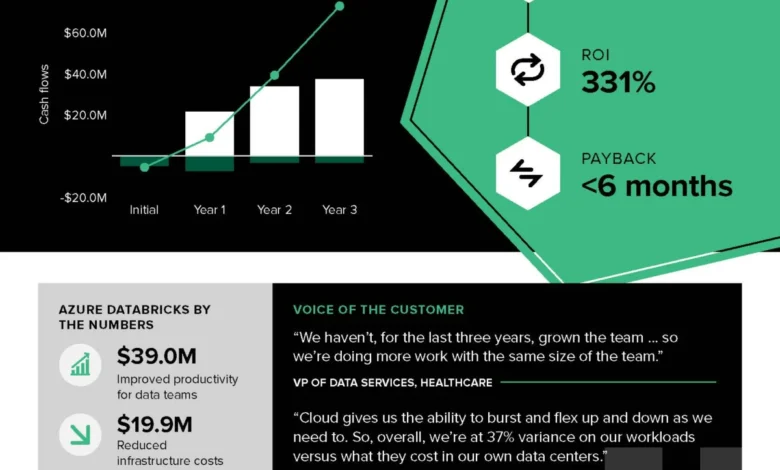
Microsoft Azure Databricks, a strategic co-engineered service by Microsoft and Databricks, is demonstrating significant tangible business value, according to a recent Total Economic Impact™ (TEI) study commissioned by Microsoft and conducted by Forrester Consulting. The findings indicate that organizations leveraging Azure Databricks can achieve a remarkable 331% return on investment over three years, with a net present value of $58.1 million and an impressive payback period of less than six months. These figures underscore the platform’s ability to drive substantial cost savings, enhance operational efficiency, and accelerate time-to-value for data and AI initiatives.
The TEI study, released in June 2026, analyzed the financial and operational impact of Azure Databricks on a composite organization. This representative entity was characterized as a $6 billion company operating within a regulated industry, managing approximately 10 petabytes of data. Prior to adopting Azure Databricks, this organization grappled with a fragmented, costly, and unreliable data estate that presented significant governance challenges. The implementation of Azure Databricks, however, transformed this landscape, yielding a total of $75.6 million in benefits against $17.5 million in costs over a three-year period, resulting in the aforementioned $58.1 million net present value.
A key differentiator highlighted in the study is Azure Databricks’ status as a true first-party Azure service. This integration is not an add-on but rather a core component, co-engineered by Microsoft and Databricks. This deep partnership ensures seamless integration with the broader Microsoft data and AI ecosystem, including familiar Microsoft tools, identity management, and governance frameworks. The study notes that this native integration streamlines workflows, reduces the need for complex tooling and extensive integration efforts, and consequently lowers overall costs.
The advantage of Azure Databricks is further amplified by its unified go-to-market strategy, encompassing a single bill, single support path, and a shared integration roadmap. This unified approach simplifies procurement and management for businesses, while technical teams benefit from enhanced native integration and superior performance. This "built-in, not bolted-on" philosophy directly translates into lower risk and faster realization of business value.
The research methodology involved in-depth interviews with existing Azure Databricks customers. Forrester Consulting synthesized these real-world experiences to construct a composite organization, allowing for a robust and representative financial model. The study’s findings, while representing a composite, offer a compelling illustration of the potential economic benefits achievable through the strategic adoption of Azure Databricks.
Unpacking the Value Drivers Identified by Forrester
The substantial returns identified in the Forrester TEI study are attributed to several key areas where Azure Databricks delivers measurable impact. While the study did not price every benefit individually, it identified crucial factors that contribute to both productivity gains and cost efficiencies.
One of the most significant contributors to the quantified benefits is the reduction in data infrastructure costs. By consolidating data workloads onto a unified platform and eliminating redundant data copies and infrastructure sprawl, organizations can realize substantial savings. The ability to manage vast datasets efficiently and cost-effectively on Azure is a cornerstone of this benefit.
Another critical area of value is the improvement in data team productivity. Azure Databricks empowers data engineers, data scientists, and analysts with a collaborative and efficient environment. Features such as simplified data preparation, accelerated model development, and streamlined deployment pipelines reduce the time spent on operational tasks, allowing these professionals to focus on generating insights and driving business innovation. This increased productivity translates directly into faster project completion and a higher output of valuable data-driven outcomes.
The study also points to enhanced business agility and faster time-to-market for data products and insights. In today’s rapidly evolving business landscape, the ability to quickly leverage data for decision-making and product development is paramount. Azure Databricks’ integrated nature and optimized performance enable organizations to accelerate the process from data ingestion to actionable insights, allowing them to respond more effectively to market opportunities and challenges. This agility is a critical competitive advantage.
Furthermore, reduced operational overhead and risk mitigation contribute significantly to the overall economic impact. The native integration with Azure services simplifies management and reduces the complexity of maintaining disparate systems. This streamlined approach not only lowers operational costs but also enhances security and compliance, mitigating risks associated with data governance and regulatory adherence, particularly important in regulated industries.
The Genesis of Value: Native Integration and Enhanced Functionality
The core of Azure Databricks’ value proposition lies in its deep, native integration within the Azure cloud ecosystem. This strategic alignment ensures that the platform functions as a seamless extension of existing Microsoft investments. For instance, the integration of Azure Databricks Genie with Microsoft Copilot Cowork exemplifies this synergy. This feature allows users to query their lakehouse using natural language directly within familiar Microsoft tools like Microsoft Teams and Microsoft 365 Copilot.
This integration is further bolstered by Genie Ontology, which grounds AI-driven tasks in trusted data. Critically, this intelligence is delivered within the confines of Unity Catalog, ensuring that access to information is strictly governed by user permissions. This means that insights can flow seamlessly into the daily workflow without compromising data security or compliance. This ability to democratize access to data while maintaining robust governance is a significant driver of productivity and trust.
The study acknowledges that while Forrester listed several unpriced benefits, these are crucial to the overall success of Azure Databricks. These include:
- Deeper native Azure services integration: This allows for seamless data movement, processing, and analytics across the Azure platform, leveraging services like Azure Synapse Analytics, Azure Machine Learning, and Power BI.
- Accelerated insights generation: The optimized architecture and performance of Azure Databricks enable faster processing of complex queries and machine learning models, leading to quicker discovery of actionable insights.
- Wider access to data: By unifying disparate data sources within the lakehouse architecture, Azure Databricks provides broader and more equitable access to data for various stakeholders across the organization.
- Enhanced governance through Unity Catalog: Unity Catalog provides a centralized solution for data discovery, access control, and auditing, ensuring that data is managed securely and compliantly across the lakehouse.
These integrated capabilities collectively contribute to a more efficient, productive, and secure data and AI environment, directly impacting the bottom line.
Independent Validation of Performance Prowess
Beyond the financial metrics, the performance capabilities of Azure Databricks have also been independently validated. Principled Technologies, a respected independent research firm, conducted a decision-support benchmark test, akin to industry-standard TPC-DS, on a 10-terabyte dataset. The results demonstrated a significant performance advantage for Azure Databricks.
In the benchmark, Azure Databricks completed a single query stream up to 21.1% faster than Databricks on AWS when autoscale was disabled. Furthermore, when running four concurrent query streams, Azure Databricks outperformed its AWS counterpart by more than nine minutes. This independently verified performance advantage is crucial, as it ensures that the cost savings and productivity gains are not only achievable but also sustainable as data volumes and query complexity grow. Faster query execution means quicker access to critical information, enabling more timely decision-making and a more responsive business.
The Strategic Imperative: A Unified Vision for Data and AI
The co-engineering and strategic partnership between Microsoft and Databricks represent a deliberate effort to provide a cohesive and high-performing data and AI platform. This collaboration ensures a unified integration roadmap, aligning the development of Azure Databricks with the broader Microsoft data and AI stack. This foresight allows organizations to benefit from continuous optimization and innovation, keeping them at the forefront of data analytics and artificial intelligence.
The implications of this partnership extend beyond technical integration. It signifies a commitment to delivering a simplified customer experience, characterized by a single motion for deployment and management, a consolidated billing process, and a unified support structure. This streamlined approach reduces friction and allows organizations to focus their resources on extracting value from their data rather than navigating complex vendor relationships.
What This Means for Organizations: A Future-Proofed Data Foundation
The findings of the Forrester TEI study and the independent performance benchmarks provide a compelling case for adopting Microsoft Azure Databricks. The platform offers a potent combination of economic benefits, operational efficiencies, and technological advantages.
For organizations making the critical decision about their data and AI platform, Azure Databricks presents a future-proofed foundation. The deep integration with Azure services ensures scalability, security, and access to a continually evolving suite of AI and data tools. The measured returns—a 331% ROI and a payback period of under six months—are not mere theoretical projections but concrete outcomes demonstrated by real-world users.
This success is a testament to the power of a first-party partnership, where engineering expertise, strategic roadmaps, and dedicated support are aligned to empower organizations. In an era where data is a critical asset, Azure Databricks provides the robust, performant, and cost-effective platform necessary to unlock its full potential, driving innovation and competitive advantage. The continued adoption of Azure Databricks by numerous teams underscores its position as a leading solution for modern data and AI challenges.
Exploring Further Opportunities with Azure Databricks
Organizations seeking to understand the full scope of Azure Databricks’ capabilities and its potential impact on their specific business context are encouraged to explore the comprehensive resources available. These include detailed documentation, case studies, and access to the full Forrester Total Economic Impact™ study. The platform’s evolution, marked by ongoing integrations and enhancements, continues to broaden its applicability and reinforce its value proposition for businesses of all sizes and across diverse industries.