Breaking Barriers Beyond the Stratosphere: Reflecting on Dr. Mae Jemison’s Historic Journey and Enduring Legacy in Space Exploration

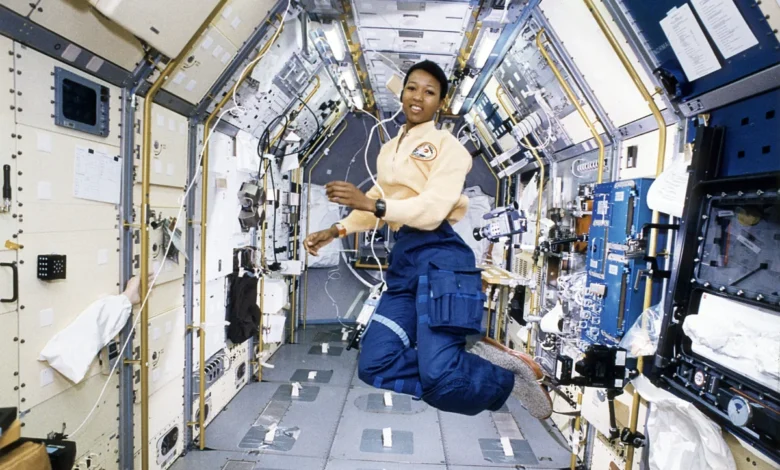
On September 12, 1992, NASA astronaut Dr. Mae Jemison etched her name into the annals of history by stepping aboard the Space Shuttle Endeavour for the STS-47 mission, officially becoming the first African American woman to travel into space. This monumental event marked a watershed moment not only for NASA, which had historically struggled with workforce diversity, but also for representation within the global scientific community. Jemison’s journey was the culmination of rigorous academic pursuit, humanitarian service, and an unwavering childhood fascination with the cosmos—a fascination famously inspired by fictional representations of diversity in space exploration, such as Lieutenant Uhura in the original Star Trek series.
While NASA’s early manned spaceflight programs—spanning Mercury, Gemini, and the initial phases of Apollo—were groundbreaking technological achievements, they were also products of an era defined by profound social exclusion. Women and people of color were systematically barred from the astronaut corps. It was not until the recruitment of the historic 1978 astronaut group—often referred to as NASA’s "Thirty-Five New Guys," which notably included the first female and minority candidates—that the agency began to shift its demographic profile.
The timeline of inclusion moved incrementally. In 1983, during the seventh space shuttle mission (STS-7), astronaut Sally Ride shattered the gender barrier by becoming the first American woman in space. Later that same year, on STS-8, Guion "Guy" Bluford became the first African American man to reach orbit. Yet, despite these critical strides, nearly another decade would pass before an African American woman was finally assigned to a flight crew. That milestone arrived on STS-47, designated as Spacelab J, a cooperative science mission conducted jointly by NASA and the National Space Development Agency of Japan (NASDA).
Born in Decatur, Alabama, and raised in Chicago, Illinois, Jemison exhibited an early and voracious appetite for science. Her academic trajectory was nothing short of exemplary. She entered Stanford University at the tender age of 16, subsequently earning a Bachelor of Science degree in chemical engineering in 1977, alongside dedicated coursework in African American studies. Following her undergraduate studies, she pursued a Doctorate in Medicine from Cornell University, graduating in 1981.
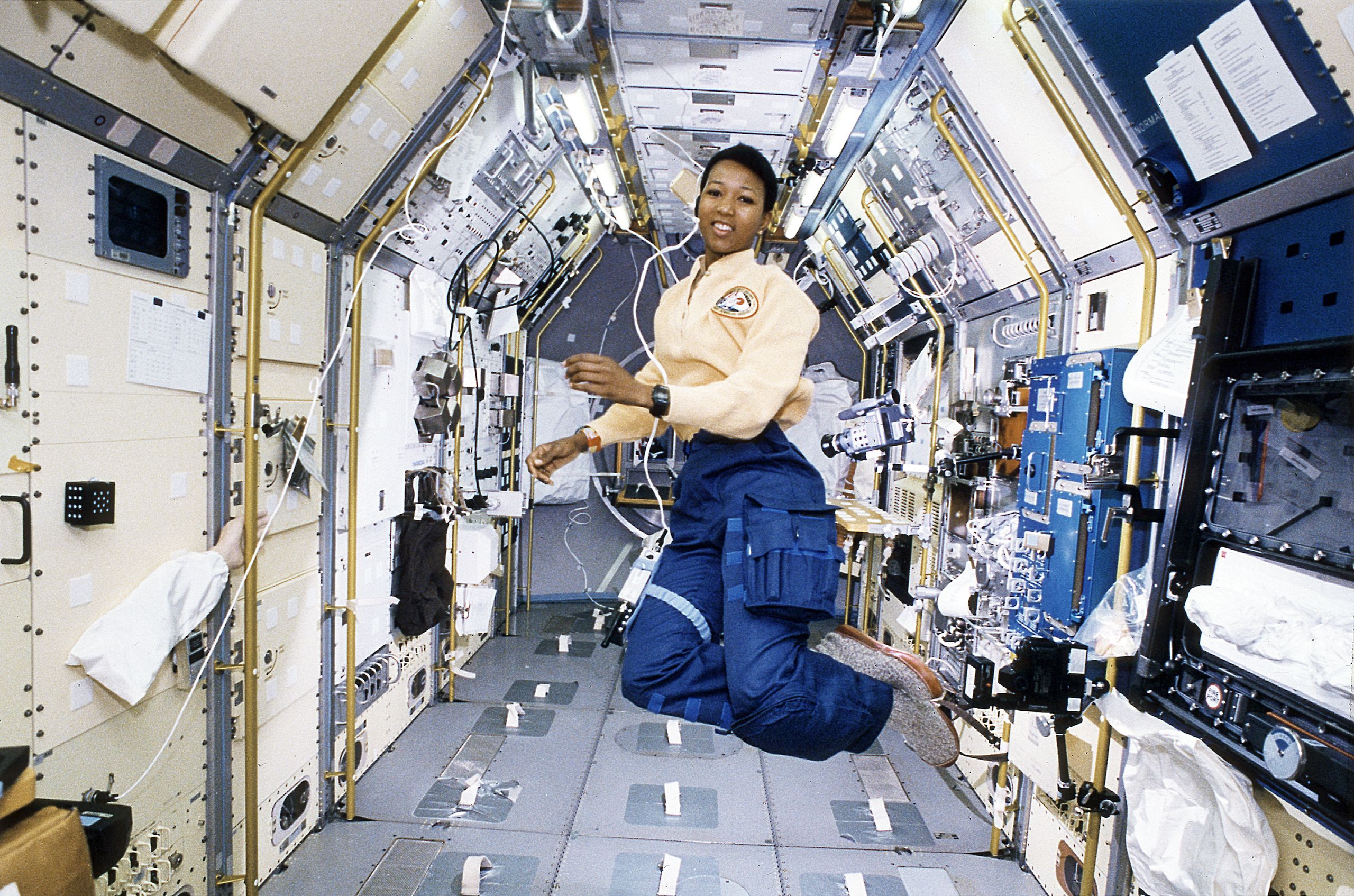
Before donning a NASA flight suit, Jemison’s dedication to public service took her across the globe. From 1983 to 1985, she served as a Peace Corps Medical Officer for the West African nations of Liberia and Sierra Leone, where she managed healthcare delivery, coordinated public health policy, and oversaw medical personnel. Upon returning to the United States, she practiced as a general-practitioner physician in Los Angeles.
When NASA selected Jemison for the astronaut corps in June 1987—as one of only 15 candidates chosen from a staggering pool of nearly 2,000 applicants—she brought with her a multidisciplinary toolkit encompassing engineering, clinical medicine, and international field experience.
As a science mission specialist on STS-47 aboard the Space Shuttle Endeavour, Jemison was thrust into a high-intensity operational environment. The mission was heavy with scientific objectives, housing the Spacelab-J module in the shuttle’s payload bay. During the eight-day, twenty-two-hour flight, Jemison was responsible for overseeing 44 separate collaborative life sciences and materials processing experiments. These investigations ranged from studying the development of bone cells in microgravity to monitoring the physiological adaptations of Japanese koi fish and human subjects in orbit.
Reflecting on the grueling demands of spaceflight, Jemison and her six fellow crew members executed their duties with precision. When Endeavour touched down safely at the Kennedy Space Center on September 20, 1992, Jemison had logged precisely 190 hours, 30 minutes, and 23 seconds in Earth orbit.
Although STS-47 would be her only spaceflight, Jemison’s departure from NASA in March 1993 did not signal an end to her contributions to science and aerospace. Instead, it marked the beginning of a prolific post-NASA career dedicated to technological innovation, education, and public engagement.
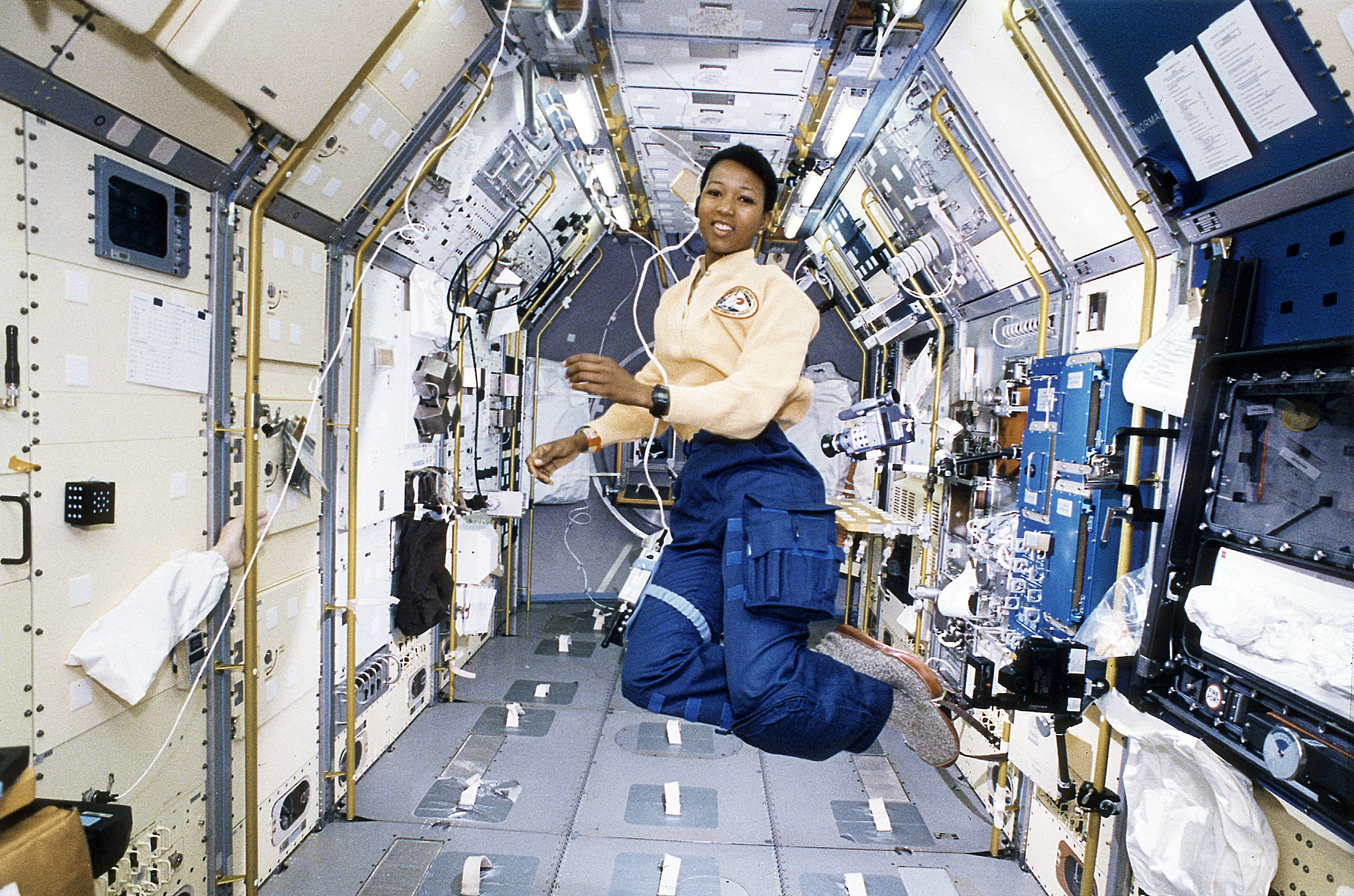
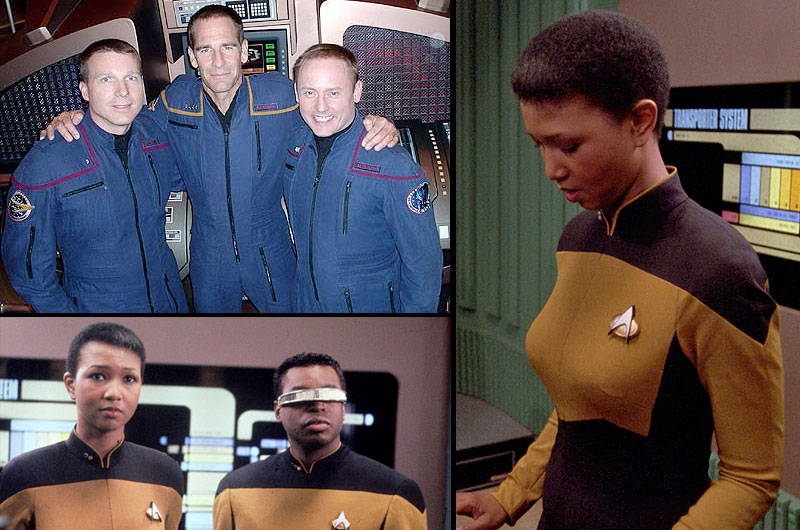
Later in 1993, she founded the Jemison Group, a technology consulting firm focused on integrating socio-cultural considerations into the design and implementation of science and technology projects, particularly in developing nations. That same year, the thematic loop of her life closed in remarkable fashion: Jemison made a guest appearance as Lieutenant Palmer in the Star Trek: The Next Generation episode "Second Chances," becoming the first real-world astronaut to appear in the iconic science fiction franchise that had inspired her childhood dreams.
Her commitment to fostering the next generation of explorers led her to establish the Dorothy Jemison Foundation for Excellence, named in honor of her mother. Through initiatives like "The Earth We Share" international science camp, the foundation has empowered thousands of students globally, teaching them critical thinking, problem-solving, and the scientific method. Furthermore, Jemison served as the principal of the 100-Year Starship project, an initiative launched under the auspices of DARPA and the Nia Tero foundation, designed to ensure the capability for human interstellar travel to another star system within the next century.
The broader implications of Mae Jemison’s historic flight resonate deeply within the architecture of modern aerospace. Historically, the demographics of space exploration skewed heavily toward military test pilots—a pipeline that systematically excluded women and minorities due to institutional barriers in both military service and higher education. By proving that exceptional scientists and physicians from diverse backgrounds could excel in the unforgiving environment of orbital spaceflight, Jemison helped reshape the archetype of the modern astronaut.
NASA’s evolving recruitment strategies over the subsequent decades reflect this paradigm shift. Today, the agency’s astronaut corps is significantly more diverse, drawing talent from a wide array of civilian, academic, medical, and engineering backgrounds. The visibility of pioneers like Jemison played a direct role in inspiring subsequent generations of young women and people of color to pursue Science, Technology, Engineering, and Mathematics (STEM) disciplines.
Cultural recognition of her contributions has also been institutionalized. In 2017, the LEGO Group immortalized her impact by including an official Mae Jemison minifigure in the acclaimed "Women of NASA" collection, ensuring that her likeness and legacy remain visible to children building their own worlds and futures.
As humanity looks toward sustained habitation on the Moon under the Artemis program and gazes further toward crewed missions to Mars, the foundational ethos championed by Dr. Jemison remains vital. Space exploration, by its very nature, is a collective human endeavor that demands the inclusion of all perspectives, intellects, and backgrounds.
Dr. Mae Jemison’s flight on STS-47 was never merely about logging hours in microgravity or managing experiments in the Spacelab module. It was a powerful assertion that the final frontier belongs to all of humanity, and that the boundaries of Earth should never dictate the limitations of human potential.
Related posts: