AWS Expands Amazon Elastic Block Store Capabilities with Cross-Account Volume Clones and Re-Encryption Support


Amazon Web Services (AWS) has announced a significant expansion of its Amazon Elastic Block Store (Amazon EBS) portfolio by introducing cross-account copy functionality for EBS Volume Clones. This new capability enables organizations to generate point-in-time volume copies and transfer them seamlessly across distinct AWS accounts. Furthermore, the feature provides administrators with the option to re-encrypt these replicated volumes using target-specific AWS Key Management Service (AWS KMS) keys, addressing complex multi-account security, compliance, and operational challenges faced by enterprise cloud architects.
The enhancement builds upon the foundational EBS Volume Clones feature introduced by AWS in the previous year. While the original release allowed users to execute instant block-level storage cloning within a single Availability Zone, enterprises running multi-account architectures—a best practice recommended in the AWS Well-Architected Framework for isolation, billing, and governance—frequently encountered friction when attempting to sync production data with isolated development, testing, and staging environments residing in separate accounts.
Background and Evolution of Amazon EBS Clones
To understand the operational significance of this new capability, it is helpful to examine the historical evolution of data duplication within Amazon EBS. Traditionally, organizations relied on Amazon EBS snapshots to back up and duplicate storage volumes. While snapshots remain an essential tool for long-term data durability, archiving, and regional disaster recovery, creating fully functional operational volumes from snapshots can introduce notable latency and overhead, particularly when dealing with massive multi-terabyte datasets.
Recognizing these performance and workflow bottlenecks, AWS introduced EBS Volume Clones. Volume Clones leverage underlying storage virtualization to create instant, metadata-driven copies of block storage volumes. Rather than physically copying every single block at the moment of creation, the underlying storage engine utilizes a redirect-on-write architecture. This allows developers and system administrators to spin up identical storage states instantaneously, dramatically accelerating data-dependent workflows such as database provisioning, patch validation, and analytics processing.
However, as enterprise customers increasingly adopted multi-account strategies governed by AWS Control Tower and AWS Organizations, the limitation of intra-account cloning became apparent. Production data often resides in tightly locked, highly restricted production accounts, whereas software development lifecycles (SDLC) occur in separate, sandbox-oriented accounts. Bridging this data divide previously required complex, multi-step procedures involving manual snapshot sharing, permission grants, snapshot restoration, and subsequent volume provisioning. The newly released cross-account cloning capability directly streamlines this operational overhead.

Technical Mechanics: How Cross-Account Volume Clones Operate
The implementation of cross-account EBS volume cloning relies heavily on AWS Resource Access Manager (AWS RAM), a service designed to facilitate secure resource sharing across AWS accounts and within structured AWS Organizations.
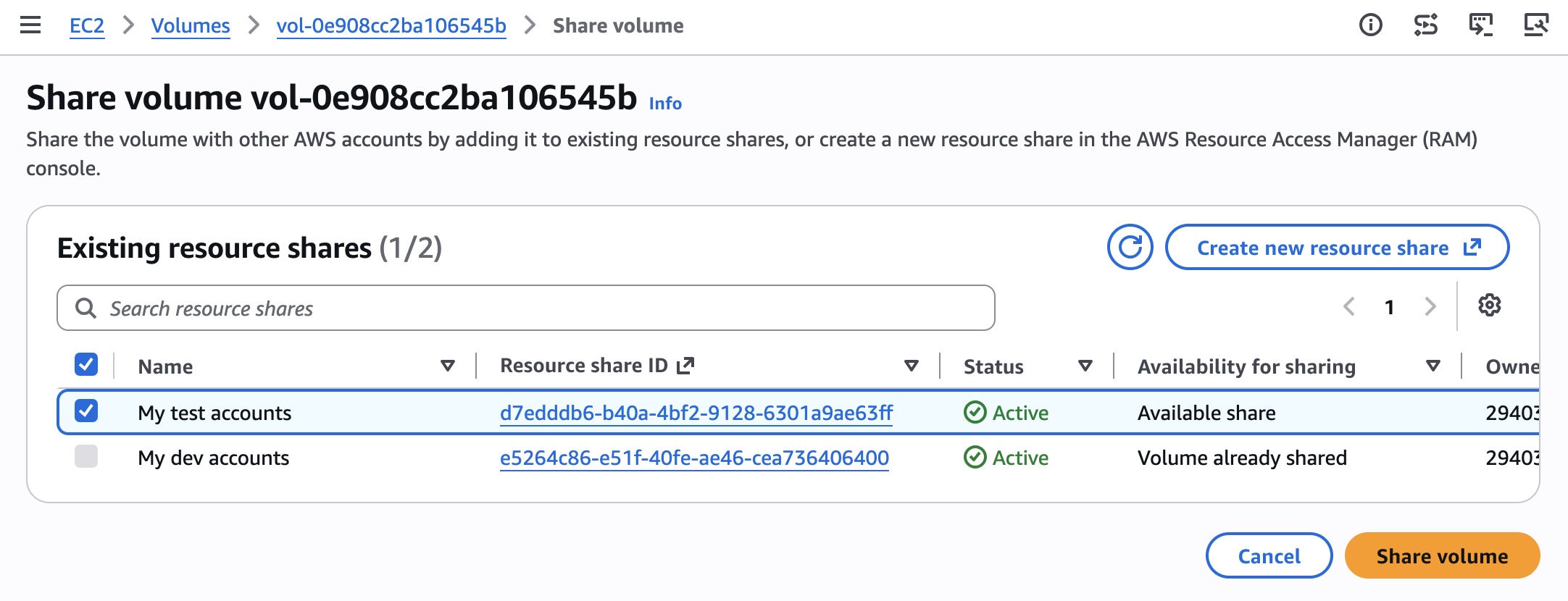
The workflow begins in the source account, where the volume owner navigates to the Amazon EC2 console, selects the desired volume, and initiates the sharing process. By utilizing AWS RAM, administrators can designate specific external AWS accounts or entire organization units as recipients of the resource share. Once the resource share is established, the target account receives an invitation that must be explicitly accepted via the RAM console.
Upon acceptance, the shared volume becomes visible within the EBS volume management interface of the target account. The receiving administrator can then execute a "Copy volume" command. During this copy operation, the system generates an independent, fully isolated clone in the target account. Crucially, this is the juncture where cross-account re-encryption can take place. By leveraging an AWS KMS key managed within the target account, organizations can ensure that data remains encrypted under keys governed strictly by the security policies of the secondary environment, satisfying stringent internal compliance and regulatory frameworks such as HIPAA, PCI-DSS, and GDPR.
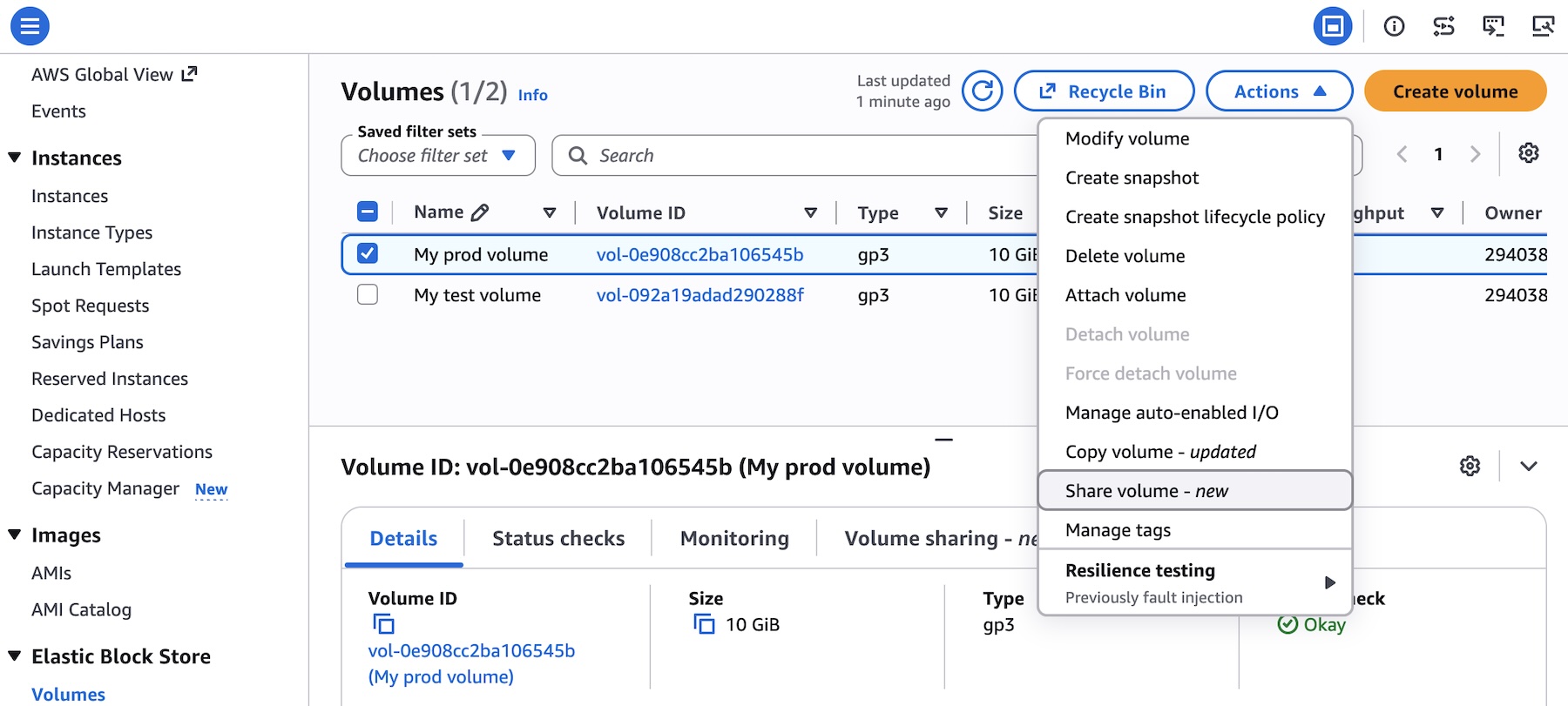
In addition to traditional graphical user interface (GUI) interactions via the AWS Management Console, AWS has integrated support for programmatic workflows. Engineering teams utilizing AI-assisted development tools and infrastructure-as-code pipelines can leverage the AWS Model Context Protocol (MCP) Server and associated plugins to automate the discovery, sharing, and copying of volumes across accounts via API calls, thereby integrating the feature seamlessly into continuous integration and continuous deployment (CI/CD) pipelines.
Enterprise Implications and Strategic Use Cases
The introduction of cross-account EBS cloning carries substantial implications for enterprise software engineering, security posture, and financial governance in cloud computing environments.
1. Accelerated Software Development and Testing (SDLC)
In modern DevOps organizations, maintaining data parity between production and lower-level testing environments is a persistent challenge. Stale test data frequently leads to undetected bugs, failed deployments, and performance discrepancies that only manifest after software hits production. By enabling frictionless, instant copying of production-grade volumes into development accounts, teams can regularly refresh test beds with real-world data schemas and volumes. This capability facilitates rigorous regression testing, load testing, and chaos engineering exercises against authentic production states without risking the integrity of live customer-facing systems.
2. Enhanced Security and Compliance Isolation
Security best practices dictate the principle of least privilege and strict workload segregation. Blurring the lines between production and non-production accounts by sharing raw credentials or direct access keys introduces unacceptable risk vectors. Cross-account cloning decouples data sharing from credential sharing. Production data can be exported securely to an isolated analytics or staging account, where it is immediately re-encrypted under a distinct KMS key owned and audited by the secondary security team. This ensures that developers working in testing environments never gain visibility into or control over production encryption keys, maintaining a robust security boundary.
3. Operational Efficiency and Cost Optimization
Time is a quantifiable metric in enterprise IT operations. Traditional data migration methods between accounts often incurred significant bandwidth utilization, time delays, and complex scripting overhead. By utilizing metadata-level cloning principles extended across account boundaries, AWS reduces the time required to provision complex datasets from hours or minutes down to seconds. Furthermore, organizations can optimize storage expenditure by deleting temporary clones immediately after testing phases conclude, leveraging pay-as-you-go cloud economics more effectively.
Industry Context and Market Analysis
Cloud storage management has evolved from a purely administrative utility into a core differentiator for hyperscale cloud providers. As enterprises migrate increasingly mission-critical databases, enterprise resource planning (ERP) systems, and analytical workloads to platforms like Amazon EC2 and Amazon EBS, the demand for granular, high-performance data management primitives has intensified.

Competitors in the cloud infrastructure market continually vie to simplify multi-account data governance. By tying EBS cross-account cloning directly into AWS RAM and AWS KMS, AWS reinforces the architectural cohesion of its ecosystem. Rather than forcing users to build custom tooling or rely on third-party snapshot management scripts, AWS provides a native, managed primitive that inherently understands IAM policies, resource tagging, organizational boundaries, and cryptographic key rotation.
Industry analysts note that features reducing operational friction in multi-account setups are particularly vital for large enterprises undergoing digital transformation. As companies scale from a handful of AWS accounts to hundreds or thousands under centralized management frameworks, native services that respect organizational guardrails while empowering autonomous teams dictate overall cloud efficiency.
Availability and Getting Started
AWS has confirmed that cross-account volume clones for Amazon EBS are generally available immediately across all global AWS Regions that currently support standard Amazon EBS Volume Clones. Organizations wishing to verify specific Regional support can consult the official AWS Capabilities by Region documentation portal.
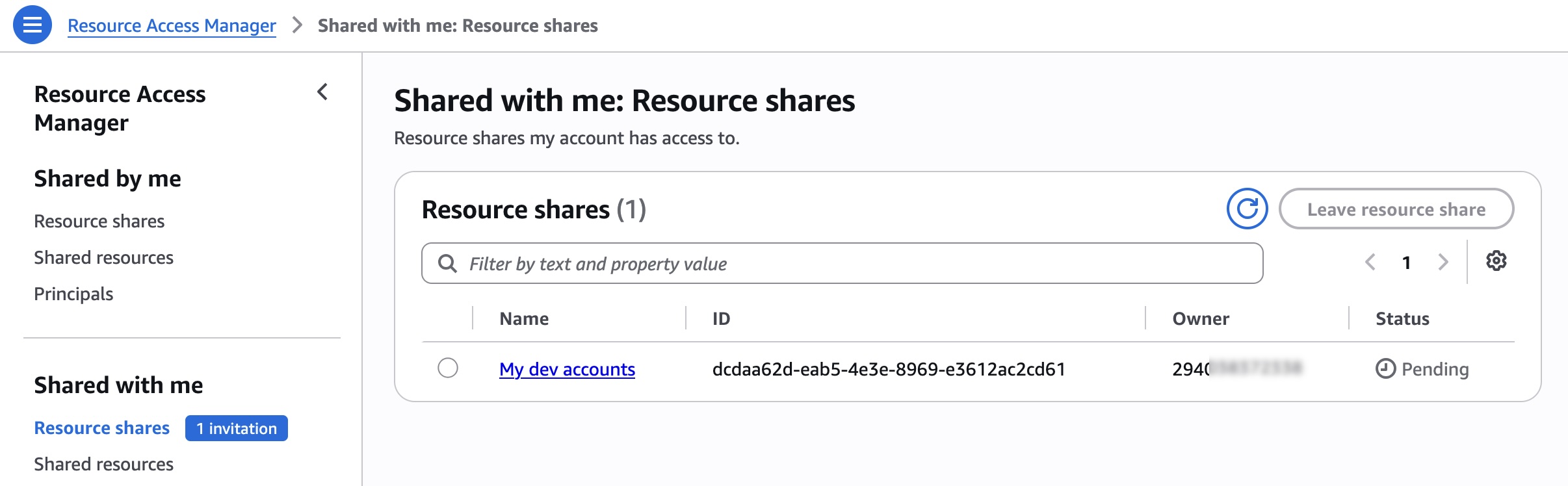
To begin utilizing the feature, administrators can access the Amazon EC2 console, navigate to the Elastic Block Store dashboard, and select an existing volume to initiate a resource share via AWS RAM. Detailed technical guidance, API reference documentation, and step-by-step configuration walkthroughs are available within the Amazon EBS User Guide. Feedback and feature requests regarding the rollout are being actively monitored by AWS product teams through the AWS re:Post community channels and standard enterprise support pathways.