AWS Announces General Availability of Continuum for Code Vulnerabilities to Streamline Cloud Security and Automated Remediation

Amazon Web Services (AWS) has officially announced the general availability of AWS Continuum for code vulnerabilities, a security service designed to identify, validate, and remediate application security flaws. The newly launched platform addresses a mounting challenge in the software development lifecycle: the overwhelming volume of security alerts generated by traditional scanning tools, combined with the accelerating speed at which malicious actors can exploit newly discovered weaknesses. By synthesizing data from code repositories and live cloud infrastructure, AWS Continuum aims to bridge the historical divide between development, infrastructure, and security teams, offering automated patch generation while maintaining human oversight over production environments.
The Modern Application Security Dilemma
In the contemporary threat landscape, the proliferation of advanced artificial intelligence models has dramatically compressed the timeline between vulnerability disclosure and active exploitation. Threat actors are now capable of transforming raw vulnerability data into working exploit code in a matter of minutes. Concurrently, modern software development practices—such as continuous integration and continuous deployment (CI/CD)—have drastically increased code velocity.

To keep pace, organizations routinely deploy automated security scanners across their application estates. However, these scanners frequently produce thousands of daily findings, creating significant alert fatigue for engineering and security personnel. A major friction point in vulnerability management has been the prevalence of false positives and unreachable code paths. Traditional scanners rely on generic severity scores that fail to account for operational context. For instance, a critical vulnerability residing in an isolated development-only utility is often assigned the same high priority as a medium-severity flaw located mere steps away from a core financial database.
Historically, confirming whether a specific vulnerability was genuinely exploitable in a live environment required hours of exhaustive manual investigation. Furthermore, deploying a verified fix could take days of cross-functional coordination. Security, infrastructure, and application teams had to manually assess the potential blast radius of a code change without the benefit of comprehensive business context. AWS Continuum was developed to close this gap by automating the heavy lifting of exploit validation and establishing clear risk boundaries for proposed remediations.
Architectural Overview and Context Graphs
At the core of AWS Continuum is its ability to construct a dynamic, comprehensive context graph by aggregating data from two primary sources: connected code repositories—such as GitHub or Amazon Simple Storage Service (S3) buckets—and live AWS cloud environments.

To integrate AWS infrastructure context, organizations deploy an AWS Continuum collector within the specific account and region where applications are executed. This collector gathers detailed resource telemetry, including AWS Config data and intricate network configurations. By combining code architecture with runtime infrastructure data, Continuum can accurately evaluate whether a given vulnerability is reachable over the network and map out the exact resources an attacker could potentially access from that entry point.
The resulting context graph enables the service to map business-critical systems, asset ownership, service-to-service dependencies, and data sensitivity. By identifying high-value repositories—such as customer data stores, payment processing pipelines, and authentication services—Continuum can intelligently rank security issues based on their proximity to critical assets and the actual attack paths available to malicious actors.
Validation, Sandboxing, and Risk Assessment
Rather than relying solely on static risk scores, AWS Continuum performs rigorous validation to determine the real-world exploitability of identified flaws. The service analyzes each finding against the broader environmental context, assigning a specific evidence level, such as verdicts proven through advanced static code analysis.
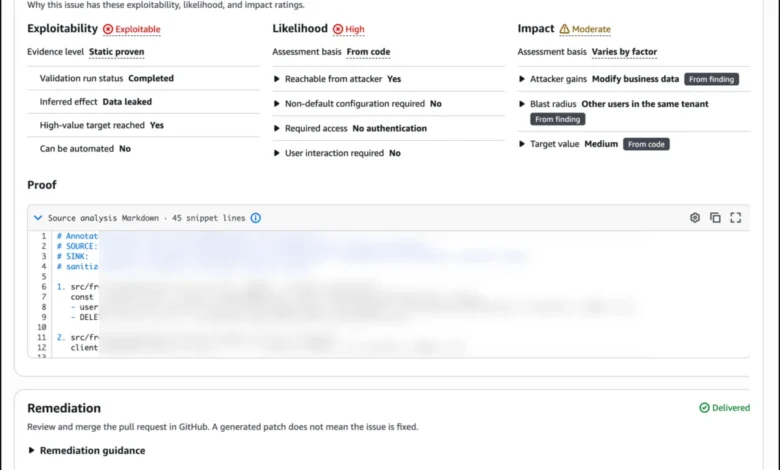
For vulnerabilities that can be safely reproduced, Continuum initiates an isolated sandbox environment to run the exploit. It then generates comprehensive proof-of-concept code, complete with exact reproduction steps, the resulting attack path, supporting source analysis, and a detailed blast radius assessment. Additionally, the service evaluates whether existing runtime defenses and network controls would successfully detect and halt the validated attack path.
Once an issue is confirmed and analyzed, Continuum generates a precise remediation—ranging from code patches and dependency upgrades to infrastructure configuration changes—and opens it as a pull request directly within the connected repository.
Human-in-the-Loop Governance
A central tenet of the AWS Continuum design philosophy is maintaining rigorous human control over production deployments. Every remediation generated by the service initially operates under a human-in-the-loop governance model. Continuum proposes the patch, but human approval is mandatory before any change is shipped to production repositories. Engineers review and merge the pull request, ensuring that the final decision remains firmly in the hands of the development team.
Looking ahead, AWS plans to introduce configurable automation guardrails. Organizations will eventually be able to establish specific confidence thresholds—incorporating parameters such as test coverage, scope boundaries, and historical remediation success rates—allowing Continuum to autonomously apply trusted classes of fixes without manual intervention.
Implementation and Console Workflow
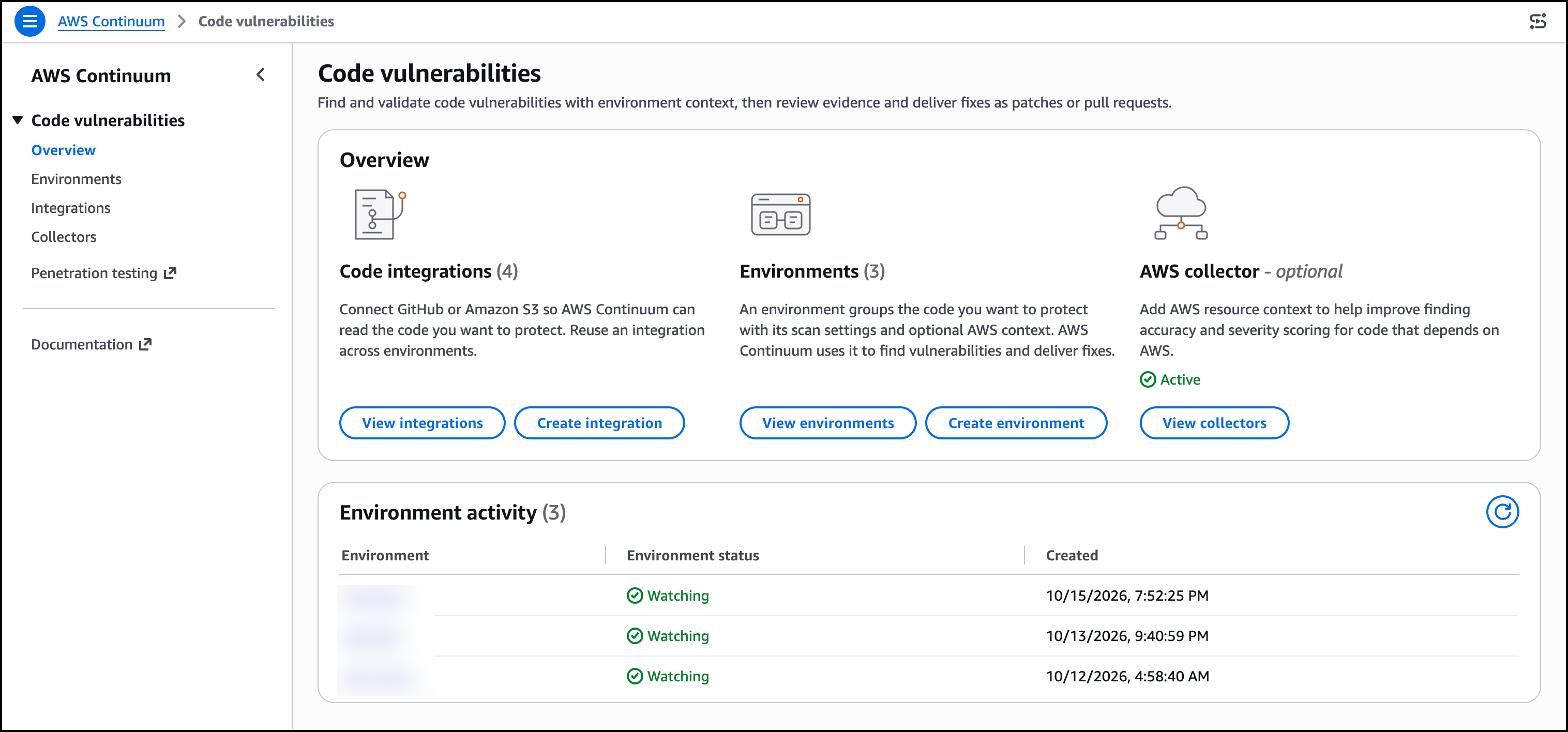
To operationalize AWS Continuum, administrators access the AWS Management Console and navigate to the dedicated Code vulnerabilities section. The setup process requires establishing code integrations via GitHub or Amazon S3 buckets, alongside configuring an optional AWS collector to supply live infrastructure context. S3 sources require specific prerequisites, including residency in the same AWS Region and account where Continuum is enabled, authorized via an AWS Identity and Access Management (IAM) role.
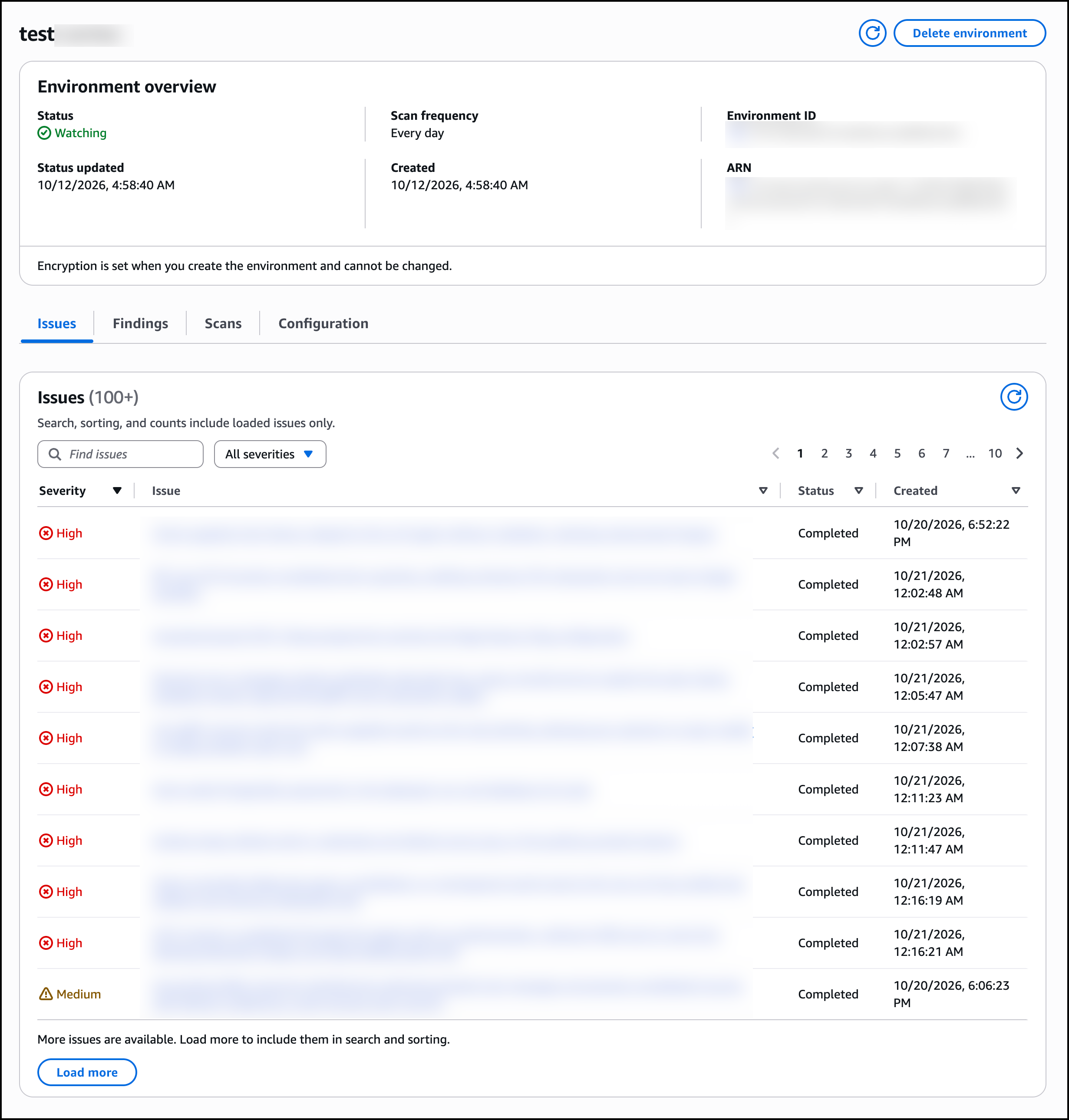
The platform’s centralized Overview page aggregates code integrations, active environments, and collector statuses. Within the Issues tab, security and engineering teams are presented with a prioritized list of validated vulnerabilities rather than raw scanner output. Selecting an individual issue reveals a granular breakdown encompassing severity ratings, exploitability status, likelihood, impact assessments, and supporting proof-of-concept documentation.
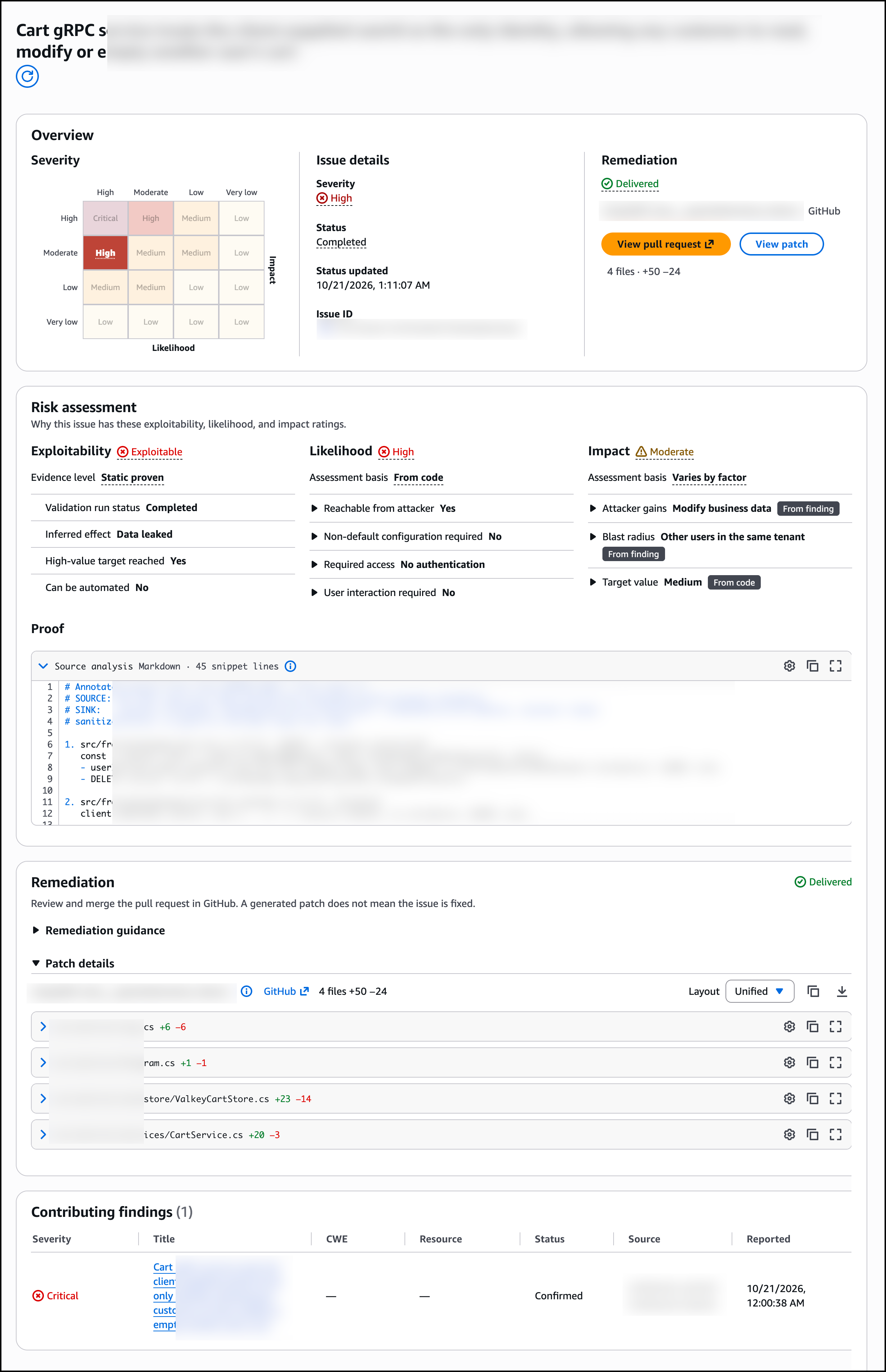
The remediation section displays the exact code modifications prepared for the repository. Because the platform mirrors these risk assessments and remediation summaries directly inside GitHub pull requests, reviewers can evaluate the technical evidence without context-switching away from their standard development workflows. Additional tabs within the console provide historical scan logs, on-demand scanning queues, and environment configuration settings.
Availability and Industry Implications
AWS Continuum for code vulnerabilities is available immediately in select cloud regions, specifically US East (N. Virginia) and US West (Oregon), with standard pricing structures detailed on the official AWS Continuum pricing portal.
Industry analysts note that the launch of Continuum reflects a broader industry shift toward contextualized application security posture management (ASPM) and shift-left remediation driven by artificial intelligence. As cloud environments grow increasingly complex and cyber threats automate their attack vectors, manual vulnerability triaging has become unsustainable for enterprise engineering teams. By merging code-level insights with deep runtime environmental context, AWS Continuum provides organizations with a systematic method to shrink their vulnerability backlogs while preserving rigorous code quality and operational control.