IFixit teardown reveals the engineering behind the new MacBook Pro with PROLED XDR Display and the return of the iconic illuminated Apple logo

The latest hardware analysis from the experts at iFixit has provided a definitive look inside the new MacBook Pro with PROLED XDR Display, uncovering the intricate engineering required to integrate a modern touchscreen interface and a nostalgia-inducing illuminated lid logo. This teardown not only settles technical curiosities regarding the device’s internal layout but also highlights Apple’s ongoing efforts to balance repairability with extreme component miniaturization. As the professional creative market continues to demand thinner, lighter, and more powerful hardware, this iteration of the MacBook Pro represents a significant architectural pivot for the company.
Unpacking the Architecture: The PROLED XDR Display
At the heart of the new device is the PROLED XDR Display, a display technology that represents a departure from traditional mini-LED setups. iFixit’s microscopic examination revealed that the panel utilizes a tandem OLED structure. By stacking two distinct light-emitting layers, Apple has achieved a superior brightness threshold while simultaneously mitigating the rapid degradation often associated with high-output OLED panels.

A key discovery during the inspection was the deliberate variation in subpixel size. Engineers observed that the blue subpixels have been manufactured with a larger surface area compared to their red and green counterparts. This is a strategic design choice; blue OLED materials are historically the most susceptible to "burn-in" and physical degradation. By increasing the size of these subpixels, Apple effectively lowers the current density required to achieve the same luminosity, which should, in theory, significantly extend the operational lifespan of the display under professional, high-intensity use.
The Return of the Glowing Logo
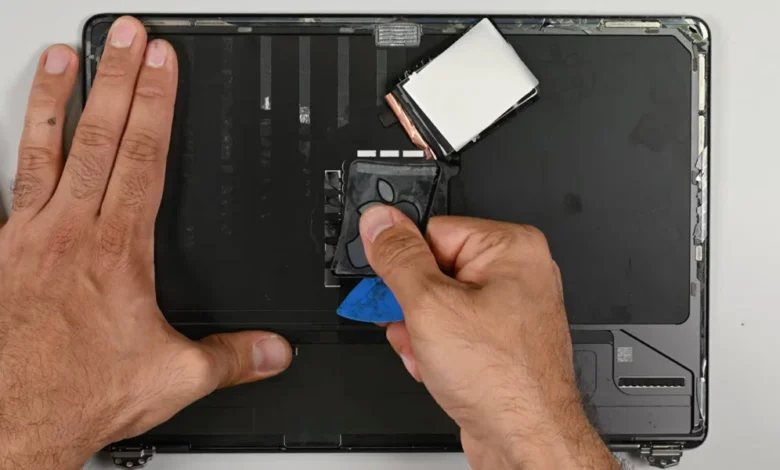
For many long-term users, the return of the illuminated Apple logo on the laptop lid is the most significant aesthetic update in a decade. The iFixit teardown process, which proved hazardous to the display panel itself due to the tight tolerances involved in the chassis assembly, provided a clear map of how this effect is achieved.
The illumination is powered by a dedicated strip of four high-efficiency LEDs. These are paired with a multi-layered light diffuser and a reflective backing to ensure the glow remains uniform across the entire surface of the logo. To achieve the signature "Apple" aesthetic—which appears as a standard polished metal finish when the device is powered down—the company has utilized a two-way mirror coating. This coating allows the internal light to pass through the logo when the system is active while maintaining a reflective, opaque appearance when the backlight is disengaged. This solution provides a seamless blend of modern function and classic design.

Structural Weight Reduction and Internal Layout
Despite the added hardware complexity—namely the touchscreen controller and the LED array for the logo—the new MacBook Pro is remarkably lighter than its predecessors. The 14-inch model has shed 0.4 pounds (roughly 180 grams), bringing the total weight down to 3 pounds (1.38 kg).
According to the teardown, this was not achieved through a single radical change but rather through a series of incremental weight-saving measures across the entire chassis. The main logic board assembly was refined, the chassis material was optimized, and the trackpad footprint was slightly reduced to save 8 grams. Even the battery, a core component of the laptop’s weight profile, was trimmed by 2 grams. These micro-optimizations demonstrate a high level of iterative refinement in Apple’s supply chain and engineering departments, allowing for a more portable professional machine without sacrificing thermal performance or battery capacity.
Repairability and the Logic Board Dilemma
The iFixit team assigned the new MacBook Pro a repairability score of 5 out of 10. While this is an improvement over the previous M5-based models, it remains a contentious point for consumer advocacy groups who champion the "Right to Repair."

The teardown confirmed that several critical components—including the USB-C ports, the cooling fans, and the headphone jack—are physically modular. However, they remain practically difficult to replace because they are buried beneath the logic board. To access these parts, a technician must perform a near-total disassembly of the machine. Furthermore, components such as the HDMI port, SDXC card reader, RAM, and the SSD storage modules remain permanently soldered to the logic board, precluding any possibility of user-side upgrades or cost-effective post-warranty memory expansion.
Software Calibration and Repair Assistant
One of the most encouraging findings from the teardown is the improvement in Apple’s "Repair Assistant" software. In previous years, swapping a logic board between two identical MacBook Pros would often trigger a cascade of software locks, rendering components like Touch ID or the display’s True Tone functionality non-functional.
iFixit found that the new MacBook Pro is significantly more permissive regarding modularity. When swapping logic boards between two units, the system successfully recognized the battery, the new display assembly, and the Touch ID sensor. Basic features like display brightness, True Tone color calibration, and even the new touchscreen interface remained fully operational after the swap. Furthermore, the ability to enroll a new fingerprint on a donor board suggests that Apple has moved away from the restrictive hardware-binding policies that characterized the M5 generation. This represents a tangible step forward for independent repair shops and users looking to extend the lifecycle of their devices.

Broader Implications for the Industry
The release of this MacBook Pro marks a transition point for high-end mobile computing. By adopting a tandem OLED display, Apple is setting a new standard for portable color accuracy and brightness. The inclusion of a touchscreen, previously a feature Apple resisted for the Mac line, indicates a shift in the company’s philosophy regarding input methods. Industry analysts suggest this may be a response to the growing convergence between iPadOS and macOS ecosystems, where users are increasingly demanding a unified experience.
The return of the illuminated logo also serves as a brand-reinforcement strategy. In the modern laptop market, where hardware designs have become increasingly homogenized, distinct visual markers are critical for brand identity. This "classic" feature, updated with modern LED technology, provides a sense of continuity that resonates with the professional user base that has been with the platform for years.
Conclusion and Future Outlook
As Apple continues to refine its custom silicon and display technologies, the focus appears to be shifting toward longevity. The use of larger blue subpixels to prevent display degradation and the more flexible repair software both point toward a product designed for a longer service life than the previous generation.

However, the 5/10 repairability score serves as a reminder that the pursuit of a thin, lightweight, and high-performance chassis inevitably results in trade-offs. The integration of high-speed memory and storage directly onto the logic board remains a significant barrier for users who require longevity in their professional workflows. For now, the new MacBook Pro with PROLED XDR Display stands as a pinnacle of engineering, balancing a heritage design with the most advanced display technology currently available in the laptop market. Whether this represents a permanent shift toward more repair-friendly hardware or merely a temporary refinement in the internal assembly process remains a subject for future teardowns and long-term field testing.
Related posts: