As artificial intelligence systems transition from narrow task performers to autonomous agents capable of complex reasoning, the fundamental architecture of machine learning is undergoing a profound paradigm shift. For decades, conventional neural networks relied primarily on fixed-parameter weights to encode information—a design that, while remarkably effective for pattern recognition, inherently limited a model’s ability to retain long-range context, process dynamic real-world environments, and verify factual claims. Today, the convergence of memory-augmented networks, differentiable external memory, knowledge-aware large language models (LLMs), multimodal fusion, and predictive world models is redefining the boundaries of machine intelligence. This comprehensive technological evolution addresses the critical limitations of static neural architectures by separating information storage from immediate computational processing.
The imperative for these advanced architectures stems from the intrinsic bottlenecks of traditional deep learning. Standard recurrent and transformer-based models often compress preceding inputs into evolving hidden states or rely on constrained context windows, frequently discarding critical fine-grained details during extended interactions. To overcome these constraints, researchers across academic and industrial laboratories have increasingly turned to structured memory mechanisms and external knowledge repositories, laying the groundwork for systems that can remember observations, retrieve factual evidence, and simulate environmental dynamics over time.
Evolution and Chronology of Memory-Augmented Architectures
The architectural journey toward advanced memory and knowledge systems spans several decades of algorithmic development, evolving from early symbolic AI to modern differentiable neural structures.

[1950s-1980s] Symbolic AI & Classical Turing Machines
       │
       ▼
[2014-2016] Neural Turing Machines (NTMs) & Memory Networks
       │
       ▼
[2017-2020] Transformers & Differentiable Neural Computers (DNCs)
       │
       ▼
[2021-Present] Knowledge-Aware LLMs, Multimodal Systems, & World Models
During the foundational eras of computing, classical Turing machines manipulated symbols on an abstract tape using discrete operations, while early artificial intelligence research focused on symbolic knowledge bases. However, these rigid systems struggled with uncertainty and perception. The introduction of deep learning in the 2010s shifted the field toward continuous representations, yet left models vulnerable to catastrophic forgetting and a lack of explicit memory storage.
A major milestone arrived in 2014 with the introduction of the Neural Turing Machine (NTM) by researchers at DeepMind. By combining a neural controller with a differentiable external memory matrix via read and write heads, NTMs demonstrated that neural networks could learn algorithmic tasks—such as copying sequences and sorting data—through gradient-based optimization. This was swiftly followed by the development of Memory Networks and End-to-End Memory Networks, which utilized attention-based operations to retrieve supporting facts for question-answering tasks.
By 2016 and 2017, the Differentiable Neural Computer (DNC) extended these concepts by introducing sophisticated memory allocation algorithms, usage tracking, and temporal linking between stored entries. Simultaneously, the rise of the Transformer architecture transformed natural language processing. While Transformer attention provided flexible access to representations within an immediate context window, persistent memory tokens and external memory banks soon emerged to bridge the gap between immediate context and long-term storage.
In recent years, the focus has expanded toward Retrieval-Augmented Generation (RAG), knowledge graphs, multimodal integration, and predictive world models—architectures that allow AI agents to navigate digital databases and physical environments with unprecedented adaptability.

Technical Mechanics: Differentiable Memory and Addressing
At the heart of advanced memory systems is differentiable memory, a computational mechanism that enables neural networks to store, retrieve, and update information via continuous representations compatible with backpropagation.
Unlike traditional computer memory, which relies on hard, discrete memory addresses, differentiable memory employs soft addressing. By calculating attention weights across multiple addressable memory slots, a model assigns probabilistic contributions to individual memory vectors. This ensures that the entire memory-access pipeline remains differentiable, allowing gradient-based optimization to jointly tune controller parameters, addressing functions, and memory interactions.
Memory reading relies on content-based addressing—where a query vector generated by a neural controller is compared against stored memory representations using similarity metrics like cosine similarity—and location-based addressing, which tracks positional relationships for sequential traversal. Conversely, memory writing governs how newly acquired information modifies existing storage through coordinated erase and add operations. Learned gating mechanisms regulate what is retained, overwritten, or discarded, mitigating memory interference over extended computational sequences.
Despite their theoretical elegance, these systems present substantial engineering challenges. Soft addressing can inadvertently distribute attention across unrelated memory entries, causing semantic blurring. Furthermore, repeated write operations without strict allocation policies can gradually corrupt vital historical data, compounding errors across deep computational graphs.

Knowledge Integration: Bridging Parametric Limits and External Databases
As language models achieved unprecedented fluency, hallucinations and outdated parametric knowledge emerged as critical vulnerabilities. Knowledge-Aware Large Language Models directly address these deficiencies by coupling parametric generation with explicit, external knowledge repositories.
┌─────────────────────────────────────────────────────────────┐
│                 Knowledge-Aware LLM Pipeline                │
└──────────────────────────────┬──────────────────────────────┘
                               │
       ┌───────────────────────┴───────────────────────┐
       ▼                                               ▼
┌──────────────┐                               ┌──────────────┐
│  Parametric  │                               │   External   │
│  Knowledge   │                               │  Knowledge   │
│ (Model Weights)│                             │(RAG / Graphs)│
└──────┬───────┘                               └──────┬───────┘
       │                                               │
       └───────────────────────┬───────────────────────┘
                               │
                               ▼
               ┌───────────────────────────────┐
               │    Grounded Generation &      │
               │      Evidence Validation      │
               └───────────────────────────────┘
The primary methodology for this integration is Retrieval-Augmented Generation (RAG). In a standard RAG pipeline, source documents are ingested, segmented into passages, embedded into vector spaces, and indexed in a specialized database. When a user issues a query, the retrieval system performs dense vector search and sparse lexical matching to extract relevant evidence. This retrieved context is subsequently injected into the language model’s prompt, enabling evidence-grounded generation.
To enhance complex reasoning, modern architectures increasingly incorporate knowledge graphs. Unlike unstructured document retrieval, knowledge graphs explicitly represent entities, attributes, and relationships through interconnected nodes and edges. This structural clarity facilitates multi-hop reasoning, allowing models to traverse multiple logical links—such as identifying an organization, extracting its associated projects, and evaluating project attributes—before synthesizing a final response.
However, integrating external knowledge introduces notable security and operational risks. Because retrieved text enters the model’s context window alongside system instructions, malicious actors can exploit prompt-injection vulnerabilities via contaminated documents. Consequently, robust knowledge-aware systems must enforce strict boundaries between trusted instructions and untrusted data sources, supported by continuous source validation, metadata filtering, and provenance tracking.

Multimodal Knowledge and World Models in Autonomous Systems
Moving beyond text, the frontier of AI research is increasingly multimodal and predictive. Multimodal Knowledge architectures integrate information across diverse data modalities—including text, images, audio, video, and physical sensor measurements—to construct comprehensive representations of complex environments.
By utilizing modality-specific encoders and contrastive learning alignment techniques, these systems map heterogeneous observations into shared embedding spaces. Cross-attention mechanisms then facilitate context-dependent information exchange, enabling an AI agent to correlate a spoken instruction with a visual object or an acoustic event.
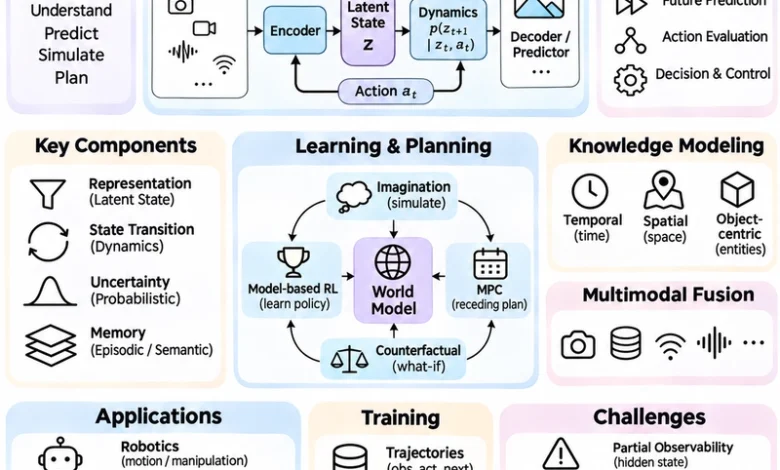
Building upon multimodal perception, World Models represent the pinnacle of dynamic environmental understanding. Rather than reacting solely to immediate sensory input, an agent equipped with a world model maintains internal latent state representations, predicts state transitions, and simulates future outcomes.
┌─────────────────────────────────────────────────────────────┐
│                    World Model Architecture                 │
└──────────────────────────────┬──────────────────────────────┘
                               │
       ┌───────────────────────┴───────────────────────┐
       ▼                                               ▼
┌──────────────┐                               ┌──────────────┐
│ Observation  │                               │   Latent     │
│   Encoder    │──────────────────────────────►│ State Space  │
└──────────────┘                               └──────┬───────┘
                                                      │
                                                      ▼
                                               ┌──────────────┐
                                               │  Dynamics &  │
                                               │  Transition  │
                                               │    Model     │
                                               └──────┬───────┘
                                                      │
                                                      ▼
                                               ┌──────────────┐
                                               │ Simulation & │
                                               │  Planning /  │
                                               │    Action    │
                                               └──────────────┘
In model-based reinforcement learning and robotics, world models allow intelligent agents to evaluate candidate actions through internal mental simulations rather than risky physical trials. By predicting obstacle trajectories, physical contact dynamics, and environmental changes over extended horizons, autonomous systems can execute robust planning, Model Predictive Control (MPC), and imagination-based policy optimization.

Implications, Scalability, and Future Outlook
The systemic integration of memory augmentation, external knowledge bases, multimodal perception, and world models carries profound implications for the future of artificial intelligence. Commercially, these technologies promise to yield hyper-reliable enterprise assistants, scientifically competent research agents, and robust autonomous robots capable of operating safely in unstructured, real-world environments.
Nevertheless, significant technical hurdles remain. Scalability continues to constrain dense memory systems and complex world models, as evaluating relationships across massive memory banks or high-dimensional latent spaces incurs severe computational latency and memory bandwidth consumption. Furthermore, ensuring the security, privacy, and traceability of stored knowledge—particularly in multi-session deployments—requires rigorous governance frameworks.
Ultimately, the transition toward advanced memory and knowledge systems marks the maturation of artificial intelligence from static pattern matchers into adaptive, reasoning entities. By effectively decoupling information storage from immediate computation while maintaining seamless interaction between the two, these architectures provide the essential foundation for the next generation of intelligent machines.