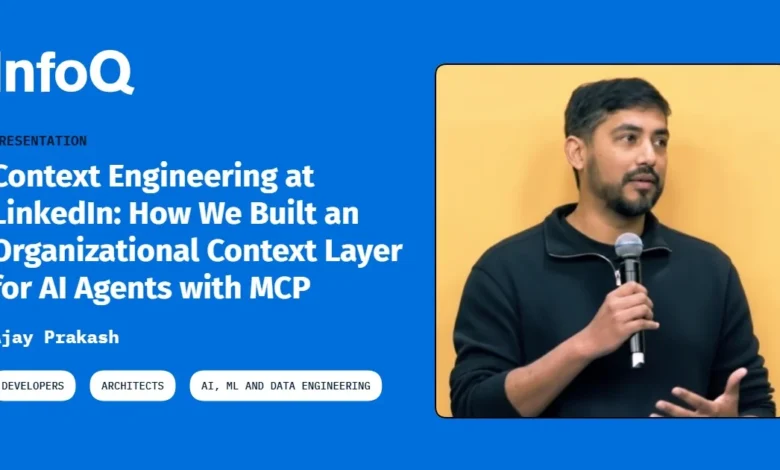
Context Engineering at LinkedIn: How We Built an Organizational Context Layer for AI Agents with MCP

As artificial intelligence begins to transition from experimental chatbots to autonomous agents capable of executing complex workflows, major technology organizations are facing a significant hurdle: the "context gap." LinkedIn, the world’s largest professional network, has recently addressed this challenge by developing a robust architectural framework known as Contextual Agent Playbooks and Tools. By leveraging the Model Context Protocol (MCP), the company has successfully integrated its internal, proprietary systems with AI coding assistants, enabling them to navigate the platform’s massive codebase and infrastructure with human-like precision.
The initiative represents a fundamental shift in how engineering teams manage productivity. Rather than relying on generic large language models (LLMs) that lack awareness of specific enterprise frameworks, LinkedIn has created a "procedural memory" layer. This system allows AI agents to act as highly knowledgeable coworkers, capable of debugging production incidents, executing migrations, and automating boilerplate code generation in minutes rather than hours.
The Evolution of Vibe Coding and the Context Wall
In early 2025, the industry witnessed a surge of interest in "vibe coding"—a concept popularized by researcher Andrej Karpathy. The premise suggested that developers could bypass traditional coding workflows by simply prompting agents to perform tasks, allowing the AI to manage terminal commands, file edits, and verification. While theoretically powerful, the practical application at a scale like LinkedIn’s proved difficult.
LinkedIn’s engineering stack is vast, comprising thousands of interconnected microservices, custom databases, and proprietary observability systems. New engineers typically undergo a week-long "bootcamp" to gain basic proficiency, and it often takes weeks more to achieve full productivity. When generic coding agents were introduced to this environment, they struggled significantly. Without access to the company’s internal tribal knowledge—stored in fragmented Slack threads, legacy wikis, and non-standardized documentation—agents frequently produced hallucinations or sub-optimal code. Engineers found themselves "babysitting" the AI, providing constant context, which negated the productivity gains that the technology promised.
Bridging the Gap with the Model Context Protocol
The turning point for LinkedIn arrived with the emergence of the Model Context Protocol (MCP), an open-source standard developed by Anthropic. MCP provided a standardized way for AI agents to connect with local and remote tools, effectively giving them a "window" into an organization’s internal systems.
LinkedIn’s engineering team utilized MCP to wrap their existing, highly sophisticated code search engine. By allowing agents to query this search tool, the AI could move beyond its pre-trained data and access live, current code snippets and file structures. This integration allowed agents to perform "tool calling," where they could iteratively search, read, and refine their understanding of the codebase. By extending this protocol to include access to feature flags, documentation wikis, and task management systems, LinkedIn effectively gave their agents the "sight" required to operate within the company’s unique ecosystem.
Procedural Memory: The Rise of Playbooks
Even with access to tools, complex tasks remained elusive. Agents often suffered from "context overload"—a phenomenon where the sheer volume of tool outputs exhausted the model’s limited context window, causing it to lose the thread of the task. To solve this, LinkedIn introduced "playbooks."
Playbooks serve as a form of procedural memory. They encapsulate specific, repeatable instructions on how to perform a task, such as setting up an Airflow pipeline or debugging a latency spike. These playbooks adhere to two design principles:
- Self-Containment: Each playbook handles one specific task, ensuring modularity.
- Composability: Larger, complex workflows are broken down into smaller, referenced playbooks, allowing for "progressive disclosure." The agent only loads the specific instructions it needs for a given step, preventing memory bloat.
This system has proven highly effective. When an agent is tasked with a problem, it can invoke the relevant playbook via MCP, receive the necessary instructions, and execute the task. If a playbook is outdated, the agents are designed to improvise using their broader toolset, identify the error, and—crucially—summarize their findings. This creates a "flywheel effect" where the system effectively maintains itself; the more the playbooks are used, the more they are updated with the latest institutional learnings.
Architectural Framework and Scalability
The architecture is built on a local MCP server installed on every LinkedIn developer’s machine. This server is auto-updated hourly, ensuring that when a team develops a new tool or playbook, it is immediately available to the entire organization. To maintain security, every tool undergoes a rigorous InfoSec review, and authentication is handled through a seamless OAuth flow that stores tokens in a secure, local keychain.
To address the performance degradation that occurs when an agent is exposed to hundreds of tools, LinkedIn implemented a search-based discovery system. Instead of loading every tool into the agent’s memory, the system provides only three entry points: a search tool, a schema retriever, and an execution tool. When an agent needs to act, it searches the catalog, selects the best fit, and pulls the relevant schema. This allows the platform to scale to thousands of playbooks without overloading the LLM’s context window.
Data-Driven Productivity Gains
Since the implementation of the MCP-based playbook system, LinkedIn has observed tangible results. Today, over 8,000 users—including not just software engineers, but also product managers and technical program managers—utilize these tools daily.
Key performance indicators show a roughly 20% increase in developer productivity. Importantly, this velocity has not come at the cost of reliability. Because the playbooks include built-in verification steps, the quality of code produced by agents remains high, and the platform’s overall system reliability has remained stable. The most common use cases include:
- Incident Investigation: Converting complex runbooks into executable playbooks.
- Boilerplate Automation: Eliminating manual setup for new services.
- Code Cleanup and Migrations: Automating large-scale refactoring tasks across thousands of repositories.
- Onboarding: Helping new engineers navigate the development environment.
Implications for the Future of Enterprise AI
The work being done at LinkedIn serves as a blueprint for other enterprises attempting to operationalize AI agents. The core takeaway is that the "agentic" era requires more than just high-quality models; it requires an "organizational context layer." Companies that fail to provide their AI agents with a secure, searchable, and modular understanding of their internal tribal knowledge will likely find that their agents remain expensive toys rather than productive employees.
Looking ahead, LinkedIn is focusing on the automation of the playbooks themselves. They are currently experimenting with background agents that analyze PR data and telemetry to identify common, repetitive workflows and automatically draft new playbooks. This shift towards self-optimizing infrastructure marks the next stage in the evolution of enterprise software development. By treating documentation and internal processes as "code" that agents can read and write, LinkedIn is building a future where the friction of organizational scale is significantly reduced, allowing engineers to focus on higher-level product innovation.
As other organizations observe these developments, the move toward standardized protocols like MCP seems inevitable. The ability to bridge the gap between abstract AI capability and concrete organizational reality is no longer a technical luxury—it is becoming a competitive necessity for any large-scale engineering operation.