Pinterest Surges Past 661 Million Monthly Active Users in Q3 2026 Driven by AI Integration and Resurgent European Growth


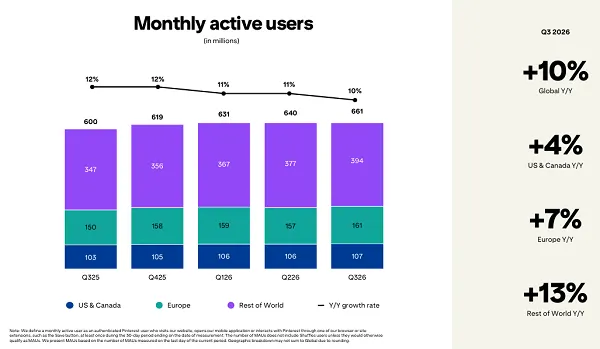
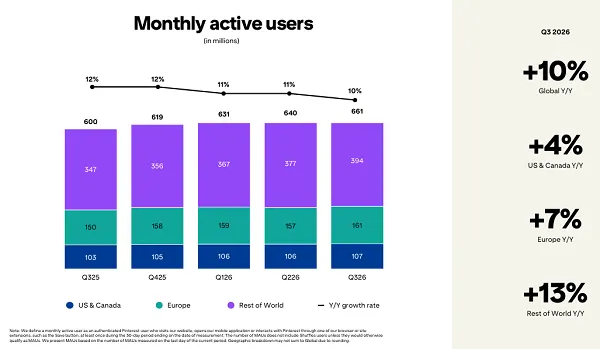
Pinterest’s financial and operational trajectory experienced a notable upward shift during the third quarter of 2026, showcasing robust metrics across user acquisition, global engagement, and quarterly revenue. According to the company’s official financial disclosures published on October 29, 2026, the visual discovery and social commerce platform successfully expanded its global footprint, welcoming 21 million net-new monthly active users (MAUs) compared to the preceding second quarter. This growth propelled Pinterest’s total global audience to an impressive 661 million MAUs, a testament to the platform’s enduring appeal in an increasingly crowded and competitive digital ecosystem.
The third-quarter results not only validate Pinterest’s ongoing pivot toward advanced artificial intelligence tools and refined content discovery algorithms, but they also highlight a crucial geographic turnaround. For market analysts, advertisers, and stakeholders monitoring the platform’s health, the latest earnings report offers a comprehensive look at how Pinterest is navigating complex regulatory landscapes, shifting demographic trends, and the double-edged sword of generative content in the mid-2020s.
Main Facts and Financial Performance
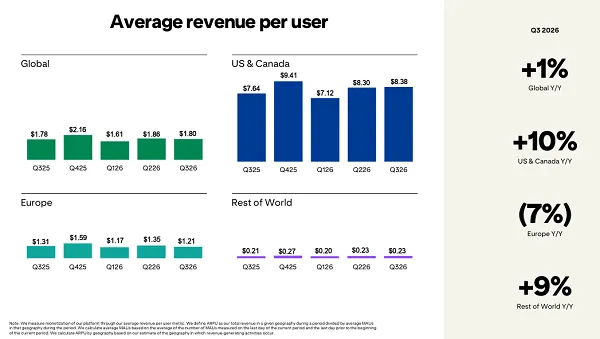
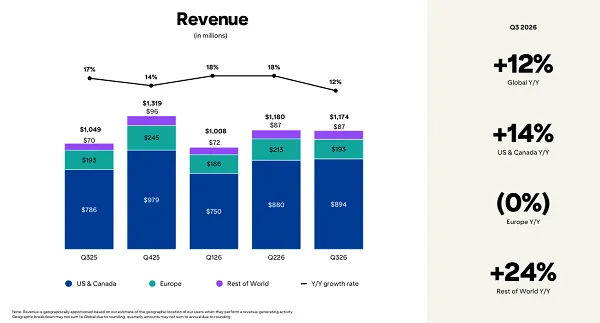
At the core of Pinterest’s Q3 2026 report is a solid financial performance marked by double-digit revenue growth. The company reported total revenue of $1.17 billion for the quarter, representing a 12% increase compared to the same period in the previous year. This revenue acceleration was led primarily by the North American market, where U.S. and Canada revenues climbed by 14% year-over-year.
However, international revenue growth faced unique headwinds. While user acquisition globally remained strong—particularly in the "Rest of World" category, which added 17 million users—European revenue growth was constrained. Pinterest’s executive leadership noted that international monetization was impacted by evolving regulatory changes across Europe that directly affected cross-border selling and digital advertising compliance. Despite these hurdles, the stabilization and subsequent upward trend of European user growth marked a critical victory for the platform. Over the past year, European user metrics had frequently stagnated or experienced slight contractions. Given that European and North American markets traditionally yield significantly higher Average Revenue Per User (ARPU) than developing regions, the resurgence of European engagement is vital for the company’s near-term financial health.
Furthermore, the platform’s user base continues to skew younger, with Generation Z now accounting for 57% of Pinterest’s total audience. In-app engagement metrics in core markets like the U.S. and Canada reflected this demographic vitality, showing heightened activity across search queries, board creation, and outbound click-through rates.
Chronology and Strategic Evolution
Pinterest’s journey to its Q3 2026 milestones has been shaped by a calculated, multi-year technological transformation. Over the past twenty-four months, the platform has systematically integrated artificial intelligence into its core discovery engines, shifting away from generic social media mechanics and doubling down on its identity as a productivity and visual planning tool.
In early 2025, Pinterest began laying the groundwork for improved ad relevance by expanding its data signals and incorporating them into broader AI-powered targeting frameworks. By the second quarter of 2026, these algorithmic refinements began bearing fruit, yielding visible improvements in user retention and ad performance.
Entering the third quarter of 2026, Pinterest rolled out several high-profile commercial and product initiatives. In September 2026, the company introduced visual search ads, allowing advertisers to embed contextual promotions directly into organic Pinterest search results and Pin close-ups. This launch was complemented by the expansion of its programmatic buying solutions across all operating regions, democratizing ad access for smaller brands and streamlining enterprise media buying.
Additionally, Pinterest has aggressively courted content creators through expanded monetization features. Brands can now officially sponsor creator Pins tied directly to commercial products. This creator-centric strategy extends beyond the digital application itself; Pinterest has continued to leverage its unique linear and streaming partnerships, including its dedicated program on Roku TV, where on-screen creators showcase shoppable items discovered directly within the app.
Supporting Data and Demographic Insights
A granular examination of the Q3 2026 data reveals several underlying trends that explain Pinterest’s current market positioning:
- Total Monthly Active Users (MAUs): Reached 661 million globally, following an addition of 21 million users from Q2 to Q3 2026.
- Regional Growth Distribution: The "Rest of World" segment accounted for 17 million of the newly acquired users, while Europe reversed its year-long stagnation to return to positive growth trajectories.
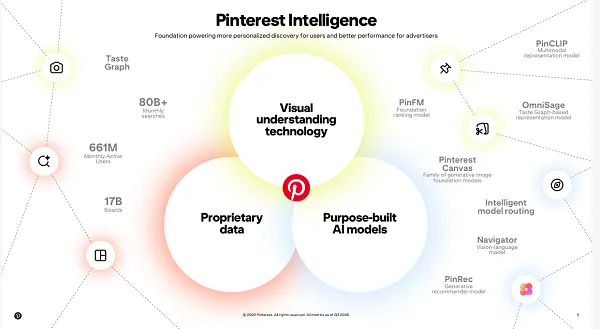
- Search and Intent Volume: Pinterest now facilitates more than 80 billion searches per month, underscoring the exceptionally high shopping and planning intent of its user base.
- Demographic Breakdown: Gen Z represents 57% of the platform’s total audience, demonstrating long-term generational viability as younger cohorts age into primary consumer demographics.
- Revenue Metrics: Total quarterly revenue reached $1.17 billion, a 12% year-over-year increase, paced by a 14% revenue jump in the U.S. and Canada.
Strategic Implications: Real-World Utility Versus Digital Fatigue
A defining narrative of Pinterest’s current strategy is its deliberate positioning as a complement to real-world experiences, rather than a platform designed to trap users in endless, passive scrolling loops. While competing platforms frequently prioritize algorithmic feeds optimized for maximum time-spent metrics, Pinterest has leaned into its utility-driven framework. Users visit the platform to plan weddings, remodel homes, design outfits, or organize recipes—actions that naturally translate into offline execution and high-intent commerce.
By aligning its AI updates strictly with visual discovery, search efficiency, and shopping utility rather than radical, unproven social experiments, Pinterest has avoided alienating its core user base. Industry analysts point out that this disciplined product roadmap is a primary reason why the platform continues to attract high-value brand partnerships.
Challenges on the Horizon: Managing the AI Content Wave
Despite the overwhelmingly positive financial and user growth metrics reported in Q3 2026, Pinterest—like virtually all major digital platforms—faces a complex moderating challenge regarding the proliferation of generative artificial intelligence.
In recent quarters, users and content creators have increasingly voiced concerns over an influx of low-quality, AI-generated content—often colloquially termed "AI slop"—clogging up search results and user feeds. Because Pinterest relies fundamentally on the aesthetic and practical integrity of its visual database, maintaining a high signal-to-noise ratio is critical. The platform is currently engaged in the delicate balancing act of utilizing sophisticated AI tools internally to drive ad relevance and search personalization, while simultaneously working to curb the overuse and low-quality spam stemming from external generative tools.
As Pinterest moves into the final stretch of 2026 and looks toward the crucial holiday shopping season, market observers will be watching closely to see whether management implements stricter content governance policies to safeguard the visual quality of its platform. If Pinterest can successfully police the boundaries of generative content while continuing to scale its programmatic buying solutions and international monetization, its Q3 performance may well serve as the launching pad for sustained, long-term digital commerce dominance.