On October 29, 1991, the National Aeronautics and Space Administration (NASA) achieved a monumental milestone in planetary exploration when the Galileo spacecraft executed a high-speed flyby of the asteroid 951 Gaspra. Located near the inner edge of the main asteroid belt, Gaspra became the very first asteroid in human history to be observed at close range by a spacecraft. This pivotal encounter served as a crucial scientific pitstop during Galileo’s ambitious, multi-year voyage toward Jupiter, fundamentally altering humanity’s understanding of small bodies within our solar system and laying the groundwork for decades of subsequent asteroid exploration.
The Road to the Asteroid Belt: Mission Background and Trajectory
The journey that led Galileo to Gaspra began years prior. NASA officially launched the Galileo mission on October 12, 1989, aboard the Space Shuttle Atlantis during the STS-34 mission. The primary objective of the spacecraft was to conduct a comprehensive, long-term study of Jupiter, its massive system of rings, and its diverse family of moons.
However, launching a heavy spacecraft directly to Jupiter using chemical propulsion alone was mechanically unfeasible at the time. To gain the necessary velocity to reach the outer solar system, mission planners designed a complex, indirect trajectory known as a gravity assist traverse, or the VEEGA (Venus-Earth-Earth Gravity Assist) path. Under this flight plan, Galileo used the gravitational pulls of Venus once (in 1990) and Earth twice (in 1990 and 1992) to slingshot itself deeper into space.
As part of this intricate dance, the spacecraft’s trajectory conveniently carried it through the main asteroid belt, a vast ring of rocky debris situated between the orbits of Mars and Jupiter. Recognizing a unique scientific opportunity, NASA mission controllers scheduled an encounter with asteroid 951 Gaspra, transforming an interim transit phase into a groundbreaking exploratory event.
The Encounter: Anatomy of a High-Speed Flyby
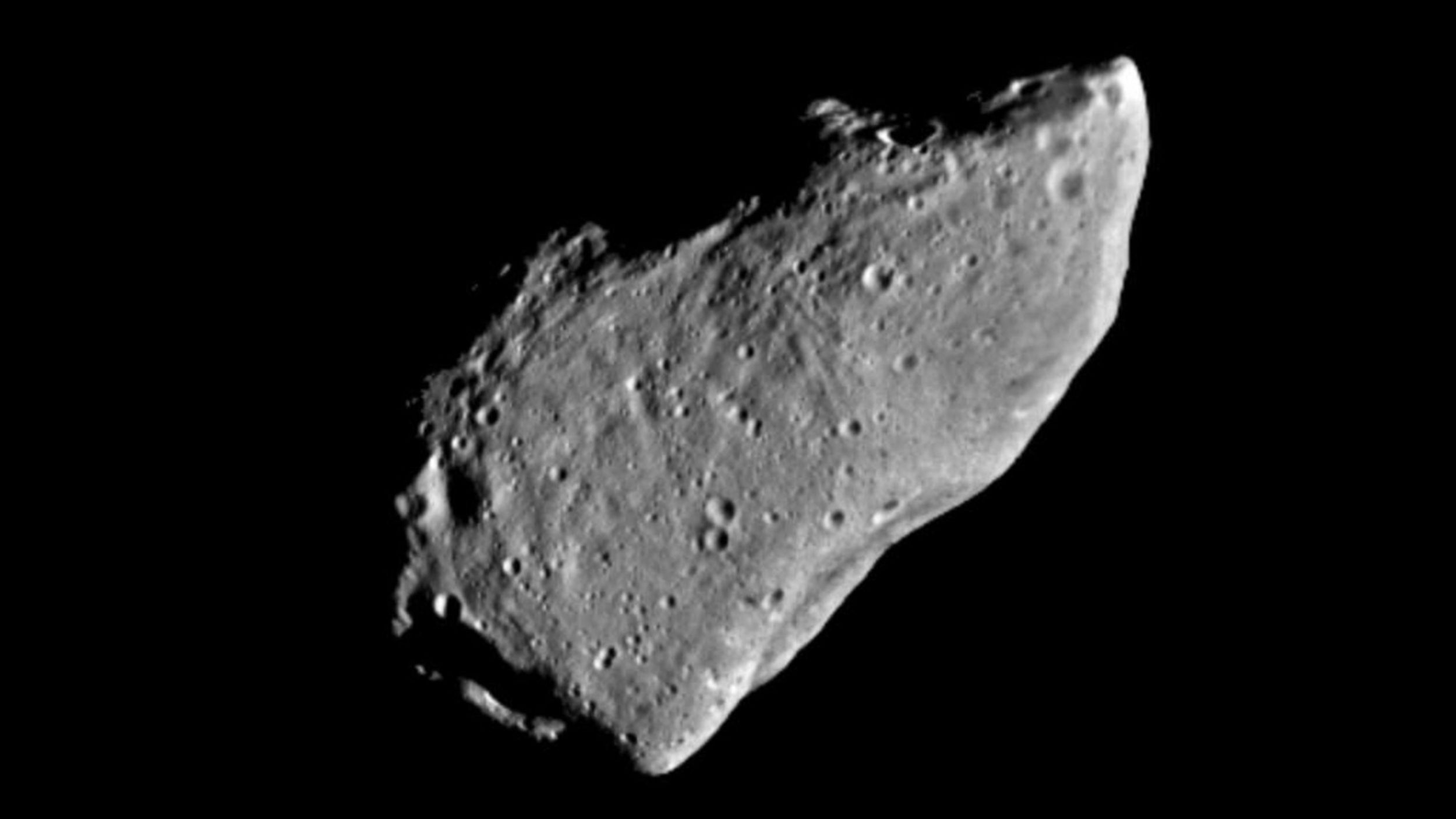
By October 1991, Galileo had been cruising through the asteroid belt for approximately two months. On the day of the encounter, the geometry of the flyby required exceptional precision from both the spacecraft and the ground control team at NASA’s Jet Propulsion Laboratory (JPL) in Pasadena, California.
At 22:37 Universal Time (UT) on October 29, 1991, Galileo made its closest approach to Gaspra. The spacecraft whizzed past the rocky body at a blistering relative velocity of approximately 5 miles per second (8 kilometers per second, or roughly 18,000 miles per hour). At its nearest point, Galileo was approximately 990 miles (1,593 kilometers) away from the asteroid’s irregular surface.
Because the spacecraft was traveling at such high speeds and maintaining a safe distance, Galileo was never captured by Gaspra’s negligible gravitational pull. Consequently, the probe was unable to directly measure the asteroid’s mass during the encounter—a limitation that would require future dedicated orbital missions to resolve for similar bodies. Nevertheless, the velocity and trajectory allowed the spacecraft to successfully execute its data-gathering sequence before continuing on its multi-year path to the Jovian system.
Scientific Discoveries: Unveiling the Face of Gaspra
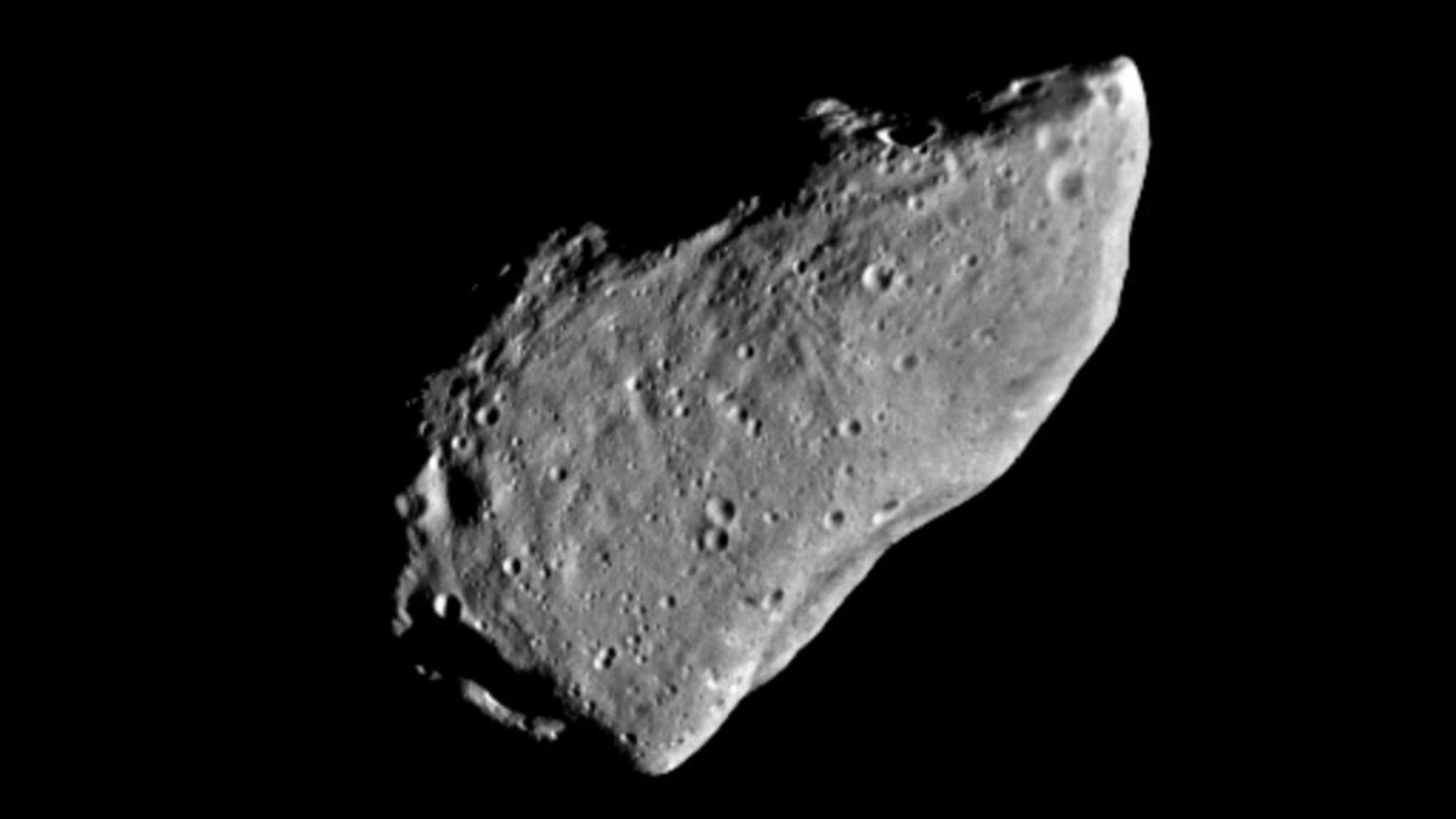
Despite the brief window of the flyby, Galileo’s onboard instruments gathered a wealth of unprecedented data. The spacecraft utilized its solid-state imaging camera system to capture a series of high-resolution photographs, while the Near-Infrared Mapping Spectrometer (NIMS) analyzed the asteroid’s mineralogy and chemical composition.
The returned data revealed that Gaspra was far from a uniform or spherical body. Instead, the images depicted an irregular, highly elongated asteroid measuring approximately 12.4 by 7.4 by 6.8 miles (20 by 12 by 11 kilometers). Its surface was heavily cratered, bearing the physical scars of ancient cosmic impacts, and was draped in a thin, superficial layer of regolith consisting of fine dust and rock rubble.
Spectral analysis conducted by the NIMS instrument indicated that Gaspra is an S-type asteroid, meaning it is composed primarily of silicate materials and nickel-iron metals. The high density of impact craters and the rugged topography provided researchers with tangible evidence regarding the violent evolutionary history of objects populating the inner asteroid belt.
Expert Insights and Contemporary Reactions
The scientific community greeted the transmission of Gaspra’s imagery with profound enthusiasm. For the first time, humanity was looking at a detailed, three-dimensional portrait of an asteroid rather than a blurry, pixelated radar return or a point of light in a telescope’s eyepiece.
"The picture we get of Gaspra is one of something that has suffered a lot during its history," noted Joseph Veverka, a member of the Galileo imaging team, during press briefings following the event, as reported by the UPI press service. "We suspect that this is the survivor of a series of catastrophic collisions in the past."
Planetary scientists inferred that Gaspra was likely a fragment of a much larger parent body that had been shattered by high-velocity impacts eons ago. The presence of numerous small craters, coupled with structural fractures visible across the asteroid’s elongated body, suggested a tumultuous geological past defined by continuous asteroid-on-asteroid violence.
Chronology of the Galileo Mission: Milestones and Surprises
The Gaspra flyby was merely the first chapter in a series of remarkable achievements for the Galileo spacecraft. A chronological overview of its extended mission highlights its groundbreaking contributions to space science:
- October 1989: Galileo is successfully launched from Earth aboard Space Shuttle Atlantis.
- February 1990: The spacecraft performs a gravity assist flyby of Venus.
- December 1990: Galileo executes its first Earth flyby, gaining critical orbital energy.
- October 29, 1991: Galileo flies past asteroid 951 Gaspra, marking the first asteroid flyby in history.
- December 1992: The probe performs its second and final Earth gravity assist.
- August 1993: Galileo flies by a second asteroid, 243 Ida, during which it makes the historic discovery of Dactyl, the first known natural satellite of an asteroid.
- July 1994: Positioned uniquely in the inner solar system, Galileo has a front-row seat to observe Comet Shoemaker-Levy 9 as its fragments violently impact Jupiter’s atmosphere.
- December 1995: After a six-year journey, Galileo arrives at Jupiter, entering orbit and deploying an atmospheric entry probe.
Broader Impact and Implications for Planetary Defense

The success of the Gaspra flyby fundamentally shifted the paradigm of planetary exploration. Prior to 1991, asteroids were largely theoretical objects studied exclusively through Earth-based telescopes and spectroscopy. Galileo proved that targeted flybys of small, fast-moving bodies were technically feasible, opening the floodgates for a new era of dedicated asteroid missions.
In the decades following Galileo’s historic encounter, space agencies around the world dramatically expanded their ambitions regarding small bodies. Notable successors inspired by these early milestones include:
- NEAR Shoemaker (NASA): Launched in 1996, this mission became the first spacecraft to orbit an asteroid (433 Eros) in 2000 and subsequently made a historic controlled landing on its surface in 2001.
- Hayabusa and Hayabusa2 (JAXA): Japan’s pioneering sample-return missions successfully traveled to asteroids Itokawa and Ryugu, respectively, collected pristine subsurface samples, and delivered them back to Earth for laboratory analysis.
- OSIRIS-REx (NASA): Following a successful multi-year mission to asteroid Bennu, NASA’s spacecraft returned a massive cache of carbonaceous asteroid material to Earth in 2023, offering clues about the origins of organic molecules in the solar system.
- DART (NASA): Demonstrating a critical application of planetary defense, the Double Asteroid Redirection Test mission intentionally impacted the moonlet Dimorphos in 2022, successfully altering its orbit and proving that humanity can deflect potentially hazardous near-Earth objects.
Legacy of a Cosmic Pioneer
Though the Galileo spacecraft’s mission officially ended on September 21, 2003, when NASA intentionally plunged the probe into Jupiter’s crushing atmosphere to protect its icy moons from biological contamination, its legacy endures.
The brief, high-speed glance at asteroid 951 Gaspra on October 29, 1991, transcended its immediate role as an engineering test during a complex interplanetary journey. It transformed obscure points of light in the night sky into dynamic, physical worlds with distinct histories, geologic features, and chemical compositions. By taking that first bold step into the asteroid belt, Galileo paved the way for modern planetary science, transforming our understanding of the building blocks that formed our solar system more than 4.5 billion years ago.