Microsoft Sovereign Cloud Evolves to Provide Comprehensive Control for Regulated Industries and Government Agencies

The global landscape for digital infrastructure is undergoing a fundamental transformation as governments, critical infrastructure providers, and heavily regulated industries navigate the dual pressures of accelerated artificial intelligence adoption and increasingly stringent data sovereignty requirements. As these organizations integrate advanced cloud capabilities into public services and essential operations, the traditional "one-size-fits-all" cloud deployment model is being replaced by a more nuanced, workload-specific approach. Microsoft, responding to these shifting geopolitical and regulatory mandates, is significantly expanding its Microsoft Sovereign Cloud offerings to provide a continuum of control that bridges the gap between public cloud scale and the stringent operational autonomy required by national security and high-stakes data environments.
The evolution of this strategy marks a critical pivot in how hyperscale providers engage with the public sector. Organizations are no longer merely asking where their data resides; they are demanding granular visibility into who accesses their systems, how sensitive digital assets are protected, and whether their critical services can withstand network, geopolitical, or regulatory disruptions.
The Chronology of Sovereign Cloud Strategy
The concept of digital sovereignty has moved from a niche regulatory concern to a central pillar of corporate and governmental IT strategy over the past twenty-four months. In late 2023, Microsoft formally introduced the Microsoft Sovereign Cloud, a framework designed to assist public sector customers in meeting local compliance and data residency requirements while still utilizing the innovations of the Azure platform.
This launch served as a response to the growing fragmentation of global digital policy, characterized by the European Union’s GDPR, the U.S. government’s tightening of cybersecurity frameworks for federal contractors, and emerging AI governance legislation. Since that introduction, the company has transitioned from high-level commitments to the deployment of tangible technical capabilities. The latest phase, unveiled as part of the lead-up to the Microsoft Ignite conference, expands these capabilities into customer-operated environments, effectively blurring the lines between public cloud, private cloud, and partner-managed infrastructure.
A Workload-Centric Continuum
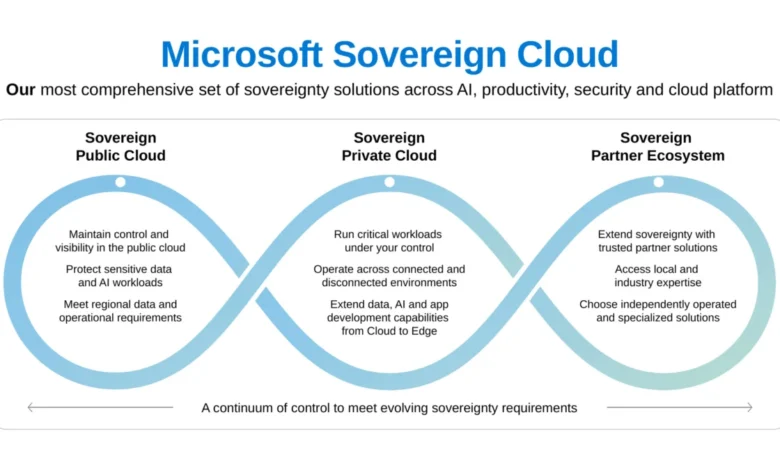
The core innovation of the current strategy is the abandonment of the binary choice between "public cloud" and "on-premises." Instead, Microsoft is promoting a "continuum of control" that allows administrators to define the security posture of a workload based on its sensitivity.
Under this model, a public-facing municipal information portal might continue to reside in the public cloud to leverage massive scalability and rapid deployment cycles. Conversely, a classified intelligence application or a system managing the power grid could be hosted in a "Sovereign Private Cloud" environment, which allows for fully disconnected operations—ensuring that critical infrastructure remains functional even in the event of a total internet blackout or cross-border connectivity failure.

Enhancing Visibility in the Sovereign Public Cloud
A significant hurdle for government agencies has been the "black box" nature of cloud operator access. To address this, the new Sovereign Control Panel acts as a centralized dashboard, providing a unified view of an organization’s sovereignty posture. By aggregating signals related to data residency, encryption, and operator activity, the panel allows administrators to identify policy gaps and simulate the impact of regulatory changes before they occur.
Furthermore, Microsoft has introduced more rigorous controls regarding "who" can access data. The expansion of the Production Touch Ledger and the implementation of Data Guardian services—specifically for EU and EFTA customers—represent a landmark shift. These services allow for European-resident oversight of remote access requests by Microsoft engineers. By creating tamper-evident, auditable records of every administrative action, the company is attempting to satisfy the stringent transparency requirements mandated by European regulators, effectively turning the cloud provider into a supervised entity rather than a monolithic operator.
Technical Hardening and Data Protection
Data protection has evolved beyond simple encryption at rest. The integration of external key management with Azure Managed HSM (Hardware Security Module) enables organizations to maintain the "root of trust" entirely outside of Microsoft’s infrastructure. This means that even if a customer’s cloud environment were fully compromised, the encryption keys remain in physical hardware controlled by the customer, rendering the data inaccessible to unauthorized parties.
In the realm of Artificial Intelligence, the introduction of Azure Confidential Clean Rooms represents a significant technological leap. By utilizing hardware-based trusted execution environments, these clean rooms allow multiple organizations to analyze shared, sensitive data sets—such as medical records or cross-border intelligence—without exposing the underlying raw data to any participant, including the cloud provider. This capability is expected to unlock collaborative research opportunities that were previously deemed too high-risk for cloud-based execution.
Operational Independence and the Sovereign Private Cloud
For critical infrastructure, the ability to operate independently of the public internet is not a luxury; it is a security requirement. The "Sovereign Private Cloud," built upon the foundation of Azure Local, has been enhanced to include SQL Server, DocumentDB, and Blob Storage, allowing for a near-parity experience with public cloud services in a disconnected state.
Perhaps most significantly, the inclusion of GitHub Enterprise Local and Foundry Local enables development teams to keep their entire software supply chain—from code repositories to AI model inference—within a local environment. This prevents the "leakage" of proprietary code or sensitive training data during the development process. By supporting local inference for AI models, Microsoft is enabling organizations to deploy agentic retrieval systems that can interact with internal data sets without the information ever leaving the client’s firewall.
The Role of the Sovereign Partner Ecosystem
Recognizing that technology alone cannot solve the complex matrix of local law and national security, Microsoft has formalized its "Sovereign Partner Ecosystem." This network includes major systems integrators like Accenture and Capgemini, as well as specialized providers like Bleu (France) and Delos Cloud (Germany).

These partnerships are vital for "Platform Co-innovation," where hardware providers such as Intel, AMD, and NVIDIA work alongside software developers to ensure that the physical infrastructure—the servers, the silicon, and the networking gear—is as secure as the software running on top of it. By leveraging local expertise, Microsoft can adapt its global platforms to satisfy local nuances, such as specific national cryptographic standards or unique data localization laws that vary significantly from country to country.
Analytical Implications: The Shift Toward Distributed Sovereignty
The implications of this strategy are profound. For the technology sector, it signals an end to the era of global, undifferentiated cloud services. The market is trending toward "Distributed Sovereignty," where the cloud provider acts as a software and API layer, but the customer retains ultimate sovereignty over the physical, operational, and administrative layers of their infrastructure.
From a macroeconomic perspective, this shift may lower the barrier to entry for governments to adopt high-performance AI. Previously, many public institutions were paralyzed by the legal risk of moving sensitive data to a hyperscale cloud. By offering a "sovereign-first" migration path, Microsoft is effectively creating a new market for AI-powered public services that are compliant with local laws, thereby potentially accelerating the digitalization of the public sector by several years.
However, this complexity introduces new challenges. Managing a hybrid, multi-cloud, and multi-local environment requires a level of IT sophistication that many public sector agencies currently lack. The success of the Sovereign Cloud will depend not just on the robustness of the technology, but on the ability of the partner ecosystem to bridge the skills gap.
Conclusion
The next chapter of digital sovereignty is defined by the integration of AI into the very core of our most sensitive systems. Microsoft’s focus on a "continuum of control" suggests a recognition that the future of cloud computing will be as much about control and exclusion as it is about connectivity and inclusion. As agencies worldwide move to modernize their aging infrastructure, the ability to selectively apply high-trust, high-control mechanisms to sensitive workloads will be the deciding factor in which digital transformation initiatives succeed. By aligning technical capability with the political reality of a fractured, security-conscious world, the company is positioning itself to remain the backbone of the public sector’s digital future, provided it can maintain the delicate balance between innovation and autonomy.