How macOS 27 Quietly Restores the Ability to Check Your Mac’s Exact Manufacture Date

For several years, finding out the exact manufacturing date of a Mac has been a surprisingly frustrating endeavor for tech enthusiasts, IT administrators, and prospective buyers alike. Following a major security and supply chain overhaul implemented by Apple in 2021, the company began issuing randomized serial numbers across its entire hardware lineup, effectively wiping out the hidden date and factory indicators historically embedded within those alphanumeric strings. However, with the public rollout of macOS 27—also widely known as macOS Golden Gate—Apple has quietly restored a native method for users to determine when their machine was manufactured, bypassing the need for third-party lookup tools or decoded serial formats.
Discovering the New Manufacture Date Feature
The newly discovered feature was initially brought to light by sharp-eyed members of the MacRumors online community during the macOS 27 beta testing cycle. Quietly slipped into the operating system without any formal announcement or spotlight from Apple’s marketing or engineering teams, the data point is embedded directly within the system’s regulatory documentation menus.
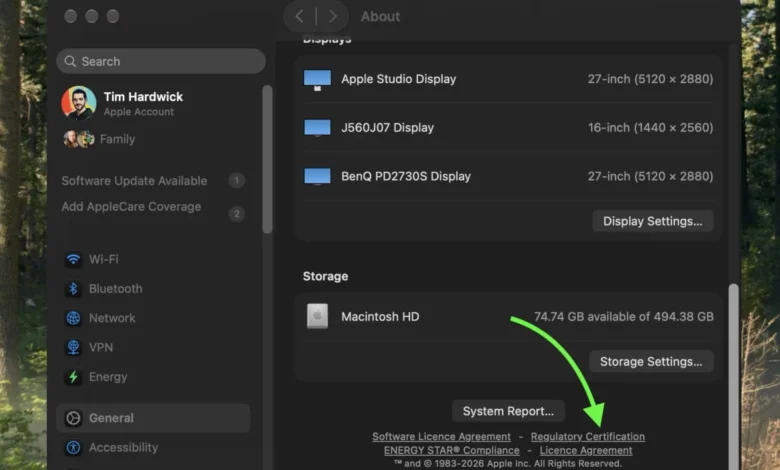
To access the manufacture date on a compatible Mac running macOS 27, users must navigate through a simple series of menu prompts. By opening the Apple menu in the top-left corner of the screen, selecting System Settings, navigating to General, and then clicking on About, users are presented with an overview of their system specifications. Near the bottom of this pane lies a button labeled System Report, accompanied by a separate link titled Regulatory Certification. Clicking on the Regulatory Certification link opens a digital compliance window. At the very bottom of this certificate, users will now find a newly added field explicitly stating the "Date of Manufacture."
While the feature is a welcome addition for anyone curious about the precise age of their hardware, early community findings suggest a minor nuance regarding what the date actually represents. According to discussions among users who have tested the feature, the date displayed on the certificate appears to tie directly to the specific logic board installed in the machine rather than the date the complete hardware unit was fully assembled on a factory line. In instances where a Mac had undergone a formal hardware repair resulting in a logic board replacement, the listed manufacture date updated to reflect the timeline of the newly swapped component. This indicates that the data field reads the programming stored within the logic board’s firmware or security enclave, offering a precise indicator of core hardware component age rather than final factory boxing.
The 2021 Shift to Randomized Serial Numbers
To understand why this quiet software addition is generating considerable interest within the Apple community, it is necessary to examine the history of Apple’s device identification practices. For decades, Apple utilized a structured, highly predictable format for the serial numbers assigned to Macs, iPhones, iPads, and other accessories.
In the classic serialization era, a device’s serial number was a trove of information. By examining specific characters within the string, users, technicians, and aftermarket resellers could reliably decode the manufacturing facility location, the year of production, and the exact week of manufacture. For instance, a sequence might immediately reveal whether an iMac rolled off an assembly line in Shenzhen, China, during the third week of November.
This transparency offered significant practical advantages. Buyers purchasing used hardware could easily verify the age of a device to ensure it aligned with a seller’s claims. Independent repair shops and enterprise IT departments could quickly triage warranty statuses, evaluate hardware lifecycles, and plan equipment refresh cycles without querying proprietary internal databases.
However, in May 2021, Apple fundamentally altered this landscape. Ahead of the release of the purple iPhone 12, Apple transitioned to a randomized serial number format. Rather than utilizing structured, data-dense strings, the company adopted completely random alphanumeric sequences designed to obscure production locations, manufacturing dates, and batch volumes.
Apple’s official rationale for the shift centered on privacy, anti-counterfeiting, and supply chain security. Predictable serial numbers made it easier for counterfeiters to duplicate legitimate identifiers and apply them to fraudulent hardware clones. Furthermore, fixed serialization formats presented minor telemetry tracking risks, allowing sophisticated actors to analyze manufacturing velocity and supply fluctuations simply by observing shifting serial ranges over time.
By randomizing the characters, Apple successfully thwarted counterfeiters and enhanced supply chain confidentiality. The trade-off, however, was a total loss of visibility for the end user. For subsequent generations of Apple Silicon Macs, determining the exact age of a machine became an exercise in guesswork, forcing users to rely on the date of a model’s initial product announcement or complex analytical tools that estimated manufacturing windows based on operating system pre-installations.
Implications for the Secondary Market and Enterprise IT
The return of a native manufacturing date in macOS 27 carries meaningful implications for several distinct groups, most notably the secondary hardware market, enterprise device management, and everyday consumers.
In the thriving ecosystem of pre-owned and refurbished Macs, verifying the exact age of a device directly influences its market valuation. When buying or selling a used MacBook Pro or Mac Studio, knowing whether a machine was manufactured six months ago versus three years ago dictates pricing, expected battery health longevity, and remaining support windows. While system specifications like processor tiers and RAM allocations have always been easily accessible in About This Mac, the exact temporal age of the chassis and core components has been obscured for years. With the regulatory certification menu now laying out the manufacture date, buyers gain a built-in verification tool that requires no external software or dubious third-party websites.
For enterprise IT administrators managing fleets of hundreds or thousands of Apple computers, the new feature simplifies hardware lifecycle management. Large organizations typically operate under strict deprecation and replacement schedules, phasing out computers once they cross a specific age threshold to mitigate security vulnerabilities and performance degradation. While enterprise Mobile Device Management (MDM) solutions often pull hardware telemetry automatically, having a standardized, easily verifiable field within the native macOS interface provides an additional layer of auditing capability for system administrators during manual equipment checks.
Broader Software Ecosystem Context: A Major Autumn for Apple
The arrival of macOS 27 and its hidden regulatory documentation updates coincides with one of the busiest software release cycles in Apple’s recent history. The debut of macOS Golden Gate arrives alongside simultaneous rollouts for iOS 27, iPadOS 27, watchOS 27, tvOS 27, and visionOS 27.
Apple’s primary technological narrative throughout this software cycle has centered heavily on advanced artificial intelligence integration. Alongside under-the-hood adjustments like the newly discovered manufacture date checker, macOS 27 and iOS 27 introduce sophisticated AI architectures, including upgraded Siri capabilities and deep backend frameworks designed to support modular third-party AI models such as Anthropic’s Claude and OpenAI’s ChatGPT.
Because Apple’s engineering teams have been intensely focused on deploying these major systemic architectural shifts, smaller quality-of-life adjustments—such as the unannounced inclusion of the manufacture date within regulatory certificates—have largely bypassed corporate press releases, leaving community sleuths to map out the hidden changes.
Looking Ahead
As macOS 27 rolls out to the general public, the discovery of the manufacture date field serves as a reminder of Apple’s complex balancing act between privacy, security, and user transparency. While the company remains firmly committed to randomized serial numbers to protect its manufacturing supply chains and deter counterfeiters, the inclusion of a date field within regulatory compliance menus offers a pragmatic compromise. It satisfies user curiosity and aids device management without compromising the cryptographic obscurity of the device’s external identifier.
For Mac users eager to find out precisely when their machine was built, the process no longer requires deciphering cryptic codes or navigating obscure databases. A few simple clicks through the system settings will reveal the exact timeline, marking a quiet victory for hardware transparency in the modern era of Apple Silicon.
Related posts: