White House Staff Devices Unwittingly Open Executive Office Network to Global Renters Through Residential Proxy Services

Security researchers have uncovered a troubling digital vulnerability within the highest echelons of the United States government, revealing that multiple computers and mobile devices belonging to White House staffers are actively utilizing residential proxy services. This misconfiguration inadvertently turns secure government endpoints into commercial exit nodes, allowing external users worldwide to rent the IP addresses assigned to the Executive Office of the President.
The alarming discovery places high-value government infrastructure at the mercy of anonymous third-party renters, raising urgent questions regarding endpoint security, employee adherence to IT policies, and the systemic risks posed by commercial proxy networks. Among the services detected operating within the secure network is Infatica, a proxy provider founded by a Russian national whose past business ventures have been linked to state-sponsored cyberattacks against U.S. election databases.
Detection and Scope of the Breach
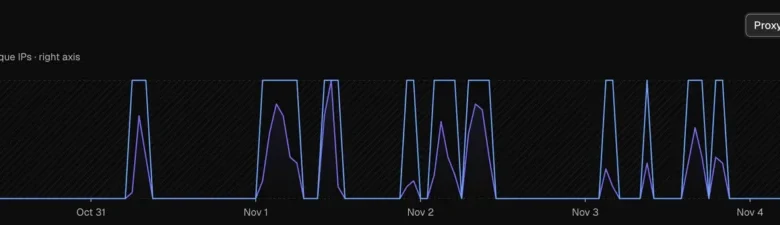
The unauthorized proxy activity came to light after cybersecurity firms Layer3 Intel and Synthient independently monitored anomalous traffic originating from the dedicated internet address block reserved for the Executive Office of the President, designated as Autonomous System 2650 (AS2650).
According to telemetry data released by Layer3 Intel, the proxy activity was remarkably persistent, occurring between October 5 and November 3. A comprehensive audit of the proxies available from the AS2650 network revealed that they successfully exited from the White House environment on 236 separate occasions across this period. Analysts noted that the exit nodes manifested across six distinct internet addresses, appearing on 26 of the 30 monitored days. Intriguingly, the vast majority of this traffic concentrated in the evening hours, specifically between 5:00 p.m. and midnight, suggesting personal device usage after standard working hours or remote access scenarios.
Synthient further pinpointed the nature of the software driving the exposure, linking the AS2650 traffic to multiple Windows 11 installations running Infatica. Infatica is a commercial proxy utility frequently bundled into ostensibly "free" mobile applications and desktop software via software development kits (SDKs). By integrating these SDKs, developers monetize user traffic, while network operators route third-party traffic through the host’s residential or corporate IP address.
Most startlingly, Layer3 Intel’s investigation revealed that Infatica was not an isolated anomaly. Security analysts discovered that a staggering 28 separate residential proxy services were capable of routing their traffic through the White House network.
"This is public access," the Layer3 Intel research team wrote in a detailed technical breakdown. "Anybody can obtain it by signing up to a public residential proxy service, paying a few dollars and sending requests through it. We did not selectively target this network or try to make our probes exit from it. We caught this by chance, simply by requesting global rotating access through these services."
The Russian Connection and Historical Precedents
The involvement of Infatica introduces severe geopolitical and counterintelligence dimensions to the incident. Infatica was founded by Vladimir Fomenko, a Russian entrepreneur whose previous web hosting enterprise, King Servers, played a central role in high-profile cyber espionage operations during the 2016 U.S. presidential election cycle.
During the 2016 investigations, federal cybersecurity investigators determined that King Servers acted as the infrastructure backbone for malicious actors tied to Russian state security services. Specifically, six of the eight internet addresses utilized to compromise and breach voter registration databases in Arizona and Illinois were traced directly back to Fomenko’s hosting firm.
While there is no immediate evidence that Infatica’s current proxy operations within the White House are being directly leveraged by foreign intelligence services, cybersecurity experts warn that the architecture of residential proxy networks inherently strips away operational security. Because these platforms often lack rigorous Know Your Customer (KYC) vetting procedures, foreign intelligence operatives, cybercriminal syndicates, and fraudsters can easily purchase access to high-value networks for pennies on the dollar.
Ben Brundage, founder of the proxy tracking firm Synthient, highlighted the alarming affordability and accessibility of these networks in an interview with KrebsOnSecurity. "Some of these resellers sell bandwidth for as low as 60 cents a Gigabyte, that means for less than a dollar you can gain access into some of the most confidential and trusted networks," Brundage stated, emphasizing that lax verification standards allow malicious actors to seamlessly penetrate sensitive environments.
Mechanics and Risks of Residential Proxies
Residential proxy networks operate by transforming consumer and corporate internet connections into commercial relay stations. When a user installs an application containing a monetized SDK, their device joins a vast, distributed botnet-like infrastructure. Customers of the proxy service—ranging from legitimate market research firms to malicious hackers—can then route their web traffic through these residential IP addresses.
To any target website or digital service, the incoming traffic appears to originate from the proxy host’s location, effectively masking the true identity and geographic origin of the customer. While useful for legitimate tasks such as web scraping, ad verification, and regional testing, these networks are frequently exploited for cybercrime, including account takeover attacks, credential stuffing, digital ad fraud, and large-scale data harvesting to train artificial intelligence models.
Beyond traffic anonymization, residential proxies introduce catastrophic local network security risks. In late 2025 and early 2026, threat intelligence firms exposed widespread vulnerabilities within proxy software architectures. Cybercriminals actively weaponized these flaws to perform internal network reconnaissance, probing proxy endpoints for vulnerable systems to infect with malware. In January 2026, numerous proxy providers were forced to issue emergency patches after researchers demonstrated how malicious botnets, such as the Kimwolf botnet, could leverage residential proxy nodes to commandeer internal devices connected to the same local network.
A Systemic Epidemic Across Government and Corporate Infrastructure
The exposure at the White House is emblematic of a much broader, systemic cybersecurity failure affecting high-security institutions worldwide. Because employees frequently blur the lines between personal and professional technology—bringing mobile devices into secure offices, connecting personal laptops to corporate Wi-Fi, or installing unsanctioned software applications—residential proxy SDKs routinely infiltrate protected perimeters.
Data from industry trackers underscores the magnitude of the threat. In a comprehensive webinar conducted in January 2026, proxy tracking service Spur revealed the staggering presence of residential proxies across critical infrastructure: researchers identified active proxy nodes within nearly 300 government-owned and operated networks, 318 public utility companies, 166 healthcare organizations and hospitals, and 141 financial and banking institutions.
Furthermore, enterprise security firm Infoblox published findings earlier this year indicating that an astonishing 65% of its corporate customer base had internal devices querying domains associated with residential proxy networks.
Broader Implications and Official Response
As of press time, the White House has not issued an official response or comment regarding the Layer3 Intel and Synthient findings.
The incident exposes critical gaps in mobile device management (MDM) and endpoint security policies within the Executive Office of the President. Analysts emphasize that standard network firewalls and perimeter defenses are often blind to residential proxy traffic, as the connections frequently mimic standard, encrypted HTTPS traffic routed through legitimate cloud infrastructure.
Mitigating this threat requires rigorous enforcement of device hygiene, stricter implementation of Zero Trust Architecture (ZTA), and comprehensive application whitelisting that bars employees from installing unvetted third-party applications on devices connected to sensitive government networks. Without aggressive remediation, the convenience of consumer software applications will continue to provide an open, inexpensive backdoor into the world’s most heavily guarded digital domains.
Related posts: