Uber Eats Enhances Restaurant Discovery with Real-Time User Signals and Listwise Ranking System

Uber Eats has rolled out significant updates to its restaurant recommendation system, integrating real-time user signals and a sophisticated listwise ranking approach designed to dramatically improve food discovery for its vast user base. This technological overhaul aims to better reflect immediate user intent during active browsing sessions, while simultaneously boosting ranking efficiency across a wide array of candidate restaurants. The refined system is now fully deployed within the Uber Eats platform, enhancing critical discovery surfaces such as the homepage feeds.
The imperative for such an advanced recommendation system stems from the hyper-competitive landscape of the food delivery industry, where user experience, retention, and satisfaction are paramount. In an era dominated by on-demand services, the ability to quickly and accurately present users with appealing options directly correlates with engagement and transaction volume. Older, less dynamic recommendation engines, often relying on batch processing, struggled to keep pace with rapidly changing user preferences or immediate contextual cues. These systems typically processed user data periodically, leading to recommendations that might be hours, or even a full day, behind a user’s most recent interactions. As a result, a user searching for "pizza" in the morning might still see "sushi" recommendations based on their last night’s order, failing to capture their current desire.
The Shift to Real-Time Personalization
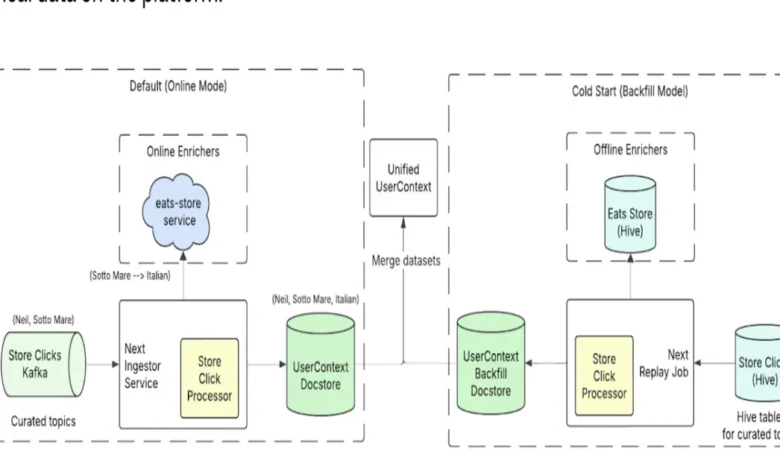
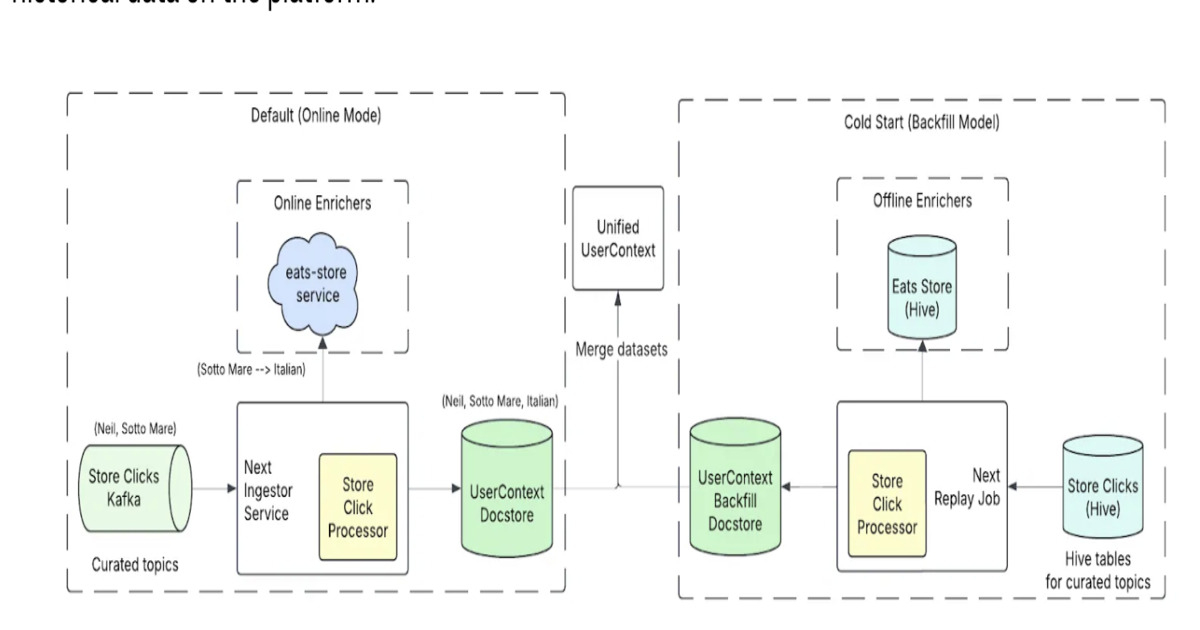
A cornerstone of Uber Eats’ updated architecture is the replacement of these earlier batch-oriented feature pipelines with a cutting-edge real-time signal processing layer. This innovative layer continuously ingests and analyzes user interactions – including clicks, searches, filters applied, items viewed, and even recent order history – to maintain an exceptionally up-to-date representation of user behavior. By transitioning to near-real-time feature updates, the system drastically reduces the latency between a user’s actions and the resulting personalization outcomes. This allows recommendations to adapt almost instantaneously to evolving preferences within a single browsing session, creating a far more responsive and intuitive experience. For instance, if a user initially browses for Italian food but then switches to searching for "vegan options," the system can pivot its recommendations immediately, rather than waiting for a daily data refresh.
This real-time capability is critical in the fast-paced world of food delivery, where momentary cravings and situational factors (like weather, time of day, or social context) heavily influence dining choices. Studies consistently show that highly personalized experiences can increase conversion rates significantly, sometimes by as much as 20-30%, and boost customer loyalty. For a platform operating at the immense scale of Uber Eats, with millions of users and hundreds of thousands of restaurants globally, even marginal improvements in personalization can translate into substantial business impact.
Leveraging Listwise Ranking for Contextual Relevance
Beyond real-time signals, Uber’s recommendation stack now incorporates a sophisticated listwise ranking approach. Traditionally, many recommendation systems evaluate restaurant candidates individually, assigning an independent score to each based on its perceived relevance to the user. Listwise ranking, however, takes a more holistic view, evaluating multiple restaurant candidates together in a single inference step. This allows the model to optimize the relative ordering across a set of options, understanding how each restaurant compares to others within the same context.
This method offers several key advantages. Firstly, it enhances computational efficiency by processing a group of items simultaneously, rather than sequentially. Secondly, and more importantly, it significantly improves ranking quality by enabling direct comparisons among candidates. The model can learn not just "is this restaurant good for this user?" but "is this restaurant better for this user than these other options when presented together?" This contextual awareness is vital for delivering a curated and diverse selection that feels genuinely personalized, rather than just a collection of individually highly-rated but potentially redundant options. It helps prevent scenarios where a user might be shown ten very similar burger joints when they might prefer a mix of cuisines or different types of dining experiences.
Architectural Evolution and Technical Underpinnings
The foundation of this advanced system rests on a unified representation of user behavior, seamlessly combining short-term session activity with longer-term historical signals. These diverse signals are processed through a shared feature extraction layer, a critical component that ensures consistency between offline training environments and online serving. This consistency is paramount for reliable model performance; it guarantees that models trained on vast historical data behave predictably and effectively when deployed live in production.
Training data for the system is meticulously generated by replaying historical user sessions. This simulation of production environments helps to minimize discrepancies between how the model is trained and how it performs during live inference, a common challenge in large-scale machine learning deployments known as "training-serving skew."
Yicheng Chen, an Engineer at Uber, highlighted the profound technical evolution behind the system, stating, "Leveraging near real-time user sequence features and a Generative Recommender-style model to power Uber Eats Home Feed recommendations and evolved the homefeed ranking from hand-crafted statistical features to transformer-based sequence modeling, cut feature freshness from 24 hours to seconds." This statement underscores a significant leap from traditional, manually engineered statistical features to more advanced, AI-driven transformer-based sequence modeling, which can better capture complex temporal patterns and relationships in user behavior. The reduction in feature freshness from 24 hours to mere seconds represents a paradigm shift in responsiveness and accuracy.
On the infrastructure side, the system has been meticulously engineered to meet the stringent low-latency constraints inherent to consumer-facing recommendation surfaces. To achieve optimal efficiency and scalability under immense traffic loads, feature preprocessing and model inference operations are strategically separated. This architectural design allows the serving layer to concentrate solely on the rapid ranking of restaurants, while upstream services manage the computationally intensive tasks of feature computation and aggregation. This modular approach ensures that the system can handle peak demand without compromising performance.
Strategic Vision: Balancing Scale, Diversity, and Intent
Brinda Panchal, Product @ Uber, articulated the broader strategic goal of this system, emphasizing, "Personalizing a marketplace at this scale isn’t just about showing ‘good food’—it’s about balancing real-time intent, diverse merchant ecosystems, and complex ranking objectives to create a seamless discovery experience." This statement encapsulates the multifaceted challenge faced by a platform like Uber Eats.
/filters:no_upscale()/news/2026/05/uber-eats-ranking-system/en/resources/1uberrecommendation-1779039608382.jpeg)
Achieving this balance involves several critical considerations:
- Real-time Intent: The system must accurately infer and respond to a user’s immediate desires, which can be fleeting and context-dependent. This means understanding not just what a user likes generally, but what they want right now.
- Diverse Merchant Ecosystems: A healthy marketplace requires supporting a wide array of restaurants, from popular chains to niche local eateries. The recommendation system must avoid a "rich-get-richer" dynamic where only the most popular restaurants are consistently shown, potentially stifling smaller businesses. Instead, it needs to strategically introduce variety and discovery, ensuring that new or less-known restaurants also have opportunities to connect with relevant customers. This benefits both users (more choices) and merchants (fairer access to the customer base).
- Complex Ranking Objectives: "Good food" is subjective and multifaceted. Ranking objectives extend far beyond simple popularity or cuisine type. They might include optimizing for delivery time, promoting new restaurants, ensuring geographical proximity, considering restaurant capacity, dietary restrictions, price point, order completion rates, and even the platform’s own strategic goals (e.g., promoting a new feature or partnership). The listwise ranking system, with its ability to evaluate multiple factors simultaneously, is particularly well-suited to navigate these complex, often conflicting, objectives.
Implications for Users, Restaurants, and the Industry
The deployment of this advanced recommendation system carries significant implications across the Uber Eats ecosystem and the broader food delivery industry.
For users, the immediate benefit is a vastly improved discovery experience. They can expect more relevant, dynamic, and satisfying food recommendations that adapt quickly to their evolving preferences. This reduces the "paradox of choice" where an overwhelming number of options can lead to decision fatigue. Instead, users are presented with a curated selection that feels intuitive and helpful, increasing the likelihood of finding new favorites and reducing the time spent browsing. This enhanced personalization contributes directly to higher user satisfaction and engagement.
For restaurants, particularly those beyond the top-tier chains, this system offers increased visibility and a more equitable opportunity to connect with customers whose real-time intent aligns with their offerings. By dynamically matching users with suitable merchants, the system can drive more targeted customer acquisition, potentially boosting orders for a broader range of eateries. This fostering of a diverse merchant ecosystem is crucial for the long-term health and appeal of the platform. Restaurants that might otherwise be overlooked in a popularity-driven ranking now have a better chance to shine when they precisely match a user’s specific, real-time craving.
In the competitive landscape, this move further solidifies Uber Eats’ position as a technology leader in the on-demand delivery sector. Competitors like DoorDash and Grubhub are also heavily investing in AI-driven personalization, making this an ongoing technological arms race. Uber Eats’ commitment to near real-time signals, listwise ranking, and transformer-based models sets a new benchmark for responsiveness and relevance. This technological edge can translate into greater market share, stronger user loyalty, and improved operational efficiency.
More broadly, this development signals a continuing trend across e-commerce and digital platforms towards hyper-personalization powered by advanced AI and machine learning. The focus on real-time adaptation and contextual understanding is becoming the gold standard, pushing the boundaries of what recommendation systems can achieve. The insights gained from such deployments at scale are invaluable for the advancement of AI research and application, particularly in the fields of reinforcement learning and generative AI, which are increasingly explored for next-generation recommendation engines.
In conclusion, Uber Eats’ latest enhancement to its recommendation system represents a significant technological leap, moving beyond static, batch-processed recommendations to a dynamic, real-time, and context-aware approach. By meticulously balancing user intent, merchant diversity, and complex ranking objectives, the platform aims to create a truly seamless and intuitive food discovery experience, setting a new standard for personalization in the competitive world of on-demand delivery.