Illuminating the Abyss: New Research Decodes How Supermassive Black Holes Ignite the Galactic Dark Through Tidal Disruption Events

The cosmos is often defined by its profound silence and impenetrable shadows, yet at the heart of nearly every large galaxy resides a monster capable of generating light that outshines billions of stars combined. These supermassive black holes (SMBHs), despite being objects from which no light can escape, frequently become the most luminous beacons in the universe. For decades, the mechanism behind these sudden, violent bursts of radiation—known as Tidal Disruption Events (TDEs)—has remained partially shrouded in mystery. However, a groundbreaking collaborative study by researchers at Syracuse University and the University of Zurich has utilized state-of-the-art supercomputer simulations to reveal how the rotation of a black hole and the resulting shredding of stars create the "cosmic fingerprints" observed by astronomers.
The G2 Incident: A Lesson in Cosmic Resilience
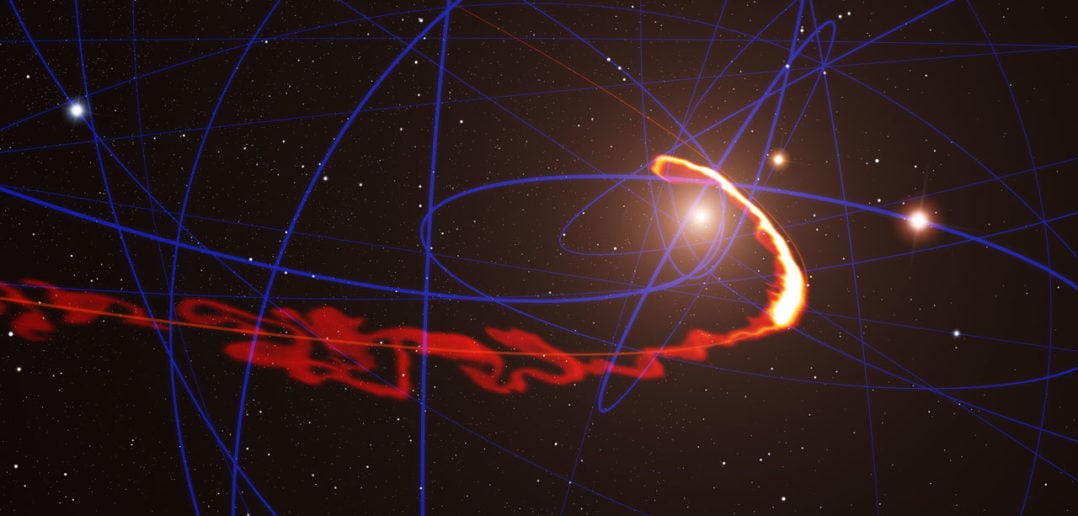
The journey toward understanding these flares reached a fever pitch in 2014, when the astronomical community turned its collective gaze toward Sagittarius A (Sgr A), the four-million-solar-mass black hole at the center of our Milky Way. An enigmatic object designated as "G2" was on a collision course with the event horizon’s vicinity. Early predictions suggested that G2 was a massive cloud of hydrogen gas. If this were the case, the intense gravitational shear of Sgr A* would have torn the cloud apart, resulting in a spectacular display of X-ray and radio emissions as the gas was consumed.
To the surprise of many, the expected "fireworks" never materialized. G2 made its closest approach, swung around the black hole, and emerged relatively intact, continuing on its eccentric orbit. This "cosmic fizzle" forced a re-evaluation of the object’s nature. Astronomers now believe G2 was not a mere gas cloud but likely a "dusty protostellar object"—a young star still encased in its natal cocoon—or perhaps the result of a binary star merger. The density of a stellar core provided the gravitational glue necessary to survive the flyby, whereas a simple gas cloud would have been obliterated.
While Sgr A* remained relatively quiet during the G2 encounter, the event highlighted a critical scientific need: a more precise understanding of what happens when a star does not survive the encounter. When the gravitational forces of a black hole exceed the self-gravity of a passing star, the result is a Tidal Disruption Event. These events provide a rare window into the properties of black holes that are otherwise invisible against the dark backdrop of space.
The Mechanics of Stellar Destruction
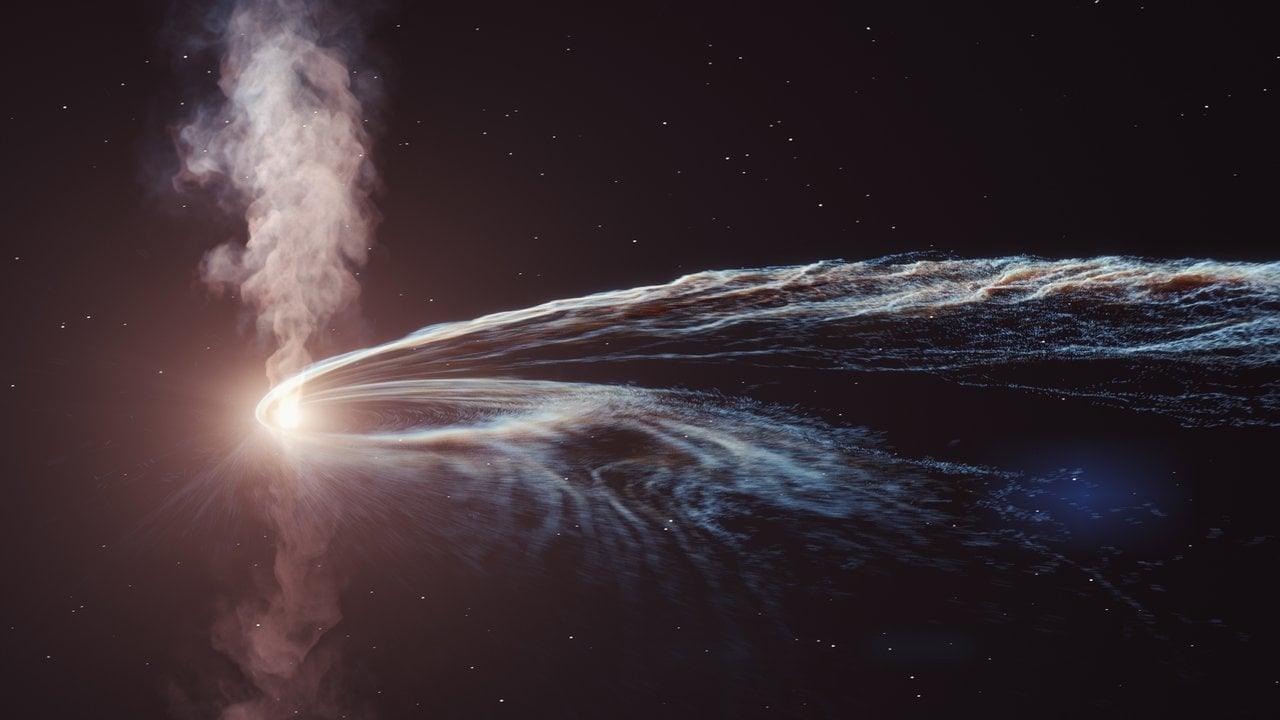
A TDE begins when a star wanders within the "tidal radius" of a supermassive black hole. At this distance, the tidal forces—the difference in gravitational pull between the side of the star facing the black hole and the side facing away—become so extreme that the star is "spaghettified." It is stretched into a long, thin strand of stellar debris.
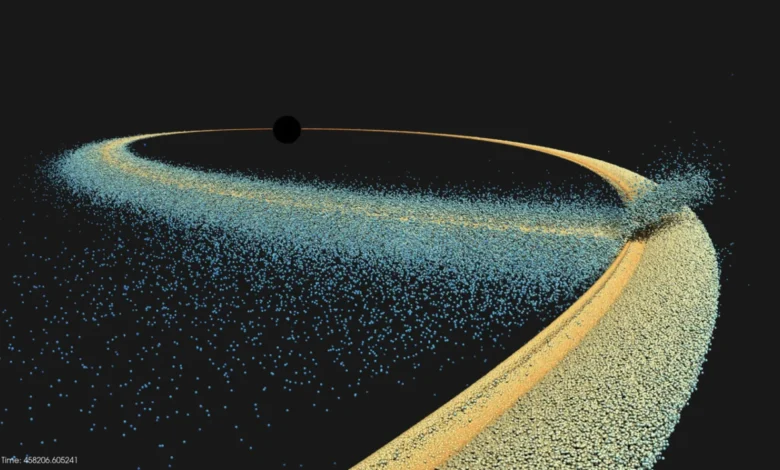
According to the new research led by Eric Coughlin, assistant professor of physics at Syracuse University, and his colleagues in Zurich, the destruction is only the beginning of the story. Using a methodology known as "smoothed particle hydrodynamics" (SPH), the team simulated the evolution of this debris with unprecedented resolution. In these simulations, the star is decomposed into tens of billions of individual "particles," each governed by the fluid dynamics equations that describe the flow of matter under extreme pressure and gravity.
The models show that as the star is shredded, roughly half of its mass is flung away into deep space at high velocities. The remaining half stays bound to the black hole, forming a narrow, coherent stream of gas. This stream follows a highly elliptical path, eventually returning toward the black hole. The "flare" that astronomers observe is not caused by the initial shredding, but by the "self-intersection" of this stream. As the gas circles back, it crashes into itself, creating massive amounts of friction and shock-heating. This process converts kinetic energy into thermal radiation, causing the accretion disk to glow with enough intensity to be seen across millions of light-years.
The Invisible Hand: Black Hole Spin and Nodal Precession
One of the most significant contributions of the Syracuse-Zurich study is the explanation of why no two TDEs look the same. Some flares brighten in a matter of days and vanish quickly, while others persist for years with erratic fluctuations. The research suggests that the "diversity" of these events is heavily influenced by the physical characteristics of the black hole itself—specifically its mass and its angular momentum, or spin.
In a static universe, a debris stream would return on a predictable, flat plane. However, Einstein’s General Theory of Relativity dictates that a spinning supermassive black hole actually "drags" the fabric of spacetime around with it. This phenomenon, known as frame-dragging or the Lense-Thirring effect, causes the orbital plane of the returning stellar debris to shift.
This shifting is called "nodal precession." If the black hole is spinning rapidly and its axis is tilted relative to the star’s incoming path, the debris stream will "wobble" like a dying top. This precession can prevent the stream from crashing into itself immediately. In some cases, the debris may loop around the black hole several times before a significant collision occurs, delaying the flare or causing it to appear much dimmer than expected.
"We can study tidal disruption events to learn more about black holes hidden from view," Coughlin noted. By analyzing the "light curve"—the specific timing and intensity of the flare—astronomers can now work backward to calculate how fast a black hole is spinning and what its mass might be. This provides a vital tool for mapping the population of SMBHs in the distant universe, many of which are currently "dormant" and invisible because they lack a steady supply of infalling gas.
Chronology of TDE Discoveries and Research
The study of TDEs has evolved rapidly over the last three decades:
- 1970s-1980s: Theoretical foundations are laid by physicists like John Wheeler and Jack Hills, who first proposed that SMBHs could shred stars.
- 1990s: The ROSAT X-ray satellite detects the first "candidate" TDEs, appearing as bright, fading X-ray sources in the centers of distant galaxies.
- 2011: The event known as Swift J1644+57 provides the first evidence of a TDE launching a relativistic jet, a beam of particles moving at nearly the speed of light.
- 2014: The G2 "fizzle" at Sgr A* underscores the complexity of black hole-object interactions and the importance of object density.
- 2023-2024: The Syracuse-Zurich simulations use the SPH-EXA code on high-performance computing clusters to resolve the "return of the stream" with billions of particles, providing the first high-fidelity look at the role of nodal precession.
Broader Implications for Galactic Evolution
The ability to accurately model TDEs has implications that extend far beyond the immediate vicinity of the black hole. These events are thought to play a role in "galactic feedback." The energy released during a TDE can heat the surrounding interstellar medium, potentially regulating the rate at which new stars form in the galactic center.
Furthermore, TDEs are "cosmic laboratories" for testing the limits of physics. The environment around an SMBH is a place of extreme gravity, high-velocity collisions, and intense radiation that cannot be replicated on Earth. By matching the Syracuse-Zurich simulations with real-world observations, scientists can verify if our understanding of General Relativity holds true in the most "stressed" environments in the cosmos.
The timing of this research is particularly auspicious. A new generation of wide-field survey telescopes is currently coming online. The Vera C. Rubin Observatory in Chile, equipped with the Legacy Survey of Space and Time (LSST), is expected to discover thousands of TDEs every year. Similarly, the Nancy Grace Roman Space Telescope will provide high-resolution infrared data that can peer through the dust clouds that often obscure galactic centers.
With a massive influx of new data on the horizon, the models produced by Coughlin and his team will serve as a "Rosetta Stone," allowing astronomers to translate the flickering lights of distant galaxies into a census of the supermassive black holes that inhabit them.
Conclusion: Turning the Dark into a Map
For nearly a century, black holes were viewed as the ultimate "sinks" of the universe—places where information and matter went to die in silence. The realization that they can "light up the dark" through the violent consumption of stars has transformed them into some of the most important tools in modern astrophysics.
The simulations from Syracuse and Zurich have moved the field from qualitative descriptions to quantitative precision. By proving that the spin of a black hole and the resulting nodal precession of stellar debris are responsible for the variety of flares observed, the researchers have provided a path forward for characterizing the millions of black holes that currently sit in darkness. As we look toward the future of observational astronomy, the "cosmic fizzle" of G2 and the brilliant flares of distant TDEs remain two sides of the same coin: reminders of the terrifying and beautiful power of gravity at the heart of our universe.
Related posts: