Snapchat Report Reveals Shifting Consumer Perceptions on Artificial Intelligence, Highlighting Growing Trust Alongside Persistent Privacy Boundaries

Artificial intelligence has rapidly transitioned from an experimental novelty into an integrated component of everyday digital life. A comprehensive new report published by Snapchat, titled Navigating the Age of AI, sheds light on this monumental shift, offering a detailed look into how everyday users interact with AI chatbots, how public perception of these tools is evolving, and where the boundaries of consumer trust truly lie. Based on extensive research and surveying conducted by market research giants Ipsos and WPP, the findings offer a fascinating glimpse into the psychological and practical dynamics driving modern AI adoption.
The report, which surveyed more than 4,200 active artificial intelligence users, indicates that AI is no longer viewed merely as a futuristic gadget or a passing technological trend. Instead, it is increasingly embraced as a trusted partner, decision-making guide, and conversational aid. As millions of people incorporate AI assistants into their daily routines, the data reveals both an unprecedented level of reliance on these systems and a complex set of consumer anxieties regarding privacy, data monetization, and hyper-personalized advertising.
Massive Adoption and the Everyday Integration of AI
To understand the current landscape, one must look at the sheer scale of adoption outlined in Snapchat’s findings. According to the report, 48% of general consumers now use artificial intelligence tools on a daily basis. Among content creators and marketing professionals, that number rises to 50%, who view AI as a non-negotiable, core part of their daily professional routine.
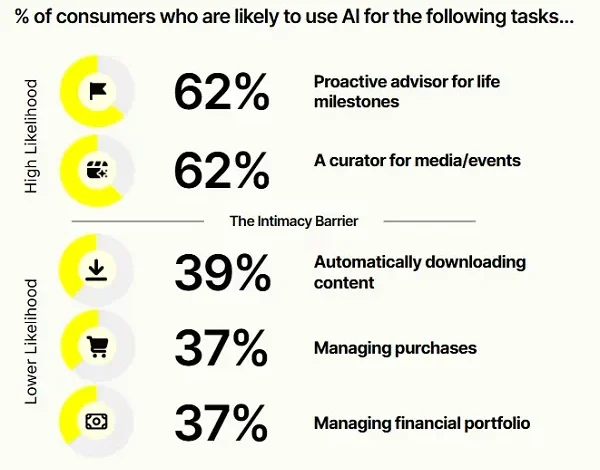
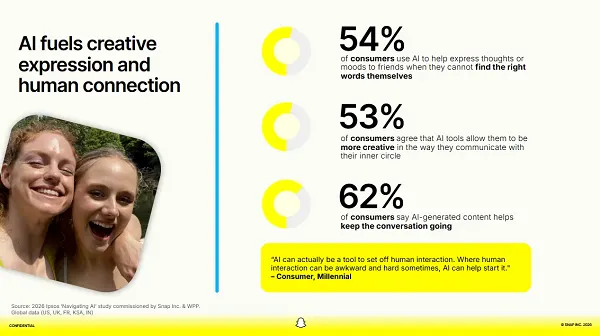
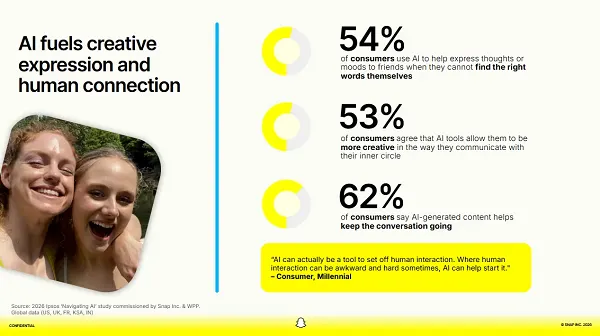
This widespread integration is transforming how people handle routine communications, brainstorming sessions, and creative projects. The vast majority of survey respondents reported that AI assistants help them communicate more clearly, express complex thoughts more effectively, and unlock higher levels of creativity. Specifically, 62% of AI users noted that these tools assist them in maintaining and enriching everyday conversations, suggesting that individuals are increasingly turning to machines to help structure their ideas, articulate emotions, and navigate interpersonal dialogues.
The data is particularly striking when examining specific demographic subgroups. Snapchat users, for instance, were found to be 2.2 times more likely to agree that artificial intelligence positively impacts their social lives, and 1.6 times more likely to leverage AI assistants when planning real-world activities, events, and gatherings.
Beyond productivity, the psychological profile of the modern AI user is shifting. More than 80% of respondents described artificial intelligence as friendly and collaborative. Furthermore, 74% view AI interfaces as a judgment-free space—a safe digital environment where they can privately coach themselves, practice difficult conversations, and articulate complex feelings before presenting them to human peers. This private coaching aspect has positioned AI chatbots not just as search engines or task managers, but as emotional and social scaffolding for a generation of digital natives.
The Value Exchange: Privacy on a Sliding Scale
Despite the high levels of trust users place in AI for personal communication and creative tasks, hesitation remains when it comes to higher-stakes applications. The Snapchat report indicates that consumers still harbor significant reservations about utilizing artificial intelligence to manage personal finances, execute banking tasks, or make autonomous purchasing decisions.
However, Snapchat argues that consumer boundaries regarding data privacy are far more flexible than conventional wisdom suggests. Rather than viewing privacy as an absolute, immutable right, the report suggests that contemporary consumers view data protection on a sliding scale defined by utility.
"Privacy today isn’t an absolute — it’s a sliding scale," the report notes. "Consumers aren’t asking, ‘Is this private?’ They’re asking, ‘Is this worth it?’ The reality is that users will willingly trade data for personalized AI experiences when the immediate value is obvious. But that value exchange has boundaries."
This assertion strikes at the heart of the modern digital economy. For over two decades, the underlying business model of social media has relied on the premise that users will willingly surrender personal data in exchange for free, highly functional, and entertaining software tools. Snapchat’s open acknowledgment of this trade-off normalizes data collection as a fair exchange for utility, providing a roadmap for corporate entities looking to accelerate consumer AI adoption.
The Dichotomy of Personalization and Aversion
Yet, this logic reveals a profound contradiction at the core of consumer sentiment. While users appear willing to trade personal information for functional utility within a chatbot interface, they draw a hard line when that same data is repurposed for commercial marketing.
According to the survey data, 70% of consumers find the use of personal data in hyper-personalized AI advertisements to be intrusive. Furthermore, 56% of respondents consider 100% AI-generated content to be fundamentally "soulless."
This creates a fascinating psychological dichotomy. On one hand, individuals are increasingly comfortable engaging in deep, intimate conversations with AI chatbots, sharing personal thoughts, and relying on algorithms to shape their daily lives. On the other hand, those same individuals reject the commercialization of that data and express deep skepticism toward fully automated, synthetic media and targeted advertising.
The takeaway for technology developers and marketers is nuanced: users appreciate AI when it acts as an empowering, private tool for personal expression and problem-solving, but they grow deeply resistant when AI is deployed as an intrusive mechanism for corporate surveillance and mass-produced content.
Broader Industry Implications and Future Outlook
Snapchat’s report arrives at a critical juncture in the evolution of generative artificial intelligence. As tech companies rush to monetize their AI investments through advertising and premium subscriptions, understanding consumer sentiment is paramount.
The findings suggest that platforms cannot simply impose blanket AI integration without alienating their user bases. Success in the next phase of AI development will depend heavily on transparency, user control, and clear boundaries between utility-driven assistance and commercial exploitation.
As regulatory bodies around the globe scrutinize data practices and the deployment of generative AI models, reports like Snapchat’s provide valuable insight into the minds of everyday users. While the appetite for personal AI companionship and productivity tools has never been higher, the public’s tolerance for intrusion remains fragile. Balancing these competing desires will define the success or failure of consumer technology platforms in the years to come.
Related posts: