Security Researcher Discloses Four Critical Linux Kernel Privilege Escalation Flaws Discovered Through AI-Assisted Analysis

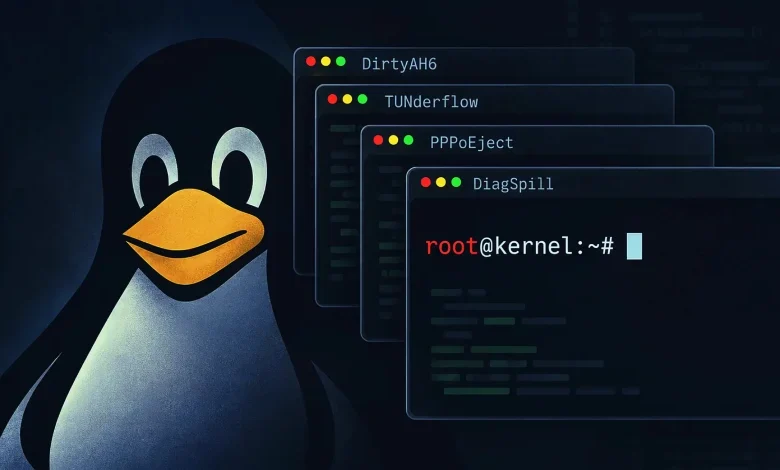
A security researcher has publicly released functional exploit code for a quartet of high-severity vulnerabilities within the Linux kernel, each of which allows a local, unprivileged user to gain root-level access to a compromised system. The flaws, collectively identified as DirtyAH6, TUNderflow, PPPoEject, and DiagSpill, represent a significant, albeit now mitigated, risk to enterprise and consumer Linux environments. While the Linux kernel development community has already finalized and distributed patches for all four vulnerabilities, the public availability of exploit material necessitates an immediate review of security update protocols for system administrators worldwide.
The Anatomy of the Quartet
The vulnerabilities—CVE-2026-80844 (DirtyAH6), CVE-2026-81000 (TUNderflow), CVE-2026-68121 (PPPoEject), and CVE-2026-74469 (DiagSpill)—were identified by security researcher Asim Manizada. Following a responsible disclosure process that commenced in mid-July, Manizada coordinated with major Linux distribution maintainers to ensure that security patches were developed and prepared for deployment before he published his technical findings and exploit proof-of-concepts on September 18.
Each of these vulnerabilities is rooted in legacy memory-management errors within the kernel’s networking subsystems. The age of the underlying codebases affected by these bugs is notable; forensic analysis indicates that the flawed code has existed in the kernel for anywhere between 10 and 21 years. This discovery underscores the "long tail" of technical debt present in massive, multi-decade open-source projects like the Linux kernel, where dormant memory-safety issues can persist for years before being identified by modern testing methodologies.
Technical Breakdown and Prerequisites
The exploitability of these flaws varies significantly based on system configuration. Three of the four—DirtyAH6, TUNderflow, and PPPoEject—rely on the presence of unprivileged user namespaces. This kernel feature, designed to allow non-root users to operate within isolated sandboxes, has historically been a frequent target for privilege escalation research because it provides a mechanism for attackers to manipulate kernel interfaces that would otherwise be restricted.

- DirtyAH6 (CVE-2026-80844): Affects the IPsec AH6 implementation within the IPv6 stack. While it can be triggered via unprivileged user namespaces, it has the rare potential for remote-triggered crashes if the target host is functioning as an IPv6 router utilizing specific Authentication Headers.
- TUNderflow (CVE-2026-81000): Targets the TUN/TAP virtual network device driver, a staple for VPNs and virtualization software.
- PPPoEject (CVE-2026-68121): Impacts the Point-to-Point Protocol over Ethernet (PPPoE) handling, a common component in ISP-provided connectivity.
- DiagSpill (CVE-2026-74469): The outlier in the group, this vulnerability does not require user namespaces or elevated privileges. It targets the SCTP (Stream Control Transmission Protocol) network diagnostic interface. While it is the most accessible in terms of prerequisites, its impact is largely limited to system crashes unless specific, non-default SCTP options are active.
The Role of Artificial Intelligence in Vulnerability Research
A defining feature of this discovery is the methodology employed by Manizada. He utilized an AI-assisted framework designed to map the kernel’s complex memory layout and reason about how different modules handle data structures. This approach allowed for the identification of deep-seated memory-safety violations that might have eluded manual code review.
The effectiveness of AI in this context is becoming a growing trend in cybersecurity. In the past year alone, several significant kernel-level vulnerabilities have been attributed to AI-augmented fuzzing and static analysis tools. The Linux kernel team has begun acknowledging these advancements, with some recent commits—including the fix for DirtyAH6—explicitly crediting "Assisted-by" automated tooling in the version control history. This signals a shifting paradigm where the development of the kernel is increasingly relying on the very tools that are simultaneously making it easier for researchers to identify long-hidden flaws.
Chronology and Response
The timeline of these vulnerabilities reflects a professional standard of coordinated disclosure:
- Mid-July 2026: Asim Manizada reports the four vulnerabilities to the Linux kernel security team.
- Late July – Early September 2026: Kernel maintainers develop, verify, and backport fixes for the affected subsystems.
- September 18, 2026: After confirming that major distributions (such as Ubuntu, Debian, Red Hat, and SUSE) have finalized their security advisories, Manizada releases his detailed research write-up and functional exploit code.
To date, there have been no confirmed reports of these exploits being utilized in malicious, "in-the-wild" cyberattacks. Because the exploits are highly customized to specific kernel builds and possess a propensity to cause system crashes, they are currently viewed as tools for security testing rather than weaponized malware. However, the release of the exploit code drastically lowers the barrier to entry for malicious actors, shifting the status of these vulnerabilities from theoretical to actionable risks.
Broader Implications for Infrastructure Security
The existence of these flaws, particularly those that bypass traditional sandbox restrictions, presents a particular risk to multi-user environments, including shared hosting providers, cloud service platforms, and container-orchestration environments. In a scenario where an attacker gains a low-privileged account on a server—perhaps through a web application exploit or a compromised service account—these kernel flaws provide the final "ladder" needed to achieve complete control over the host operating system.

Furthermore, the theoretical potential for container escape remains a point of concern. While Manizada did not develop a specific container escape payload, he noted that the memory corruption primitives offered by these bugs are, in theory, sufficient to allow an attacker to break out of a containerized environment. For organizations relying heavily on Docker or Kubernetes, the risk of a "break-out" vulnerability that elevates to host-level root is a critical threat vector that necessitates strict adherence to kernel patching cycles.
Recommended Mitigation Strategies
The primary recommendation from security experts is the immediate application of kernel updates provided by distribution vendors. Because the Linux kernel project itself maintains the "mainline" code, users should not rely solely on the mainline version numbers, but rather consult their specific distribution’s security bulletin.
If an immediate kernel update is not feasible—perhaps due to the need for extensive regression testing on mission-critical legacy applications—administrators should consider the following temporary hardening measures:
- Restrict Unprivileged User Namespaces: On many distributions, this can be achieved by setting
kernel.unprivileged_userns_cloneto 0. This effectively mitigates three of the four disclosed vulnerabilities. - Disable Unnecessary Modules: If SCTP is not required for the specific workload, disabling the kernel module (
modprobe -r sctp) removes the attack surface for the DiagSpill vulnerability. - Network Perimeter Hardening: For the remote-triggerable aspects of DirtyAH6, ensuring that IPv6 routing is handled by hardened, dedicated network appliances rather than general-purpose Linux servers can reduce the exposure of the kernel’s IPsec stack.
Manizada strongly cautions against relying solely on these workarounds. As he noted in his disclosure, these bugs are indicative of broader issues within the networking code. He advises that "patching is the only reliable path to remediation," as there may be undiscovered, alternative code paths that reach the same memory-safety vulnerabilities.
As the industry moves toward 2027, the "quartet" of vulnerabilities serves as a reminder of the inherent risks in the Linux kernel’s vast, aging codebase. The combination of AI-driven research and the public release of exploit code is likely to become the new normal for high-profile security disclosures. For organizations and individual users alike, the lesson is clear: the velocity of vulnerability discovery is accelerating, and the window of time between discovery and active exploitation is closing, making rapid patch management an indispensable component of modern system administration.
Related posts: