Redefining the Final Frontier: SpaceNews and RTX to Host Virtual Event on Satellite Mission Management at the Edge

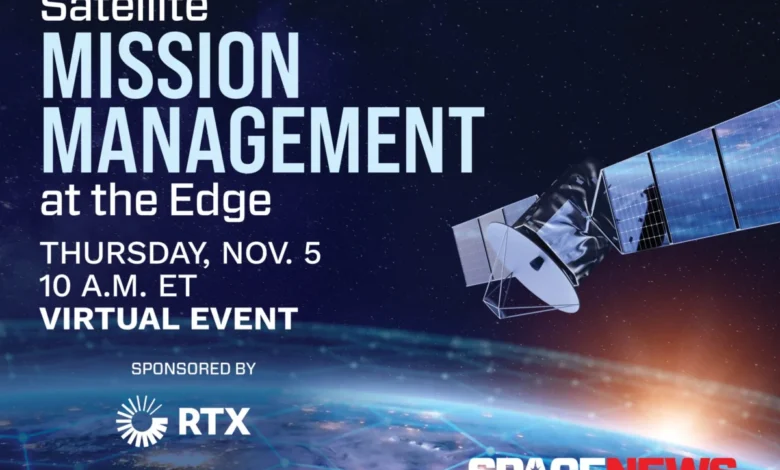
The operational landscape of space is undergoing a profound paradigm shift. As the orbital environment grows increasingly congested, contested, and complex, the traditional models of satellite operations—often characterized by heavy reliance on terrestrial ground stations, rigid operational timelines, and monolithic spacecraft architectures—are proving insufficient for the demands of modern national security. In response to these evolving threats and technological imperatives, SpaceNews, in partnership with defense and aerospace giant RTX, is set to host a high-profile virtual event titled Satellite Mission Management at the Edge on November 5.
The 45-minute virtual panel, scheduled from 10:00 a.m. to 10:45 a.m. Eastern Time, will convene industry leaders, defense experts, and technologists to examine the transformative role that emerging technologies and commercial capabilities play in reshaping national security space missions. Against a backdrop of rapid commercial innovation and rising geopolitical tensions in low Earth orbit (LEO), medium Earth orbit (MEO), and geostationary orbit (GEO), the event aims to address how modern operators can achieve greater resilience, faster decision-making cycles, and advanced on-orbit adaptability without compromising security, reliability, or operational control.
The Imperative for Modernization in National Security Space
The modern national security space enterprise faces unprecedented challenges. Historically, military and intelligence satellites operated in relatively benign environments where the primary risks were technical failures rather than intentional adversarial interference. Today, however, space is recognized as a contested warfighting domain. Potential adversaries possess advanced counter-space capabilities, including electronic jamming, cyberattacks, directed-energy weapons, and direct-ascent anti-satellite (ASAT) missiles.
To survive and maintain operational superiority in this environment, space architectures must transition from fragile, high-value constellations to resilient, distributed networks of smaller, proliferated satellites. This shift demands a radical evolution in how satellites are commanded, controlled, and managed. Traditional mission management systems, which rely on data being downlinked to ground stations, processed by human operators, and then having commands uploaded back to the spacecraft, introduce latency that is incompatible with modern tactical and strategic timelines.
By bringing intelligence closer to the spacecraft—a concept widely known as edge computing—operators can drastically reduce decision loops. Edge computing allows satellites to process onboard sensor data locally, detect anomalies, identify threats, and execute evasive or defensive maneuvers autonomously. This capability is particularly critical for missions involving missile warning, space domain awareness (SDA), and tactical communications, where every second counts.
Event Focus Areas and Core Themes
The virtual event will delve deeply into several critical technological pillars driving the future of satellite operations. Foremost among these is the integration of advanced mission management tools that leverage automation, artificial intelligence (AI), and machine learning (ML). As constellations grow from dozens of satellites to hundreds or even thousands, human-centric operations become mathematically unsustainable. Automated mission management systems are required to handle routine station-keeping, payload scheduling, and constellation optimization, freeing human operators to focus on high-level strategy and anomaly resolution.

Another key theme of the agenda is the adoption of cloud-native architectures. By migrating command and control (C2) infrastructure to secure cloud environments, military and commercial operators can achieve unprecedented scalability, interoperability, and cost-efficiency. Cloud-native architectures enable seamless data sharing across disparate defense agencies and allied partners, fostering a more cohesive and synchronized multi-domain operations framework.
Furthermore, the conversation will address the persistent challenge of legacy systems. The Department of Defense and intelligence community operate a vast portfolio of legacy satellites and ground control stations that represent multibillion-dollar investments. Replacing these systems outright is financially and operationally unfeasible. Consequently, the panel will explore modular approaches and open-architecture standards—such as the Space Enterprise Consortium (SpEC) and Universal Command and Control (UC2) frameworks—that allow new commercial capabilities and edge-computing payloads to be retrofitted or integrated with legacy infrastructure.
Background Context: The Convergence of Commercial Space and Defense
The timing of this virtual event reflects a broader, industry-wide acceleration toward the commercialization of national security space. For decades, military satellite systems were custom-built, highly proprietary, and developed over lengthy multi-year timelines. However, the emergence of the "New Space" economy, characterized by rapid commercial innovation, mass manufacturing of spacecraft, and declining launch costs, has compelled defense agencies to pivot toward commercial off-the-shelf (COTS) solutions.
The United States Space Force, the Space Development Agency (SDA), and the Defense Innovation Unit (DIU) have increasingly emphasized the need to leverage commercial resilience. The SDA’s Proliferated Warfighter Space Architecture (PWSA), for instance, relies heavily on commercial partnerships to build a layered mesh network in low Earth orbit for global connectivity and missile tracking.
However, integrating commercial technologies into classified or highly sensitive national security missions introduces distinct hurdles. Cybersecurity vulnerabilities, supply chain integrity, data sovereignty, and interoperability standards remain prominent concerns for military acquisition officials. Events like Satellite Mission Management at the Edge serve as vital forums for government and industry stakeholders to align their roadmaps, address regulatory and technical bottlenecks, and accelerate the fielding of resilient capabilities.
The Role of RTX in Shaping the Future of Space Defense
As the primary sponsor of the event, RTX brings substantial industry heft and technical expertise to the discussion. Headquartered in Arlington, Virginia, RTX is one of the world’s leading aerospace and defense companies, employing more than 180,000 people globally. With reported sales exceeding $88 billion, the corporation plays a foundational role in developing integrated defense systems, advanced radar technologies, secure communications, and space-based payloads that protect global security interests.
RTX’s involvement underscores the critical intersection between prime defense contractors and emerging software-defined space architectures. Modern space defense is no longer just about building durable spacecraft hardware; it is equally about developing the sophisticated software, encryption protocols, and data processing algorithms that govern satellite behavior in orbit. Through its advanced technology solutions and manufacturing capabilities, RTX is actively engaged in helping global defense customers modernize their C2 infrastructures, enhance space domain awareness, and deploy resilient processing power directly to the edge.

Implications for the Broader Space Economy
The discussions at the November 5 event carry significant implications for the wider aerospace and defense ecosystem. As edge computing and cloud-native mission management become standard requirements for national security programs, the commercial market for space software and payload processing is poised for rapid expansion.
Companies specializing in onboard data processing, AI-driven autonomy, software-defined radios, and cybersecurity are likely to see increased demand from both defense prime contractors and government procurement agencies. Moreover, the emphasis on modularity and open architectures lowers the barrier to entry for smaller technology firms and startups, encouraging a more diverse and innovative industrial base to contribute to national security missions.
At the same time, the successful implementation of edge computing in space addresses long-term affordability concerns. By automating routine operations and extending the useful lifespan of satellites through autonomous health management, defense agencies can optimize their procurement budgets and maximize return on investment for taxpayer-funded space assets.
Registration and Event Logistics
The virtual event is open to defense officials, industry executives, engineers, researchers, and media professionals interested in the future of space operations. Participation is accessible via Zoom, and attendees must complete an online registration process. Upon successful registration, participants will receive a unique access link to join the live broadcast.
For those unable to attend the live session, SpaceNews has confirmed that a comprehensive recording of the event will be made available on its platform shortly after the broadcast concludes. Attendees are also subject to SpaceNews’ standard privacy policies and terms of service regarding communications and partner updates.
As space continues to evolve into a critical domain for global security, dialogues centered around edge computing, resilient mission management, and commercial integration will remain essential. The insights shared during the Satellite Mission Management at the Edge event are expected to help chart a practical course for military and commercial leaders striving to maintain operational dominance in an increasingly complex orbital environment.