Qilin Ransomware Gang Exploiting Critical Palo Alto Networks GlobalProtect Flaw for Domain-Wide Encryption Attacks


The Qilin ransomware gang is actively exploiting a critical authentication bypass vulnerability in Palo Alto Networks’ PAN-OS GlobalProtect software, identified as CVE-2026-0257, to infiltrate victim networks and deploy ransomware, according to findings from cybersecurity firm Arctic Wolf. This exploitation has led to multiple instances of domain-wide encryption, underscoring the severe and ongoing threat posed by this flaw. The rapid weaponization of this vulnerability by a prominent Ransomware-as-a-Service (RaaS) operation highlights the urgent need for organizations to implement patches and bolster their defensive postures against sophisticated cyber threats.
Unveiling the Vulnerability: CVE-2026-0257
The vulnerability, designated CVE-2026-0257, pertains to a critical authentication bypass flaw affecting the GlobalProtect portal and gateway components of Palo Alto Networks’ PAN-OS software. This flaw allows an unauthenticated attacker to bypass security restrictions, effectively establishing an unauthorized Virtual Private Network (VPN) connection to the target network. Such a bypass provides a critical initial access vector, enabling threat actors to circumvent perimeter defenses that organizations rely on for secure remote access and network segmentation. The integrity of VPN solutions is paramount, as they often serve as the first line of defense for remote employees and partners connecting to corporate resources. A bypass of this nature fundamentally compromises that trust model, opening the door to deeper network penetration.
Palo Alto Networks officially addressed the vulnerability on May 13, 2026, releasing patches and issuing a stark warning to its extensive customer base. At the time of disclosure, the company acknowledged that it was "aware of limited exploit attempts on unpatched PAN-OS devices without mitigations applied." This initial warning signaled the potential for real-world exploitation, urging customers to prioritize patching efforts. However, the situation quickly escalated. Just four days later, on May 17, cybersecurity firm Rapid7 reported observing active exploitation of the flaw against numerous customers. This swift transition from theoretical vulnerability to active exploitation in the wild underscores the agility and aggressive tactics employed by modern threat groups, who often reverse-engineer patches within hours of their release to develop exploits.
The severity of CVE-2026-0257 prompted the U.S. Cybersecurity and Infrastructure Security Agency (CISA) to take decisive action. On May 29, 2026, CISA added the flaw to its Known Exploited Vulnerabilities (KEV) catalog, a definitive list of vulnerabilities that have been observed being actively exploited in the wild. Inclusion in the KEV catalog carries a significant mandate for federal agencies, which were ordered to secure their GlobalProtect VPN instances within a mere three days. This directive highlights the critical risk the vulnerability posed to government networks and critical infrastructure, emphasizing the urgent need for immediate remediation across all sectors.
Qilin Ransomware’s Aggressive Exploitation Campaign

The initial warnings and CISA’s directive proved prescient. On Monday, June 10, 2026, Arctic Wolf Labs released a detailed report confirming that the Qilin ransomware gang is indeed leveraging CVE-2026-0257 as a primary entry point for their attacks. Arctic Wolf Labs revealed that during June 2026, their incident response teams investigated multiple distinct intrusions that directly resulted in the deployment of Qilin ransomware. Crucially, all these attacks originated from the exploitation of CVE-2026-0257 against vulnerable Palo Alto Networks firewall appliances configured with GlobalProtect.
The cybersecurity firm’s investigation provided critical insights into Qilin’s operational tactics. Evidence gathered during these incidents strongly suggests that multiple affiliates operating under the Qilin Ransomware-as-a-Service (RaaS) umbrella are actively exploiting this flaw to breach target networks. This RaaS model allows the core Qilin developers to outsource the labor-intensive initial access and ransomware deployment phases to a network of affiliates, significantly broadening their attack surface and increasing the volume of successful intrusions.
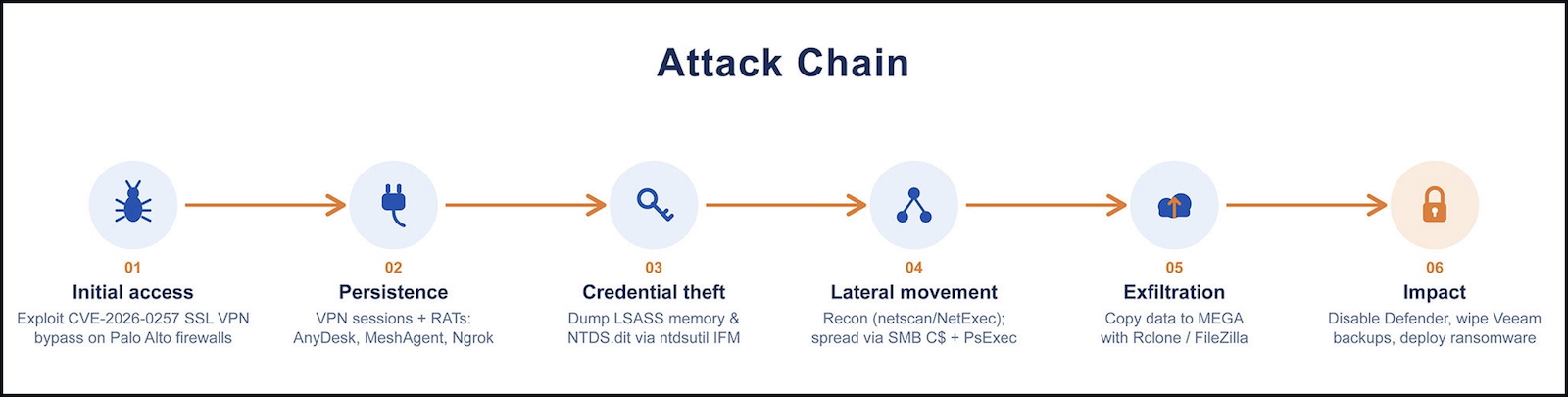
Arctic Wolf Labs noted a variation in post-exploitation tradecraft across the observed incidents. Some attacks involved "rapid encryption-only operations," where the focus was solely on encrypting data as quickly as possible to extort a ransom. Other incidents showcased "full double-extortion" tactics, where attackers not only encrypted data but also exfiltrated sensitive information prior to encryption, threatening to publish it on their dark web leak sites if the ransom was not paid. This dual pressure strategy maximizes leverage against victims, increasing the likelihood of a payout. The differing methodologies among attacks further supports the assessment of multiple affiliates, each potentially with their own preferred tactics, operating under the Qilin banner.
The attack chain observed by Arctic Wolf Labs typically begins with the exploitation of CVE-2026-0257 to gain initial access. Once inside, the threat actors proceed with typical post-exploitation activities, which can include privilege escalation, lateral movement within the network, reconnaissance to identify valuable data and critical systems, disabling security tools, and ultimately, the deployment of the Qilin ransomware payload for widespread encryption. Arctic Wolf Labs assesses with "moderate confidence that intrusions leveraging CVE-2026-0257 and leading to Qilin ransomware deployment are likely ongoing." This assessment is based on two key factors: the extensive scanning activity observed targeting GlobalProtect instances globally, and the inherent nature of the RaaS model, which tends to quickly distribute effective exploits among its network of affiliates to maximize impact before patches are widely applied.
The Prolific Threat of Qilin Ransomware
Qilin, initially known as "Agenda," emerged on the threat landscape in August 2022 and has since established itself as a highly prolific and dangerous RaaS operation. The group operates a dedicated dark web leak site where it publicly shames victims who refuse to pay the ransom, often publishing exfiltrated data as proof of compromise and to exert additional pressure. To date, Qilin has claimed responsibility for over 2,000 victims globally, a staggering number that underscores its reach and effectiveness.
The list of organizations targeted by Qilin includes numerous high-profile entities across various sectors, demonstrating the gang’s broad targeting strategy and its capability to compromise significant enterprises. Notable past victims include:

- Nissan: The automotive giant confirmed a data breach in its design studio, claimed by Qilin ransomware, leading to potential compromise of sensitive intellectual property and operational data.
- Yanfeng: Another major automotive supplier, Yanfeng, was also reportedly hit by Qilin, disrupting parts of its global operations and supply chain.
- Asahi: The Japanese beer giant suffered an attack where Qilin ransomware claimed responsibility and subsequently leaked data, impacting internal systems and potentially customer information.
- Synnovis: A pathology services provider in London, Synnovis, was linked to a Qilin ransomware attack that severely disrupted healthcare services, delaying tests and operations across multiple hospitals. This incident highlighted the critical impact of ransomware on essential services.
- Lee Enterprises: The publishing giant experienced an attack where Qilin claimed responsibility and leaked stolen data, affecting news operations and potentially subscriber information.
- Australia’s Court Services Victoria: Recordings from Victorian courts were exposed in a reported ransomware attack, showcasing the gang’s willingness to target sensitive government and legal institutions.
These incidents illustrate the diverse range of sectors Qilin targets and the significant operational, financial, and reputational damage it inflicts upon its victims. The RaaS model allows Qilin’s core developers to focus on developing and maintaining their ransomware payload and infrastructure, while affiliates handle the initial penetration, negotiation, and data exfiltration, creating a highly efficient and resilient criminal enterprise.
The Scale of Exposed Systems and Urgent Mitigation
The widespread adoption of Palo Alto Networks products exacerbates the potential impact of CVE-2026-0257. Palo Alto Networks boasts an impressive customer base, serving over 70,000 customers worldwide, including most of the largest U.S. banks and 90% of Fortune 10 companies. This extensive market penetration means that a critical vulnerability in one of its widely used products, like GlobalProtect, presents a lucrative target for ransomware groups like Qilin.
Internet threat monitoring services provide a sobering view of the sheer number of potentially vulnerable systems still exposed online. Shadowserver, a non-profit security organization, tracks over 167,000 GlobalProtect VPN instances that are publicly accessible on the internet. Similarly, Shodan, a search engine for internet-connected devices, identifies over 172,000 IP addresses exhibiting a GlobalProtect fingerprint. While these figures do not differentiate between honeypots, patched systems, or truly vulnerable instances, they strongly indicate a massive attack surface. The challenge for organizations lies in accurately identifying which of these exposed instances remain unpatched and therefore susceptible to Qilin’s ongoing exploitation.
The urgency for organizations to patch their Palo Alto Networks PAN-OS GlobalProtect installations cannot be overstated. Given the confirmed active exploitation by a sophisticated RaaS group, every unpatched instance represents a direct and immediate threat. Beyond applying the vendor-supplied patches, organizations must also engage in proactive threat hunting and incident response activities. This includes:
- Immediate Patching: Prioritizing the application of patches released by Palo Alto Networks for CVE-2026-0257 across all affected GlobalProtect installations.
- Vulnerability Scanning: Regularly scanning external and internal networks to identify unpatched systems and other potential weaknesses.
- Log Review: Thoroughly reviewing VPN access logs, firewall logs, and security information and event management (SIEM) system alerts for any indicators of compromise (IoCs) related to unauthorized access or suspicious activity originating from GlobalProtect.
- Multi-Factor Authentication (MFA): Ensuring that MFA is enforced for all VPN connections, as this can significantly mitigate the impact of authentication bypass vulnerabilities by requiring a second factor even if the primary authentication mechanism is compromised.
- Network Segmentation: Implementing robust network segmentation to limit lateral movement by attackers if an initial breach occurs through the VPN.
- Incident Response Planning: Having a well-defined and regularly tested incident response plan specifically for ransomware attacks, including data backup and recovery strategies.
- Threat Hunting: Actively hunting for signs of compromise using intelligence from Arctic Wolf and other security vendors.
- Security Audits: Conducting regular security audits and penetration tests to identify and remediate vulnerabilities before attackers can exploit them.
Broader Implications for Cybersecurity
The ongoing exploitation of CVE-2026-0257 by the Qilin ransomware gang is a stark reminder of several critical trends in the modern cybersecurity landscape. Firstly, it highlights the increasing speed and efficiency with which critical vulnerabilities are weaponized by threat actors. The window between patch release and active exploitation is shrinking, demanding that organizations adopt a "patch or perish" mentality for high-severity flaws.
Secondly, it underscores the persistent threat posed by Ransomware-as-a-Service operations. The RaaS model has democratized ransomware, making sophisticated attack capabilities accessible to a wider array of cybercriminals and significantly amplifying the volume and reach of attacks. The varied post-exploitation tactics observed by Arctic Wolf further illustrate the flexibility and adaptability of RaaS affiliates.
Thirdly, the incident emphasizes the supply chain risk inherent in widely adopted software and hardware. When a critical flaw is discovered in a product used by tens of thousands of organizations globally, the potential for widespread disruption is immense. Organizations must scrutinize the security postures of their vendors and have strategies in place to respond to vendor-specific vulnerabilities.
Finally, the incident reinforces the critical role of intelligence sharing among cybersecurity firms, government agencies, and the private sector. The timely alerts from Palo Alto Networks, Rapid7, CISA, and Arctic Wolf Labs have been instrumental in raising awareness and guiding remediation efforts. This collaborative approach is essential in the ongoing cat-and-mouse game between defenders and increasingly sophisticated attackers.
In conclusion, the active exploitation of CVE-2026-0257 by the Qilin ransomware gang represents a significant and immediate threat to organizations worldwide. The potential for domain-wide encryption, coupled with the gang’s history of targeting high-profile entities, necessitates an urgent and comprehensive response. Proactive patching, rigorous security hygiene, and robust incident response capabilities are no longer optional but are foundational requirements for defending against such pervasive and damaging cyberattacks.
Related posts: