Oracle and Microsoft Unveil Agentic AI Integrations to Transform Enterprise Data Operations at Microsoft Ignite 2026


The landscape of enterprise computing shifted significantly today at Microsoft Ignite 2026 as Oracle and Microsoft announced a series of deep integrations designed to embed agentic artificial intelligence directly into the fabric of business-critical workflows. By bridging the gap between Oracle’s robust database infrastructure and Microsoft’s comprehensive AI ecosystem, the two companies aim to solve one of the most persistent challenges in modern IT: the friction between siloed enterprise data and the intelligence required to act upon it.
This collaborative effort centers on the Oracle AI Database@Azure platform, which now enables AI agents to reason across diverse data sets—ranging from complex financial records and supply chain logistics to human resources and customer operations—while simultaneously leveraging the context provided by Microsoft Work IQ. By synthesizing data from meetings, email communications, documents, and Microsoft Teams, the new integration allows business users to access, analyze, and act upon mission-critical information directly within familiar interfaces like Excel and Copilot.
A Chronology of the Oracle-Microsoft Partnership
The announcement marks a pivotal milestone in a multi-year strategy to modernize enterprise workloads through a "multicloud-by-design" philosophy. The journey began in earnest with the foundational launch of Oracle Database@Azure, which sought to eliminate the latency and complexity associated with moving massive, mission-critical datasets between clouds.
In 2025, the partnership accelerated as both companies focused on geographic expansion and technical optimization. By early 2026, Oracle AI Database@Azure had scaled to 33 Azure regions, establishing a footprint that exceeds that of any other hyperscaler-based database offering. This scale was further bolstered at Oracle AI World 2026, where the companies introduced Proximity Placement Groups (PPGs). This architectural advancement was specifically engineered to reduce VM-to-Exadata network round-trip latency by approximately 50%, a critical factor for organizations relying on real-time data processing.
The current announcement at Microsoft Ignite 2026 represents the transition from infrastructure optimization to application-layer intelligence. By introducing agentic AI capabilities, the partnership is shifting the focus from simply storing data to actively governing and utilizing it through autonomous, intelligent agents that operate within strict security and compliance parameters.
Operational Visibility: The Azure Workload Center for Oracle
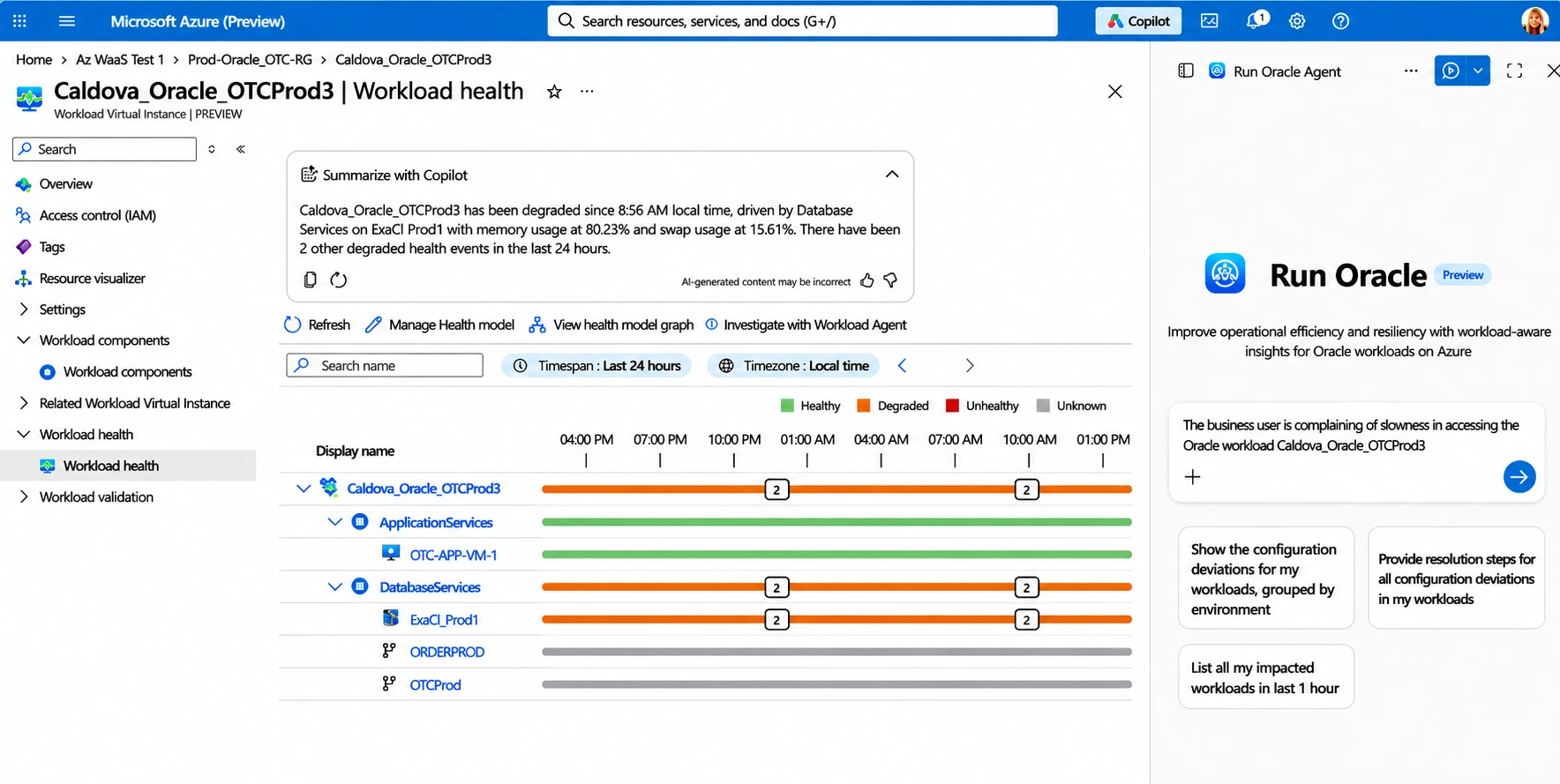
For IT operations teams, the complexity of managing distributed, heterogeneous environments has historically been a significant barrier to agility. To address this, the companies introduced a limited preview of the Azure Workload Center for Oracle. This tool utilizes a construct known as a Workload Virtual Instance (WVI) to unify the architecture, resources, and dependencies of a given workload.
By integrating WVI with Azure Monitor Health Models and the Microsoft Azure Copilot Run Oracle agent, IT administrators can now achieve a comprehensive, cross-layer view of their infrastructure. This is particularly relevant for diagnosing performance bottlenecks. In a scenario where an order-processing application exhibits latency, an administrator can utilize the Workload Center to identify the root cause—be it a database service issue, a network configuration, or an application-layer dependency—without manually parsing logs across disparate systems.
The integration is fortified by robust security controls. By utilizing Microsoft Entra authentication alongside Oracle Deep Data Security, the system ensures that AI agents operate strictly within the bounds of a user’s existing permissions. Every interaction is routed through a managed Model Context Protocol (MCP) server, ensuring that all database queries are auditable and compliant with enterprise governance standards.
Democratizing Data: The Oracle AI Database Plug-in for Excel
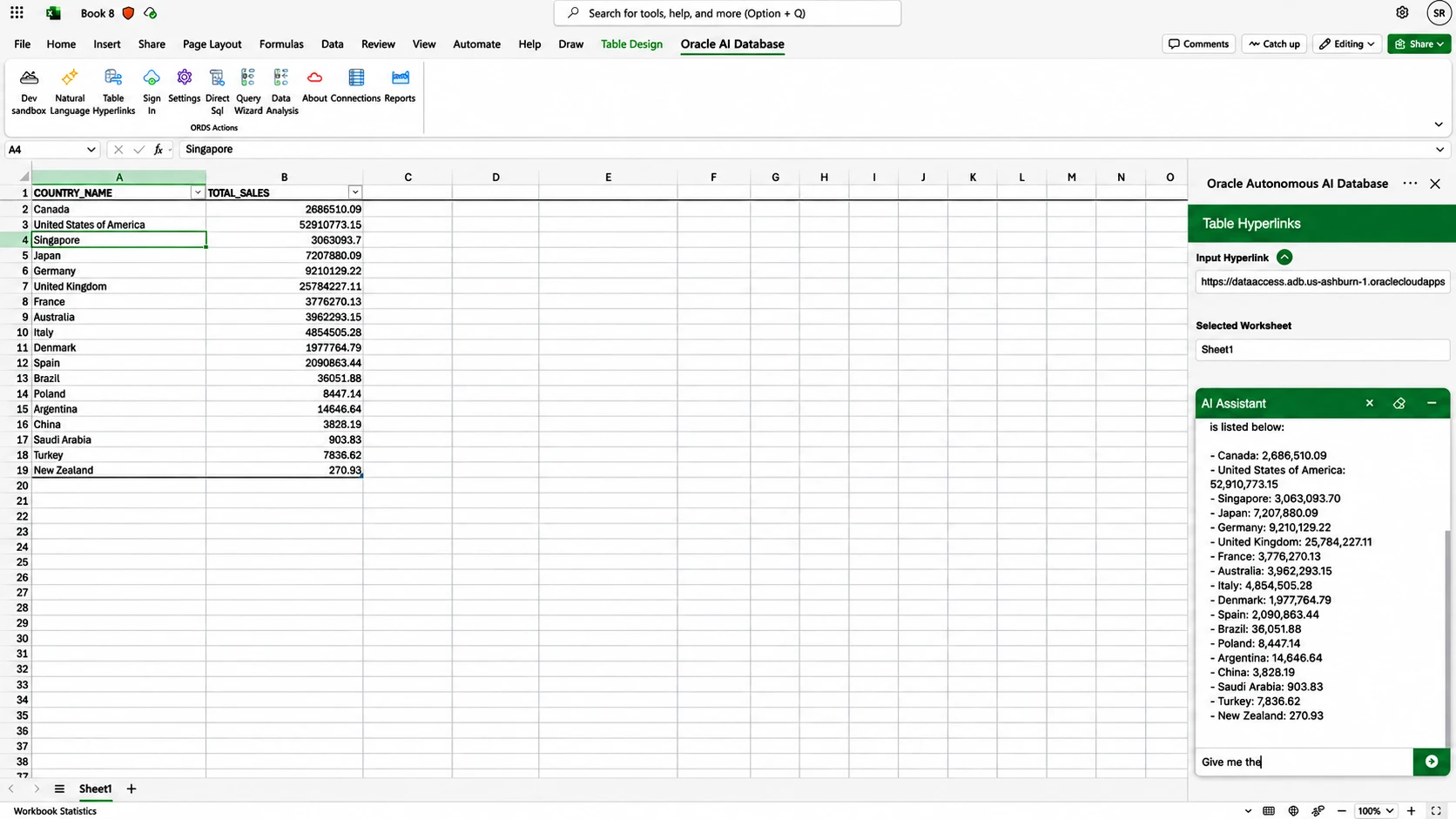
Perhaps the most immediate impact for end-users is the release of the Oracle AI Database plug-in for Excel. Historically, business analysts have relied on technical intermediaries to extract and format data from large-scale Oracle databases, a process that is both time-consuming and prone to delays.
The new plug-in facilitates a direct, secure connection between Excel and the Oracle Database. Users can query, retrieve, and manipulate trusted enterprise data without leaving the spreadsheet environment. When combined with Microsoft Copilot, this functionality allows for sophisticated, natural-language analysis. For example, a financial controller can ask Copilot to analyze margin shifts or identify anomalies in supply chain demand. Copilot, in turn, draws on the "Work IQ" context—such as recent email threads or meeting summaries—to provide an explanation of the data, offering a level of insight that was previously buried in disconnected dashboards.
Empowering Developers with Microsoft Foundry
For developers, the challenge has never been the availability of AI models, but the difficulty of moving from a prototype to a production-ready, enterprise-grade agent. The introduction of support for Microsoft Foundry, coupled with Managed Model Context Protocol (MCP) servers and the A2A protocol, provides a structured framework for building trusted agents.
These tools allow developers to create agents that interact with Oracle databases through predefined, governed SQL and PL/SQL operations. By enforcing role-based access, the system ensures that AI agents cannot "hallucinate" or exceed their authorized data scope. Instead of copying sensitive data into AI models—a significant risk factor for many organizations—the AI is brought to the data. This "data-local" approach preserves the security of the primary system of record while enabling the creation of complex, multi-agent systems that can perform cross-functional tasks, such as sales intelligence, risk assessment, and customer policy management.
Implications for the Enterprise AI Market
The convergence of Oracle’s data dominance and Microsoft’s AI capabilities carries profound implications for the enterprise software market. As organizations move beyond the initial "AI hype" cycle, the demand for "grounded" AI—systems that provide verifiable, cited, and accurate results—has become the primary driver of investment.
From an analytical standpoint, the partnership addresses the "trust deficit" that has plagued early AI deployments. By tethering agentic AI to a governed database, companies can reduce the risk of inaccurate outputs, which is a requirement for sectors such as finance, healthcare, and public administration. The upcoming FedRAMP Class D certification for Oracle AI Database@Azure, for instance, underscores the commitment to meeting the rigorous security standards required by the US government and other public-sector entities.
Furthermore, this integration effectively challenges the status quo of "black box" AI. By providing operational transparency through the Workload Virtual Instance and ensuring that all agent actions are logged and auditable, the companies are establishing a template for how enterprises can safely adopt autonomous agents.
Looking Ahead
The announcements at Microsoft Ignite 2026 serve as a clear signal that the next phase of enterprise transformation will be defined by the seamless integration of systems of record and systems of intelligence. As businesses continue to grapple with the pressures of digital transformation, the ability to turn raw, legacy data into real-time, AI-driven action will likely become a primary competitive differentiator.
For organizations currently navigating their AI roadmaps, the integration of Oracle and Microsoft technology provides a viable path to scale. By leveraging existing investments in Oracle’s database estate and extending them through Microsoft’s AI-native tools, companies can bypass the need for massive, risky data migrations.
As these tools move from preview to general availability, the focus for the industry will inevitably shift toward the measurement of tangible ROI—specifically, the reduction in time-to-insight and the improvement in operational efficiency. While the promise of agentic AI is vast, the success of this initiative will be measured by the reliability, security, and accuracy of the outcomes produced by these agents in real-world, high-stakes environments.
For those seeking to understand these advancements further, Oracle has provided access to technical documentation and on-demand breakout sessions from the Ignite conference, including deep dives into the operational benefits of the Azure Workload Center for Oracle and the architectural advantages of the new agentic frameworks. The path forward suggests that the future of enterprise AI will not be built on isolated, experimental models, but on the disciplined, secure integration of the world’s most trusted data systems.
Related posts: