AWS Weekly Roundup: Local Development Tools, Hardware Security, and Infrastructure Updates Set New Standards for Cloud Engineering

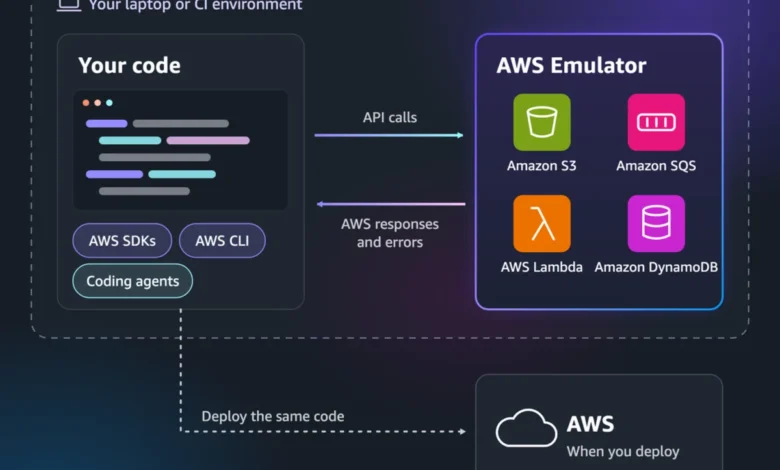
The landscape of cloud software development experienced a significant shift last week with a series of pivotal announcements from Amazon Web Services (AWS), led by the general availability of the AWS Emulator. Designed to streamline both human-driven coding workflows and automated agentic interactions, the new emulator allows developers to run AWS API simulations locally without provisioning cloud resources. Alongside this headline tool, AWS introduced a robust suite of updates focusing on hardware-enforced workload isolation through Nitro Sandboxes, advanced token exchange protocols via Amazon Cognito, and high-performance serverless search capabilities for Amazon ElastiCache. These releases collectively address long-standing engineering bottlenecks in cost management, iterative testing velocity, multi-tenant security architecture, and disaster recovery preparedness.
The Evolution of Local Development and Testing Infrastructure
For decades, cloud-native development has required continuous interaction with remote cloud environments, creating friction in iterative testing cycles and increasing initial prototyping costs. The debut of the AWS Emulator directly targets this operational overhead. By deploying a local HTTPS endpoint that accepts standard requests from the AWS Command Line Interface (CLI) and official AWS Software Development Kits (SDKs), the tool enables developers and coding agents to test API integrations directly on personal workstations or continuous integration (CI) pipelines.
During initial evaluations, engineering teams have utilized the emulator to execute standard operations—such as creating Amazon DynamoDB tables, writing structured items, and executing read queries—entirely offline. Because these emulated operations require neither an active AWS account nor incur service fees, the barrier to rapid experimentation has dropped substantially.
However, industry analysts and AWS technical leads emphasize that the emulator is designed for functional logic iteration rather than exhaustive security validation. The current implementation does not replicate complex Identity and Access Management (IAM) permissions, resource-policy enforcements, cross-account boundaries, or multi-Region behaviors. Consequently, standard engineering best practices still mandate comprehensive integration testing against live cloud infrastructure prior to production deployment. Furthermore, developers must consult published fidelity matrices; unsupported API calls return standard HTTP 501 error codes, allowing coding agents to dynamically adjust or flag unhandled interactions.
Hardware-Enforced Workload Isolation via Nitro Sandboxes
Addressing the rigorous security demands of enterprise multi-tenancy, shared compute environments, and autonomous coding agents, AWS introduced Nitro Sandboxes. This capability brings hardware-level isolation directly to individual Amazon Elastic Kubernetes Service (EKS) pods, Amazon Elastic Container Service (ECS) tasks, and Amazon Elastic Compute Cloud (EC2) virtual machines.
Operating on shared EC2 infrastructure traditionally required balancing density optimization with strict security boundaries. Nitro Sandboxes solve this challenge by introducing two distinct operational modes: isolated mode and confidential mode. Isolated mode establishes a dedicated virtual machine boundary around individual tasks or pods, separating workloads from neighboring processes on the same host. Confidential mode advances this security posture by incorporating hardware-level protections that shield data and execution states even from node operators, supported by cryptographic attestation protocols.
This architectural shift is particularly timely given the rise of automated coding agents capable of executing generated code within infrastructure environments. By containing execution risks at the hardware hypervisor level, organizations can safely provision high-risk build jobs, untrusted third-party plug-ins, and autonomous agent workspaces on shared infrastructure without incurring the financial penalty of dedicated, single-tenant host provisioning.
Identity Delegation and Advanced Security Protocols
As distributed systems increasingly rely on microservices and delegated agentic architectures, the secure propagation of user identity and permissions has become paramount. To support these complex auth flows, Amazon Cognito has added native support for the OAuth 2.0 Token Exchange specification.
Under the new protocol, applications can exchange an existing user token for a downstream-scoped token tailored to specific microservices or backend integrations. This derived token features narrower permission boundaries, a strictly defined single audience, and omits refresh tokens to minimize long-term exposure risks. Additionally, the inclusion of an act claim within the token structure identifies intermediary entities—such as an AI assistant acting on a user’s behalf—providing explicit traceability for audit logs and security compliance frameworks. This feature is currently available across Essentials and Plus tiers in all commercial Amazon Cognito regions.
Concurrently, system administrators managing large-scale logging operations gained granular control through the introduction of account-level retention policies in Amazon CloudWatch Logs. Organizations can now define uniform retention lifecycles across all existing and newly provisioned log groups—or target specific naming prefixes—eliminating the previous administrative burden of updating individual log group configurations manually. When overlapping policies occur, the system automatically defaults to the longest retention period, ensuring compliance with corporate and regulatory data governance standards.
Breakthroughs in Machine Learning Models and Search Capabilities
The enterprise artificial intelligence ecosystem on AWS received a major expansion with the introduction of Claude Fable 5.2, now accessible via Amazon Bedrock and the Claude Platform on AWS. Developed by Anthropic, Fable 5.2 is positioned as a premier model for advanced technical operations, including multi-step software engineering tasks, deep academic research, and complex quantitative financial modeling.
Enterprise adoption of the model is governed by Amazon Bedrock’s established data privacy and compliance frameworks, including specific model retention policies that store interaction traffic for up to 30 days exclusively for automated abuse detection, alongside temporary zero-retention exceptions for approved internal workloads.
Complementing these AI model deployments, Amazon ElastiCache Serverless for Valkey has integrated native support for advanced search and server-side aggregations. Developers can now combine vector embeddings, full-text search, and hybrid query models directly within serverless cache infrastructure. This capability significantly optimizes product discovery engines, recommendation systems, and real-time agent-memory retrieval pipelines, enabling high-speed querying of rapidly evolving datasets without the operational complexity of managing dedicated search clusters.

Enterprise Data Resilience and Disaster Recovery
Data availability and business continuity measures received a substantial upgrade with the introduction of managed cross-Region disaster recovery for the Amazon OpenSearch Service. Administrators can now pair OpenSearch domains running version 3.7 or later across two distinct AWS Regions within the same account.
AWS benchmarked the service against stringent Recovery Point Objectives (RPO) and Recovery Time Objectives (RTO), targeting under one minute for data loss during failovers and under 20 minutes for total recovery time. While planned switchovers preserve all committed writes, unplanned failover events carry the risk of losing unreplicated data. Infrastructure teams remain responsible for synchronizing cluster configurations and dynamically redirecting application routing endpoints following a role reversal.
Operational Impact, Cost Optimization, and Industry Implications
The convergence of local developer tooling, hardware sandboxing, and advanced AI runtimes highlights a broader industry trend toward maximizing engineering velocity while tightening cost predictability. Alongside the primary service launches, recent updates to the Amazon Bedrock AgentCore runtime—which defaults to microVM isolation with sub-two-second startup times and a 68% reduction in idle memory billing—demonstrate how cloud providers are actively restructuring pricing and architecture to support autonomous agent deployment at scale.
Industry analysts note that these combined infrastructure advancements remove critical friction points that have traditionally slowed enterprise cloud migration and AI adoption. By shifting debugging loops to local hardware via the AWS Emulator, lowering the cost barriers of agentic tasks, and enforcing strict workload isolation through Nitro Sandboxes, AWS has established a modernized foundation for cloud-native software development.
As organizations prepare for upcoming industry gatherings, including the upcoming AWS re:Invent conference in Las Vegas, technical leaders are expected to focus heavily on integrating these local-first development patterns and hardware-isolated execution boundaries into their enterprise roadmaps. These tools collectively signal a mature phase of cloud engineering, where developer productivity and robust security infrastructure are no longer mutually exclusive design compromises.