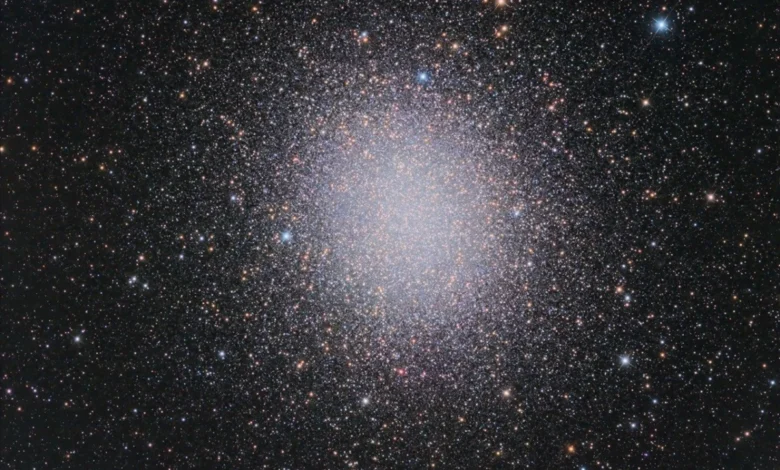
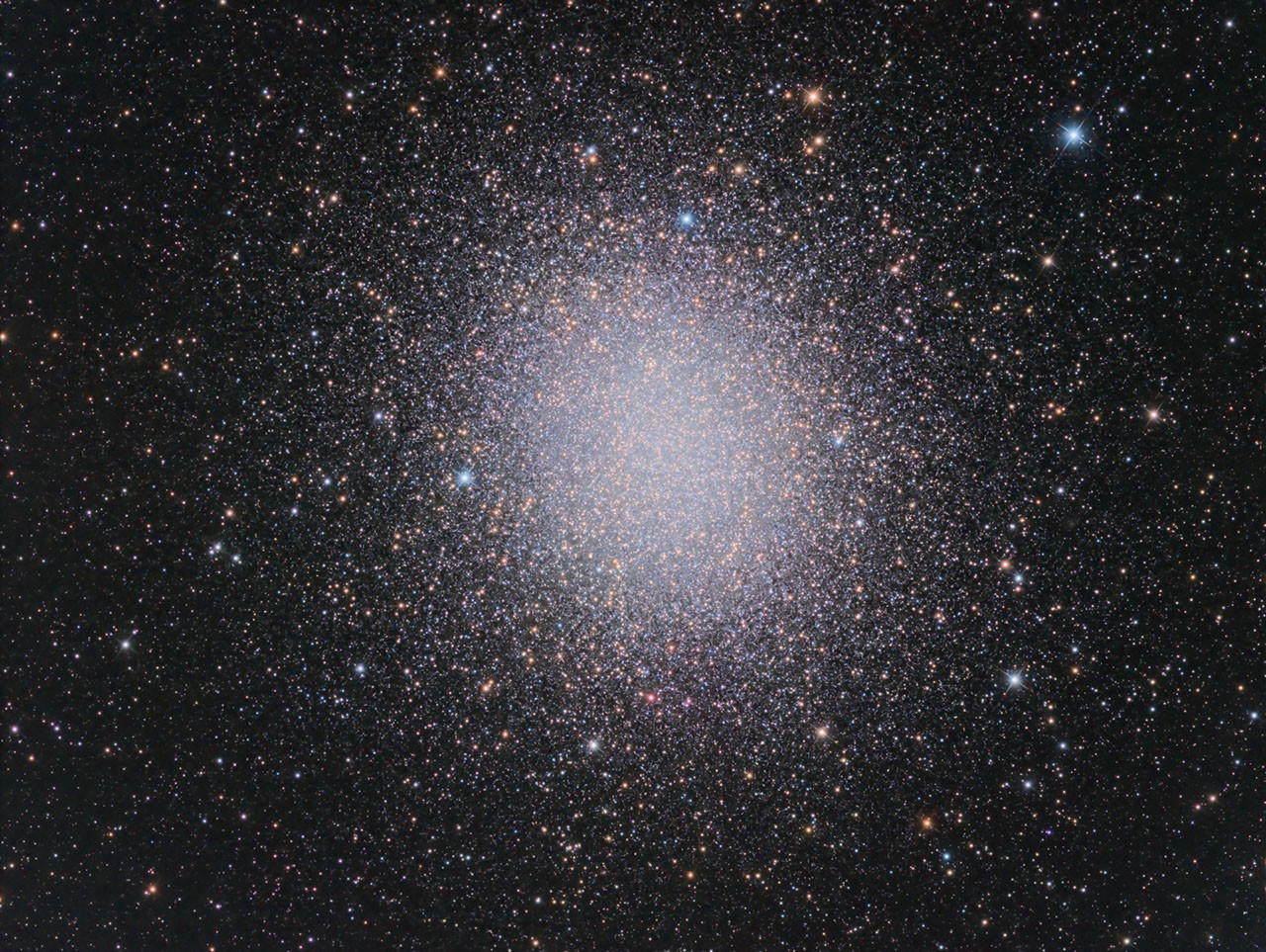
Omega Centauri, cataloged officially as NGC 5139, stands as the most spectacular and enigmatic globular cluster orbiting within the halo of the Milky Way. Spanning roughly 150 light-years in diameter and situated approximately 15,000 light-years from Earth, this massive gravitational anchor contains upwards of 10 million stars. While it has long been categorized as a standard globular cluster, modern astrophysical analysis suggests that Omega Centauri is far more than a mere collection of ancient stars; it is likely the stripped-down, surviving core of a dwarf galaxy that was cannibalized by the Milky Way billions of years ago. Recent observations, fueled by decades of high-resolution imagery from the Hubble Space Telescope, have further solidified this theory, identifying the presence of a central intermediate-mass black hole and complex stellar populations that defy the traditional definitions of a simple star cluster.
A Chronology of Discovery and Classification
The history of human observation regarding Omega Centauri dates back to antiquity, though it was not initially recognized as a cluster. Ptolemy, in the second century, recorded it as a star, as did Johann Bayer in his 1603 star atlas, Uranometria, where he assigned it the Greek letter Omega. It was not until 1677 that the astronomer Edmond Halley identified it as a non-stellar object, and later, in the 19th century, John Herschel confirmed its nature as a globular cluster.
For most of the 20th century, the scientific consensus held that globular clusters were "simple" systems. These were defined as groups of stars born from the same cloud of gas at the same time, sharing a uniform chemical composition. However, as spectroscopy and photometry advanced in the late 1990s and early 2000s, researchers discovered that Omega Centauri was an outlier. Unlike its peers, which typically show a single stellar population, Omega Centauri displayed multiple "generations" of stars, ranging in age and heavy-metal content. This discovery prompted a paradigm shift in galactic archaeology, leading experts to hypothesize that the cluster is actually the remnant nucleus of a dwarf galaxy that lost its outer regions to the Milky Way’s tidal forces during an ancient merger event.
Stellar Dynamics and Compositional Data
The internal architecture of Omega Centauri is staggering. With a mass estimated at 4 million times that of the Sun, the cluster is significantly more massive than any other globular cluster in the Milky Way. Its stars are predominantly ancient, with many having formed over 10 billion years ago, long before the Sun ignited. However, the presence of younger, metal-rich stars suggests that the progenitor galaxy was capable of sustained star formation, a characteristic typically reserved for larger, independent galaxies rather than globular clusters.
The yellowish hue that dominates the cluster is a direct result of the population of red giant stars—aging stars that have exhausted their core hydrogen and expanded significantly. These giants act as tracers, allowing astronomers to map the density and velocity of the cluster’s core. The sheer density of stars in the center of Omega Centauri is so high that if one were to reside on a planet orbiting a star in the core, the night sky would be perpetually illuminated by the light of thousands of neighboring stars, rendering true darkness impossible.
The Search for the Central Black Hole
One of the most significant recent breakthroughs in the study of NGC 5139 involves the confirmation of an intermediate-mass black hole (IMBH). For years, astronomers have sought evidence of black holes in the "mass gap"—those that are larger than stellar-mass black holes but smaller than the supermassive black holes found at the centers of major galaxies.
By utilizing over 20 years of archival Hubble Space Telescope data, researchers were able to measure the precise motions of stars in the cluster’s innermost regions. The velocity dispersion of these stars—how fast they move relative to one another—suggests that an invisible, highly concentrated mass of approximately 8,200 solar masses exists at the very center of the cluster. This finding provides critical evidence that globular clusters may hold the keys to understanding how supermassive black holes grow through the hierarchical merging of smaller galactic components. If Omega Centauri is indeed a dwarf galaxy remnant, the presence of this black hole is the "smoking gun" of its former status as an independent entity.
Scientific Implications and Future Missions
The implications of the Omega Centauri study extend well beyond the cluster itself. By treating this object as a laboratory for galactic evolution, astrophysicists are gaining a better understanding of how the Milky Way grew to its current size. The study of stellar streams and tidal debris in the galactic halo has allowed scientists to reconstruct the "merger history" of our home galaxy, identifying other globular clusters that may share a similar, exotic origin.
The shift in how we perceive Omega Centauri—from a simple cluster to a complex galactic nucleus—has fundamentally changed how mission planners look at deep-space survey data. As NASA and the European Space Agency continue to transition their archival assets to new, more accessible platforms like science.nasa.gov, the ability for the global scientific community to cross-reference data on Omega Centauri grows. The democratization of this data allows for more robust statistical analysis, which is essential for confirming the presence of complex stellar populations in other candidates across the Local Group.
Perspectives from the Astrophysical Community
Professional astronomers have noted that the "Omega Centauri problem" serves as a benchmark for stellar evolution models. Dr. A. V. M. Cadenas, whose work on high-resolution imaging has contributed to our understanding of the cluster’s morphology, has previously noted that the intricate patterns of star formation observed in NGC 5139 suggest a far more violent and turbulent history than previously thought.
Furthermore, the integration of data from the Gaia mission, which provides precise parallax and proper motion measurements, has allowed researchers to map the orbit of Omega Centauri as it plunges through the Milky Way’s halo. This orbital data indicates that the cluster is on a highly eccentric path, further supporting the theory that it was captured by the Milky Way from an external source.
Broader Impact on Galactic Archaeology
The story of Omega Centauri is effectively the story of the Milky Way’s expansion. Every star cluster that acts as a "survivor" from a past merger event adds a chapter to our understanding of the cosmic timeline. As we look toward the next generation of space observatories, including the James Webb Space Telescope and the upcoming Nancy Grace Roman Space Telescope, the focus on targets like Omega Centauri will likely intensify.
These future missions aim to resolve individual stars in even more distant clusters, providing a comparative framework to see if the characteristics of Omega Centauri are common or if it represents a rare, singular event in the history of our galaxy. The shift of the Astronomy Picture of the Day (APOD) archive to the new NASA Science portal represents a broader institutional commitment to keeping these findings accessible to both the public and the scientific community. By maintaining a centralized, verified, and updated repository of information, NASA ensures that the discovery process remains transparent and collaborative.
In conclusion, Omega Centauri remains the crown jewel of the southern sky. It challenges our assumptions about the simplicity of globular clusters, invites us to reconsider the hierarchy of galactic structures, and provides a tangible link to the violent, formative years of the Milky Way. As we continue to probe its depths, the "prize star cluster" of the Milky Way will undoubtedly continue to yield new insights into the fundamental processes that govern the lifecycle of galaxies, the birth of stars, and the inevitable influence of black holes in the vast, cosmic expanse.