Molecular Gas Structure and Star Formation Diversity in Stephan’s Quintet Revealed by ACA CO(1–0) Mapping

The movement of star-forming gas within galactic environments represents one of the most fundamental, yet complex, challenges in contemporary astrophysics. Galaxies are not static collections of stars; they are dynamic, interacting systems where molecular hydrogen—the primary fuel for stellar birth—is subjected to immense gravitational forces, shock fronts, and tidal stripping. This gas exists in a state of constant flux: stretched into elongated streams between merging galaxies, compressed by high-velocity impacts, and distributed in states ranging from diffuse, cold reservoirs to dense, radiation-soaked nurseries.
While molecular hydrogen ($H_2$) is the most abundant molecule within giant molecular clouds, it remains notoriously difficult to detect directly due to its physical properties. Consequently, astronomers rely on carbon monoxide (CO) as a primary tracer. Although CO accounts for only a tiny fraction of the total molecular cloud volume, its widespread presence and sensitivity to energy fluctuations make it an indispensable proxy for mapping the distribution and motion of $H_2$. A recent study led by researchers at Osaka Metropolitan University has leveraged this technique to produce the most detailed map to date of one of the universe’s most famous cosmic laboratories: Stephan’s Quintet.
A Cosmic Landmark: The Context of Stephan’s Quintet
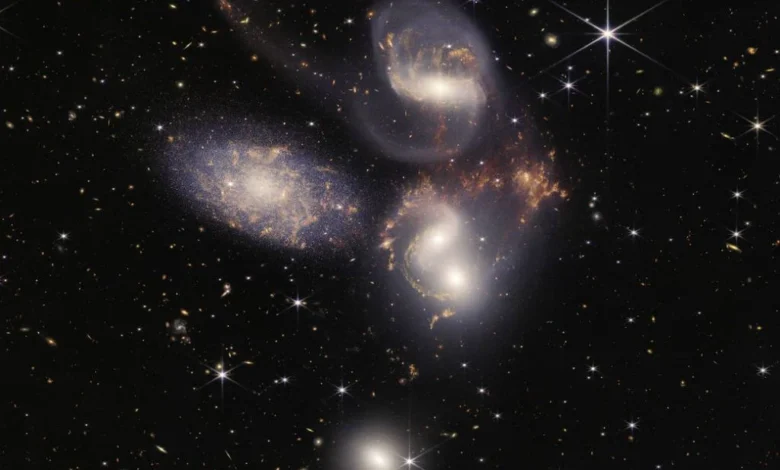
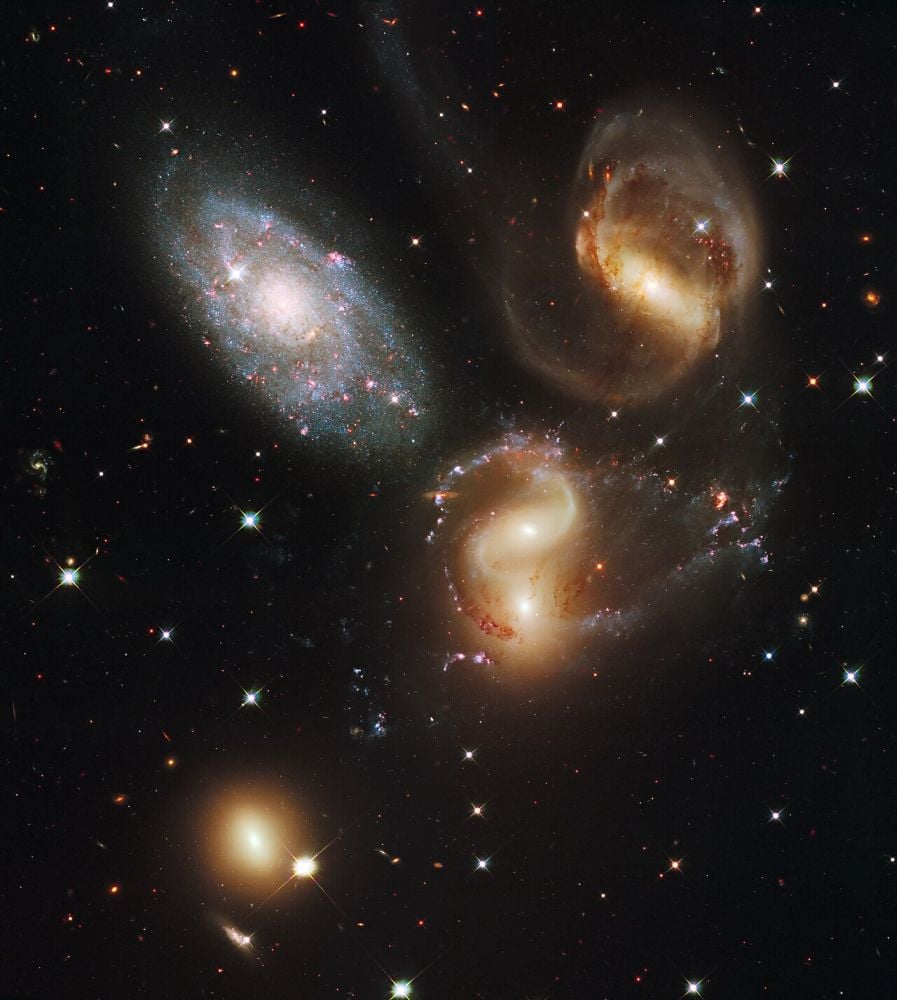
Stephan’s Quintet (SQ) has long occupied a central place in the study of galactic evolution. Discovered by Édouard Stephan in 1877 at the Marseille Observatory, it was the first compact galaxy group ever identified. Over the subsequent 147 years, it has become the gold standard for studying the violent physics of galaxy interactions.
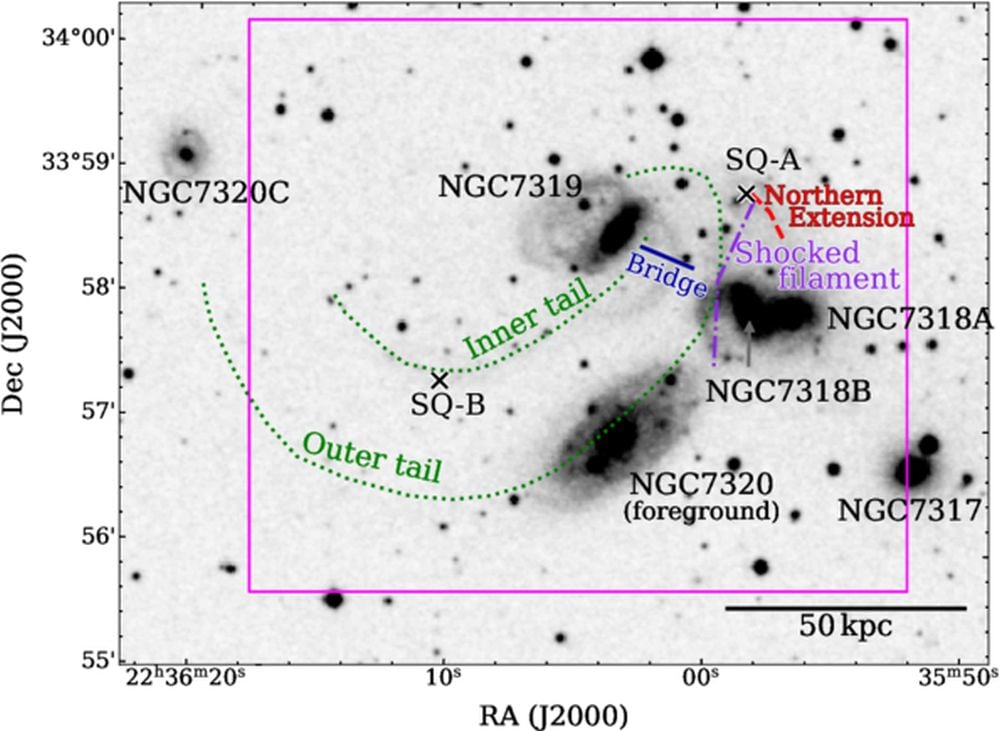
Located in the constellation Pegasus, the system is visually striking. However, appearances can be deceptive. While it appears to be a tight-knit family of five galaxies, modern spectroscopic analysis has revealed that one member, NGC 7320, is a foreground object. It resides approximately 40 million light-years from Earth, while the other four members—NGC 7317, NGC 7318a, NGC 7318b, and NGC 7319—form a true compact group located roughly 290 million light-years away. These four galaxies are currently locked in a slow-motion, gravitational dance that is stripping them of their gas and fundamentally altering their star-forming potential.

The Methodology: Utilizing the Atacama Compact Array
To achieve a higher level of detail than previously possible, lead researcher Misaki Yamamoto and her team utilized the Atacama Compact Array (ACA), a specialized component of the Atacama Large Millimeter/submillimeter Array (ALMA) located in the high-altitude Atacama Desert in Chile.
The ACA, often referred to as the "7-m Array," is designed to provide high-fidelity imaging of extended objects. While the larger ALMA array is optimized for high-resolution snapshots of compact sources, the ACA’s shorter baselines allow it to capture the large-scale distribution of gas that is often "filtered out" by larger interferometers. By combining the 7-meter antennae with the Total Power array, the researchers were able to synthesize a comprehensive map of the 12CO(1–0) emission line across the entire 137 kpc by 119 kpc extent of the group.
The study, published in The Astrophysical Journal, provides a spatially resolved map with a resolution of approximately 5.5 kiloparsecs. This represents a significant advancement in our understanding of how molecular gas is organized across the entire group, rather than focusing solely on individual galactic nuclei or localized hotspots.
Findings: Gas Distribution and Turbulence
The mapping data reveals a dramatic transformation of the group’s internal environment. In a typical spiral galaxy, molecular gas is neatly organized within the galactic disk, where it serves as the raw material for star formation. In Stephan’s Quintet, however, the data shows that the member galaxies are significantly hydrogen-deficient.
The gravitational interplay between the members has stripped vast quantities of neutral hydrogen from the disks, throwing it into the intergalactic medium. This gas now forms elongated tidal tails and shocked filaments extending far beyond the borders of the individual galaxies. The researchers found that while gas is present, its distribution is highly irregular and dominated by the ongoing collision process.
Perhaps the most critical finding concerns the role of turbulence in regulating star formation. By measuring the velocity dispersion of the CO gas—the spread in speeds within a given cloud—the team was able to quantify the turbulence within these structures. Their findings indicate a clear, negative correlation between velocity dispersion and Star Formation Efficiency (SFE).
In areas where turbulence is low, star formation proceeds at rates comparable to those observed in isolated, quiescent disk galaxies. However, in regions surrounding the shocked filaments—where velocity dispersion reaches extreme values of 50 to 150 km/s—star formation is severely suppressed. This suggests that the same gravitational forces that "stir up" the gas in the early stages of a collision may, paradoxically, prevent that gas from settling into the dense, stable cores required for stars to ignite.
Official Reactions and Implications
The research team emphasized that these observations offer a clearer window into the mechanics of galaxy evolution. "Interactions between galaxies can both compress and disperse molecular gas, creating dramatic differences in star formation activity," noted Misaki Yamamoto in a press release following the publication. "The findings point to turbulence as a critical factor in regulating where, and how efficiently, stars can form."
Co-author Kazuyuki Muraoka added that the study serves a broader purpose in the field of cosmology. "Star formation is one of the most fundamental processes in galaxy evolution. Understanding how galaxy collisions and interactions in the early universe enhance or suppress star formation will allow researchers a better tool to trace the history of galaxy evolution across cosmic time."
The implications of this work extend to our understanding of the early universe. During the epoch of galaxy assembly, high-speed collisions and mergers were far more frequent than they are today. If turbulence serves as a natural "brake" on star formation in these high-energy environments, it explains why some massive, interacting systems in the early universe exhibit surprising deficits in star-forming activity despite having abundant gas reservoirs.
Broader Impact on Galactic Evolution
This study provides a rigorous quantitative framework for interpreting future observations from next-generation telescopes. By establishing a baseline for how turbulence affects the SFE in a well-characterized system like Stephan’s Quintet, astronomers now have a template for analyzing similar "compact group" environments in the deep field.
The data further clarifies that the "death" of a galaxy—the process by which it ceases to produce new stars—is not merely a matter of running out of fuel. It is also a matter of dynamic state. Even when galaxies possess the necessary chemical components to build stars, the structural turbulence induced by tidal interactions can render that fuel unusable. This "starvation by turbulence" represents a significant shift in the theoretical models of how galaxies transition from active, star-forming entities to "red and dead" elliptical galaxies.
As the scientific community continues to analyze the high-resolution data provided by ALMA and its sub-arrays, the case of Stephan’s Quintet serves as a sobering reminder of the violent history of our universe. What appears to be a harmonious arrangement of stars from our vantage point on Earth is, in reality, a chaotic process of stripping, crushing, and kinetic interference. The work of Yamamoto et al. confirms that in the grand architecture of the cosmos, the movement of gas is the invisible hand that dictates the fate of galaxies, and it is the turbulent, often violent history of these interactions that ultimately defines the life cycles of the stars they contain.
Moving forward, the researchers plan to integrate these CO maps with multi-wavelength data, including infrared observations from the James Webb Space Telescope (JWST), to obtain a more complete picture of the transition from neutral gas to stellar clusters. By correlating the cold gas motion with the infrared signatures of nascent stars, they hope to further solidify the causal link between turbulent dissipation and the suppression of star-forming potential in the most crowded regions of the universe.
Related posts: