GitHub Redesigns Issues Navigation for Instant Performance with Client-Side Architecture

GitHub has unveiled a significant architectural overhaul for the navigation experience within GitHub Issues, strategically shifting more processing power to the client-side to dramatically reduce perceived latency for developers. This ambitious redesign introduces a sophisticated blend of client-side caching, predictive prefetching, and service worker-based request handling, collectively aiming to transform the user experience. The immediate impact of these innovations is notable: the proportion of "instant navigation experiences" has surged from a mere 4% to an impressive 22%. This architectural evolution directly confronts a pervasive challenge in the realm of large-scale web applications: mitigating the persistent delays frequently incurred by repeated network requests and redundant client initialization, particularly within high-frequency developer workflows.
The Imperative for Speed: Addressing Developer Friction
In the dynamic world of software development, efficiency is paramount, and even minor delays can fragment focus and impede productivity. GitHub, as the foundational platform for millions of developers worldwide, recognizes that latency isn’t merely a technical metric; it’s a critical factor influencing developer flow state and overall platform utility. The previous architecture, heavily reliant on server-side rendering and fresh data fetches for every interaction, inadvertently created friction for its most active users. Developers frequently navigating between issues, pull requests, project boards, and related views often encountered repetitive loading sequences, diminishing the fluidity of their work.
This challenge is endemic to complex web applications, where a vast amount of data needs to be presented and updated. Each click or navigation often triggers a cascade of server requests, database queries, and client-side rendering processes. While modern internet speeds have improved, the cumulative effect of these micro-delays, especially when multiplied across hundreds of interactions daily, translates into significant time loss and cognitive load. As Alexander Lelidis, a senior software engineer at GitHub, succinctly put it, "Latency isn’t just a metric. It’s a context switch." This powerful statement underscores the psychological impact of waiting: each pause forces a developer to break concentration, pulling them out of their problem-solving mindset and requiring a conscious effort to re-engage. GitHub’s engineering team identified this as a critical area for improvement, understanding that enhancing the navigation experience directly translates to a more productive and satisfying environment for its vast user base.
A Local-First Philosophy: Shifting Intelligence to the Edge
At the core of GitHub’s new approach is a "local-first" philosophy, a paradigm shift that prioritizes the immediate availability of data within the user’s browser. Instead of defaulting to fetching fresh data from backend services for every view, the system now intelligently renders already available information directly from client-side storage. Concurrently, background processes asynchronously retrieve and synchronize newer information as needed, ensuring data freshness without sacrificing responsiveness. This strategy is particularly effective for read-heavy applications like GitHub Issues, where users often revisit previously accessed content.
To facilitate this local-first model, GitHub has implemented a sophisticated multi-layered client-side storage architecture. For persistent data storage, critical information that needs to survive across sessions is meticulously managed within IndexedDB. This powerful browser API provides a robust, low-level API for client-side storage of large amounts of structured data, making it ideal for caching complex issue details, user comments, and project metadata. Complementing this persistent layer is an in-memory caching mechanism, designed for frequently accessed data during an active user session. This ensures that transitions between recently viewed issues or lists are virtually instantaneous, leveraging the fastest possible access speeds. The combination of these storage layers allows GitHub Issues to maintain a rich, readily available dataset directly within the user’s browser, drastically reducing the reliance on repeated network round trips and minimizing perceived loading times.
Architectural Pillars: Caching, Prefetching, and Service Workers
The engineering team deployed a trio of interconnected technologies to achieve this performance leap:
1. Advanced Client-Side Caching with Stale-While-Revalidate:
The caching model adopted by GitHub follows the widely recognized "stale-while-revalidate" pattern. When a user revisits content they have previously accessed, the application is designed to immediately display the locally stored, potentially "stale" data. This instantaneous display eliminates the frustrating waiting period associated with server requests. Crucially, while the user is already interacting with the displayed content, the system quietly initiates a background synchronization process to fetch the latest version of that data from the backend. Once the fresh data is retrieved, the cached information is updated, ensuring consistency with the server’s state for subsequent accesses. This intelligent approach provides the best of both worlds: immediate responsiveness for the user and eventual data consistency.
2. Predictive Prefetching and Preheating:
To further optimize cache effectiveness and anticipate user needs, GitHub introduced "preheating." This innovative technique leverages user navigation patterns and behavioral analytics to predict which data a user is likely to require next. Before the user even explicitly requests it, the system proactively fetches and populates relevant cache entries in the background. For instance, if a user is viewing an issue and has a high probability of clicking on a linked pull request or a related user profile, that data might be prefetched. This proactive data loading ensures that when the user does make the anticipated navigation, the information is already available in the local cache, leading to an instant transition.
However, the efficacy of prefetching is context-dependent, a nuance highlighted by BareStack. As they pointed out, "Prefetching pays when the data graph is small and read-heavy like Issues. Most applications have a larger graph with read/write collisions, so prefetched views may re-fetch after landing. The reusable pattern is the shell-first render + cache-hit hydration, not prefetching itself." This critical distinction emphasizes that while prefetching is powerful for GitHub Issues’ predominantly read-heavy and relatively contained data graph, its application in other types of applications with more complex, frequently mutating data graphs requires careful consideration. The core takeaway for broader application design remains the combination of a "shell-first render" (displaying a basic UI quickly) and "cache-hit hydration" (populating it with cached data), rather than blindly relying on prefetching for all scenarios.
3. Service Workers for Intelligent Request Handling:
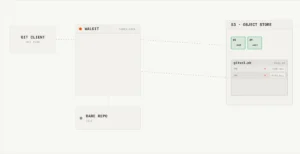
Service workers represent a cornerstone of modern web application performance, acting as a programmable proxy between the browser and the network. GitHub has extensively leveraged service workers to intercept all browser requests originating from GitHub Issues. Upon intercepting a request, the service worker first checks its local cache for available resources. If the requested data is found in the cache and deemed sufficiently fresh (or acceptable for stale-while-revalidate display), it can be rendered immediately to the user, bypassing the network entirely.
Should the data be unavailable in the cache, or if it’s determined to be critically stale beyond the acceptable threshold for background synchronization, the service worker allows the request to proceed through the normal network path to the backend servers. This intelligent routing mechanism ensures that users always receive the fastest possible response, whether from local cache or the live server, while also enabling sophisticated offline capabilities and background synchronization. The service worker request flow, detailed in GitHub’s engineering blog, illustrates this sophisticated routing: requests are first checked against the cache, then potentially served from it, or routed to the network, with background updates ensuring long-term data consistency.
Quantifiable Impact: A Leap in Performance Metrics
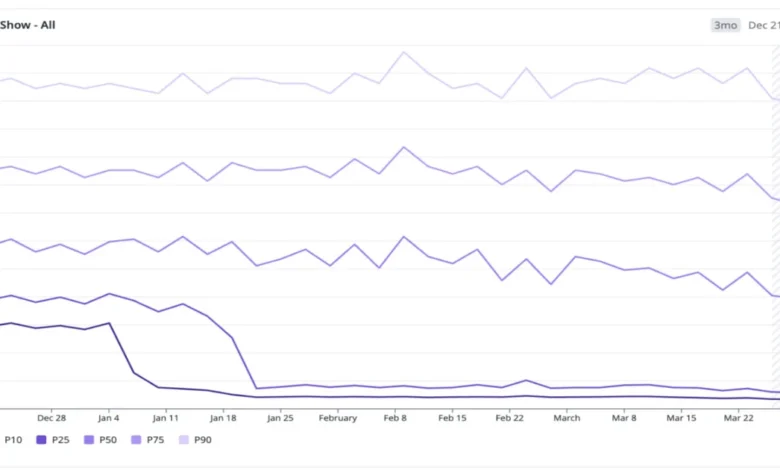
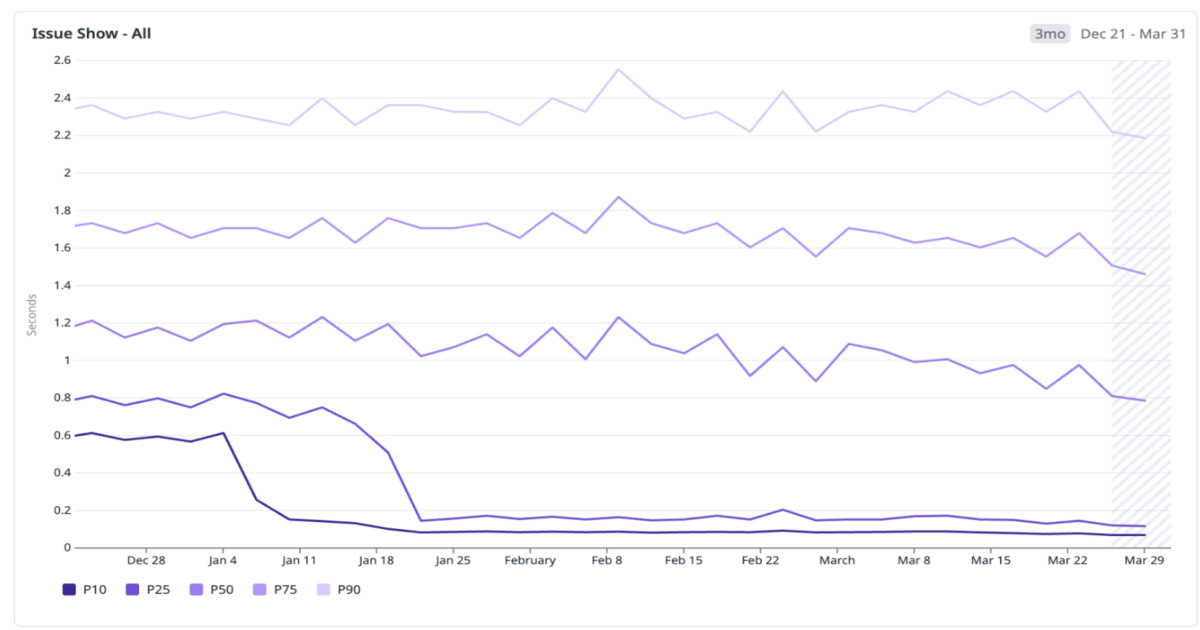
The architectural overhaul has yielded substantial, measurable improvements across various navigation latency distributions, reflecting a significant enhancement in user experience across the board. The improvements are not just at the tail end of the distribution but demonstrate a holistic uplift in performance for a wide range of users.
- P10 Latency: This metric, representing the fastest 10% of navigation experiences, saw a dramatic decrease from approximately 600 milliseconds to a mere 70 milliseconds. This means the quickest navigations are now nearly instantaneous, almost 9 times faster.
- P25 Latency: The 25th percentile, indicating that 25% of navigations are faster than this value, improved from 800 milliseconds to 120 milliseconds. This represents a substantial improvement for a quarter of all user interactions.
- Median Latency (P50): The median latency, which means half of all navigations are faster than this value, saw a significant reduction from 1,200 milliseconds (1.2 seconds) to 700 milliseconds. This improvement is crucial as it represents the experience of the typical user.
- P75 Latency: The 75th percentile, indicating that 75% of navigations are faster than this value, decreased from 1,800 milliseconds to 1,400 milliseconds. While not as dramatic as the lower percentiles, this still represents a noticeable improvement for users experiencing moderately slower navigations.
- P90 Latency: The 90th percentile, meaning 90% of navigations are faster than this value, improved from 2,400 milliseconds to 2,100 milliseconds. Even for those experiencing the slower end of the spectrum, the system is now demonstrably faster.
These percentile improvements highlight a crucial aspect of modern performance engineering, as emphasized by Oguz Guven: "Shifting from the p99 tail to distribution quality is the real engineering maturity here." This observation points to a move beyond merely fixing the absolute worst-case scenarios (P99 or P100) to instead elevate the entire user experience across the spectrum. By improving P10, P25, P50, P75, and P90, GitHub ensures that a vast majority of its users benefit from significantly faster and more consistent navigation, fostering a more pleasant and productive development environment. The increase from 4% to 22% instant navigation experiences is a direct manifestation of this commitment to improving the overall "distribution quality" of performance.
/filters:no_upscale()/news/2026/07/github-issues-navigation/en/resources/1clientside-1783811916296.jpeg)
Broader Implications for Web Development and Developer Experience
GitHub’s successful redesign of Issues navigation carries significant implications, not only for its own platform but for the broader landscape of web application development. This initiative serves as a powerful validation of client-side architectural patterns, demonstrating that even for highly complex, data-intensive applications, a strategic shift to the client can yield transformative performance gains.
1. Reinforcing Client-Side Dominance: The success of GitHub’s local-first approach underscores the growing maturity and capability of client-side technologies. As browsers become more powerful and web standards evolve, the ability to offload significant processing and data management to the user’s device is becoming a critical competitive advantage. This move by a platform as influential as GitHub is likely to inspire other large-scale web applications to explore similar architectural shifts, especially those with high user interaction and data reuse patterns.
2. Lessons for Other Platforms: The detailed insights shared by GitHub, including the nuances of prefetching highlighted by BareStack, provide invaluable lessons for other development teams. The understanding that prefetching is most effective in read-heavy, small-data-graph scenarios will help developers make more informed architectural decisions, avoiding potential pitfalls in applications with frequent read/write collisions. The emphasis on "shell-first render + cache-hit hydration" as a broadly reusable pattern offers a robust blueprint for enhancing perceived performance.
3. Elevating Developer Experience as a Strategic Asset: This project reaffirms GitHub’s commitment to the developer experience as a core product differentiator. In an increasingly competitive landscape for developer tools, platforms that reduce friction, enhance productivity, and provide a delightful user experience are more likely to attract and retain their audience. Faster navigation means less frustration, more time spent coding, and a stronger connection to the platform. This strategic investment in performance translates directly into enhanced user satisfaction and loyalty.
4. The Future of Web Standards and Frameworks: GitHub’s innovative use of IndexedDB, in-memory caching, and service workers pushes the boundaries of what’s possible within current web standards. Such high-profile implementations often influence the direction of future web platform enhancements and inspire the development of new frameworks and libraries that abstract away the complexity of these advanced client-side patterns. We may see an acceleration in tools designed to simplify the implementation of local-first architectures and sophisticated caching strategies.
5. A Model for Balancing Freshness and Responsiveness: The careful balance struck between immediate responsiveness and eventual data consistency, through strategies like stale-while-revalidate, provides a practical model for applications where real-time data is important but not always immediately critical. This approach allows for a fluid user experience without compromising the integrity of the underlying data, a challenge many web applications grapple with.
In conclusion, GitHub’s comprehensive redesign of its Issues navigation architecture is more than just a technical upgrade; it’s a strategic move to redefine the developer experience on its platform. By embracing a local-first philosophy and leveraging advanced client-side technologies, GitHub has not only achieved remarkable performance improvements but also set a new benchmark for how large-scale web applications can address the pervasive challenge of latency. The lessons learned and the architectural patterns demonstrated through this initiative will undoubtedly resonate across the web development community, influencing future trends and ultimately contributing to a faster, more responsive, and more productive digital landscape for developers worldwide.