Microsoft November 2026 Patch Tuesday Delivers 1,259 Fixes Highlighted by Actively Exploited Outlook Zero-Day Flaw

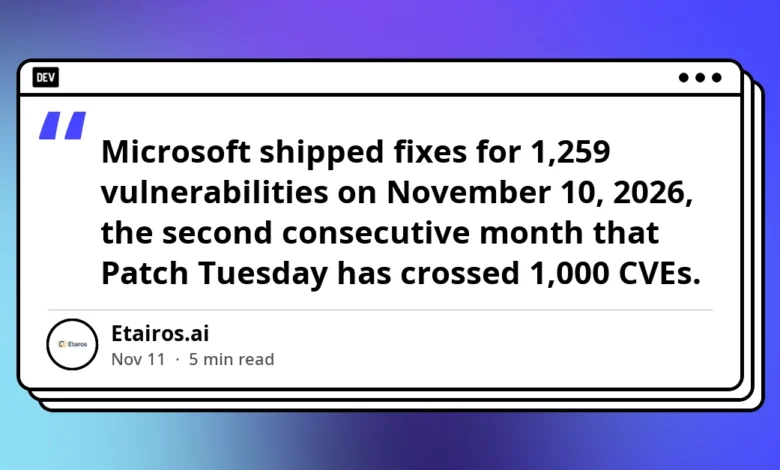
The cybersecurity landscape faced yet another unprecedented volume challenge as Microsoft Corp. rolled out its November 2026 Patch Tuesday updates on November 10, 2026, addressing a staggering 1,259 distinct vulnerabilities across its expansive ecosystem. This massive software update marks the second consecutive month that Microsoft’s monthly security bulletin has surpassed the 1,000 CVE threshold, signaling a structural shift in the sheer scale of modern software maintenance and vulnerability discovery. While the collective volume of patches demands intensive administrative effort from enterprise security teams worldwide, a single vulnerability buried deep within the release notes has captured the immediate and urgent attention of security professionals: CVE-2026-124194.
This newly disclosed vulnerability impacts Microsoft Outlook, the ubiquitous enterprise email client, and has been officially confirmed by Microsoft as actively exploited in the wild. The flaw enables an unauthenticated attacker to bypass standard user interface safeguards, forcing targeted systems to establish unauthorized network connections that inadvertently leak sensitive user credentials. Recognizing the severe operational risk posed by the flaw, the U.S. Cybersecurity and Infrastructure Security Agency (CISA) added CVE-2026-124194 to its Known Exploited Vulnerabilities (KEV) catalog on the very same day of disclosure, mandating strict compliance and remediation for federal civilian executive branch agencies by November 24, 2026.
Anatomy of an Exploited Outlook Flaw: CVE-2026-124194
At its technical core, CVE-2026-124194 has been classified by Microsoft as a spoofing vulnerability carrying a Moderate severity rating and a Common Vulnerability Scoring System (CVSS) score of 6.5. Despite the seemingly modest risk score, security researchers and threat intelligence analysts emphasize that the real-world danger vastly exceeds what the numeric score suggests. According to Microsoft’s security advisory, the root cause of the vulnerability stems from a user interface (UI) flaw within Outlook that fails to adequately warn users of potentially unsafe actions when interacting with specially crafted message files.
The exploitation vector is deceptively simple and requires minimal friction for an adversary. An unauthenticated attacker crafts a malicious message file and delivers it to a target via email or other communication channels. Once the recipient opens the file within an affected build of Microsoft Outlook, the application automatically attempts to connect to an attacker-controlled network location. Crucially, the vulnerable software build bypasses the standard external-content warning prompt that would normally alert the user or outright block the outbound connection.
This covert outbound connection does more than merely reach out to a remote server; it carries vital authentication material. Microsoft’s advisory confirms that the handshake sequence can disclose sensitive user information, specifically the user’s NTLMv2 password hash. Armed with this cryptographic material, an attacker can proceed to impersonate the user across the enterprise network. Successfully executing this attack requires only network connectivity and a single user action: opening the malicious file.
The discovery of this critical loophole was a collaborative effort. Microsoft officially credited security researcher Nono alongside Benoît Sevens of Anthropic, who utilized artificial intelligence tools, specifically the Claude model, to aid in discovering and reporting the issue. This highlights a growing trend in vulnerability research where advanced AI systems are increasingly leveraged to uncover complex logic and UI flaws in enterprise software.
Why a Leaked NTLMv2 Hash Presents an Immediate Enterprise Risk
The unauthorized capture of an NTLMv2 hash is a well-established and highly effective technique in the playbook of modern cybercriminals and nation-state actors. Forced NTLM authentication mechanisms provide attackers with a direct pathway to digital identities rather than just compromised mailboxes, transforming a simple phishing lure into full-scale network access.
Industry experts have been quick to challenge the Moderate severity label assigned to CVE-2026-124194. Jack Bicer, director of vulnerability research at Action1, underscored the gravity of the situation by noting that email remains the path of least resistance into any corporate environment, effectively converting a single opened file into a stolen identity. Once an adversary obtains a valid NTLMv2 hash, they can initiate pass-the-hash attacks, crack weak passwords offline, or relay the authentication credentials to other internal services.
The potential blast radius of such an attack is directly tied to the privileges of the victim. If an ordinary employee falls for the lure, the impact may be contained; however, if a help desk technician, system administrator, or finance officer opens the file, the stolen credentials could grant the attacker elevated privileges, lateral movement capabilities, and access to sensitive corporate repositories, file shares, and core infrastructure.
Concurrently, security defenders are grappling with a significant intelligence gap. As of the initial disclosure, Microsoft has not attributed the in-the-wild exploitation of CVE-2026-124194 to any specific threat actor or organized cybercriminal syndicate. Furthermore, the vendor has not published detailed technical indicators regarding the precise delivery mechanisms or weaponization techniques observed in real-world attacks. This leaves corporate security operations centers (SOCs) without specific vendor-supplied indicators of compromise (IoCs) or known infrastructure signatures, forcing them to rely on generalized behavioral monitoring—such as detecting anomalous outbound NTLM authentication traffic directed at external hosts.
The Broader November 2026 Patch Tuesday Landscape: 1,259 Vulnerabilities
While CVE-2026-124194 demands immediate triage, it represents only a fraction of the massive software updates pushed by Microsoft on November 10, 2026. The cumulative total of 1,259 fixed vulnerabilities spans nearly every major product line offered by the technology giant, compounding the operational workload for enterprise IT and security departments.
A granular breakdown of the November release reveals 726 vulnerabilities patched within the core Windows operating system, 174 flaws in Microsoft Office, 59 issues in SQL Server, 27 vulnerabilities in SharePoint Server, and dozens more across various developer tools. Additionally, the release incorporates 165 CVE identifiers originating from third-party components integrated into the broader Microsoft ecosystem. Categorized by vulnerability type, more than 500 of these patches address elevation of privilege (EoP) bugs, followed closely by a high volume of remote code execution (RCE) and information disclosure flaws.
According to Satnam Narang of Tenable, Microsoft has now addressed more than 5,100 CVEs throughout the course of 2026 alone, illustrating an unprecedented acceleration in software vulnerability discovery. Alongside the actively exploited Outlook zero-day, the November release includes several high-profile vulnerabilities that, while not currently known to be under active exploitation, pose significant latent risks due to their placement in core enterprise infrastructure.
Notable among these are critical vulnerabilities discovered within the Lightweight Directory Access Protocol (LDAP) and the Schannel security package. Because LDAP and Schannel sit at the heart of enterprise directory services and secure communications protocols, they are frequently accessible from wide segments of an internal corporate network. If left unpatched, vulnerabilities in these components could allow unauthenticated attackers to execute remote code on domain controllers or critical servers, making them prime targets for future weaponization by sophisticated threat actors once proof-of-concept exploits inevitably emerge.
Patch Fatigue as an Operational Risk
The reality of consecutive months featuring over 1,000 CVEs has transformed patch management from a routine administrative chore into a major operational risk. Industry analysts emphasize that this volume is no longer a temporary statistical spike but a structural shift in how software vulnerabilities are identified and reported.
Jake Knott, head of threat intelligence at watchTowr, pointed out that many enterprise security teams are suffering from severe fatigue, struggling to recover from previous months of high-volume vulnerability disclosures while attempting to determine which patches require immediate deployment. To navigate this overwhelming influx of updates, security leaders recommend a disciplined triage framework: prioritize internet-facing assets first, immediately address flaws with confirmed in-the-wild exploitation next, and subsequently tackle all other updates—provided the vulnerable software component is actively installed and its specific exploitation prerequisites are met within the environment.
Within this prioritization hierarchy, CVE-2026-124194 sits firmly at the very top of the queue. Delivered via email—a communication vector that reaches virtually every employee—and targeting Outlook, an application deployed on almost every corporate endpoint, the vulnerability combines widespread exposure with active exploitation.
However, the sheer volume of CVEs introduces a subtle tactical disadvantage for defenders. When a monthly security bulletin contains 1,259 entries, a vulnerability assigned a CVSS score of 6.5 and a Moderate rating is easily filtered out or deprioritized on dashboards automatically sorted by severity metrics. Adversaries, conversely, do not sort vulnerabilities by CVSS scores; instead, they target the path of least resistance to acquire valid credentials. In November 2026, that path is an Outlook flaw masked by a misleadingly low severity score.
Strategic Recommendations for Enterprise Security Teams
As organizations race to comply with the federal remediation deadlines set by CISA and secure their internal networks against active exploitation, security leaders are urged to take comprehensive action. Beyond simply deploying Microsoft’s November 2026 cumulative updates to all affected endpoints, organizations should audit their mail environments and endpoint configurations to ensure robust monitoring of outbound authentication traffic.
Security teams should actively hunt for anomalous NTLM authentication requests originating from client workstations toward external IP addresses or unrecognized domains. Furthermore, implementing network-level controls to block outbound NTLM traffic at enterprise perimeter firewalls can significantly mitigate the risk of credential leakage, even if a user inadvertently interacts with a malicious message file.
Ultimately, the events of November 2026 underscore the evolving nature of cyber threats, where attackers increasingly exploit user interface design and human interaction to bypass perimeter defenses. By combining rigorous patch management practices with proactive threat hunting and robust network segmentation, enterprises can better protect their digital identities and maintain operational resilience in an era of unprecedented software vulnerability volume.