Developer Launches ‘Starl,’ an Open-Source, Self-Hostable Android Music Client Aimed at Combating Bloatware

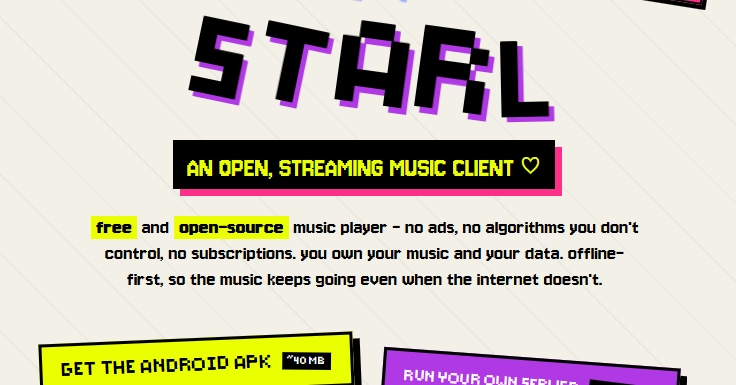
In a significant move for the open-source and self-hosting communities, developer m4iva, known online as "da crazy," has officially launched Starl, a new streaming music client for Android. This project, which has been under development for the past several months, is presented as a direct response to widespread user dissatisfaction with the current landscape of music applications, particularly concerns regarding "bloatware," lack of user control, and frequent abandonment of alternative open-source solutions. Starl is designed from the ground up to offer a clean, offline-capable, ad-free, simple, and entirely user-controlled experience, aligning with a growing demand for greater digital autonomy.
The impetus behind Starl’s creation stems from a common critique leveled against many modern applications, both proprietary and some open-source alternatives: they are often perceived as overly complex, resource-intensive, or unreliable. M4iva articulated this frustration, noting that existing open-source alternatives to popular music apps frequently suffered from issues such as being "bloated, abandoned, buggy or just too visually complex and noisy." This observation highlights a critical gap in the market for a straightforward, dependable, and user-empowering music client, especially one that supports the self-hosting paradigm. The developer’s commitment to continuous improvement is underscored by their active engagement with potential users, inviting thoughts, feature requests, and bug reports, signaling a community-driven development approach.
The Growing Challenge of Digital Bloat and Loss of Control
The digital landscape of music consumption has undergone a profound transformation over the last two decades. From physical media to digital downloads, and now predominantly to streaming services, the way individuals access and manage their music libraries has evolved dramatically. While major streaming platforms like Spotify, Apple Music, and YouTube Music offer unparalleled access to vast catalogs, they often come with trade-offs. These include subscription fees, data collection practices, integrated advertisements (for non-premium tiers), and a lack of direct control over one’s music files and playback environment.
Beyond these commercial giants, even many independent or open-source applications can inadvertently fall into the trap of feature creep. "Bloatware" refers to software that consumes excessive system resources (CPU, RAM, storage, battery life) due to an abundance of features, inefficient coding, or unnecessary background processes. This can lead to slower device performance, reduced battery life, and a generally less responsive user experience. For music applications, this often translates into slow loading times, complex navigation menus, and hidden background activities that might track usage or push notifications. The problem is exacerbated when developers cease updates, leaving users with buggy or outdated software, a common fate for many passion projects in the open-source realm.
M4iva’s decision to develop Starl directly addresses these pain points. The project is positioned as a deliberate counter-narrative to the prevailing trends, prioritizing performance, simplicity, and user sovereignty above all else. By focusing on a "clean" interface, "offline" capabilities, an "ad-free" environment, and ensuring it is "totally on your control," Starl aims to carve out a niche for users who value minimalist design and absolute command over their digital music experience.
Starl’s Core Philosophy: Simplicity, Openness, and Self-Hosting
At its heart, Starl embodies several key principles that resonate strongly with a particular segment of tech-savvy users and privacy advocates.

The Open-Source Ethos
As an open-source project, Starl’s source code is publicly available, allowing anyone to inspect, modify, and distribute it. This transparency is a cornerstone of the open-source movement, fostering trust and enabling community collaboration. For users, it means greater security as potential vulnerabilities can be identified and patched by a global community of developers. For the project itself, it invites contributions, ensuring longevity and adaptability. In an era where proprietary software often operates as a "black box," open-source alternatives like Starl offer a refreshing level of accountability and freedom. The developer’s custom "Pure Freedom Forever" (PFF) license, while unique, reinforces this commitment to perpetual accessibility and user rights. While custom licenses can sometimes present compatibility challenges with broader open-source ecosystems, its intent is clear: to ensure the project remains free and unencumbered.
Embracing the Self-Hosting Paradigm
One of Starl’s most defining characteristics is its design as a "self-host" streaming music client. This means that instead of relying on third-party cloud services to store and stream music, users are expected to host their own music library on a personal server (e.g., a home server, a network-attached storage (NAS) device, or a virtual private server (VPS)). Starl then connects to this personal server, allowing users to stream their own music collection to their Android device.
The self-hosting movement has gained considerable momentum in recent years, driven by increasing concerns over data privacy, surveillance capitalism, and the desire to reduce dependence on large tech corporations. Platforms like Plex, Jellyfin, Navidrome, Subsonic, and Airsonic have popularized the concept of personal media servers. Starl integrates into this ecosystem by providing a client-side application that can interface with such servers, offering users a comprehensive solution for managing and enjoying their personal music libraries. The benefits are manifold:
- Complete Data Ownership: Users retain full control over their music files and associated metadata.
- Enhanced Privacy: No third-party analytics or advertising tracking.
- Customization: The ability to curate a music library precisely to one’s tastes without algorithmic interference or licensing restrictions.
- Cost-Effectiveness: Eliminating recurring subscription fees for streaming services.
- Reliability: Dependence on one’s own infrastructure, which can often be more stable for personal use than reliance on external services that can change terms, increase prices, or discontinue features.
User-Centric Design: Cleanliness, Offline Access, and Ad-Free Experience
Starl’s design philosophy prioritizes a minimalist and intuitive user experience. The emphasis on a "clean" interface aims to reduce cognitive load and provide a focused music listening experience, free from visual clutter or unnecessary distractions. This contrasts sharply with many mainstream apps that often incorporate social features, news feeds, or discovery algorithms that can detract from the primary function of music playback.
The inclusion of "offline" capabilities is crucial for modern mobile applications. While streaming is convenient, reliable internet access is not always guaranteed. Starl likely incorporates robust caching mechanisms, allowing users to download or sync portions of their music library from their self-hosted server to their Android device. This ensures uninterrupted playback during commutes, travel, or in areas with poor network coverage, enhancing the utility and reliability of the application.
Finally, the commitment to being "no ads" is a significant draw. In an age where even premium services sometimes integrate sponsored content, an ad-free experience is a premium feature that Starl offers by default, aligning with its user-first philosophy and reinforcing the sense of complete control over the listening environment.
The Development Journey and Community Engagement
M4iva’s statement, "I spent the last few months building," provides a glimpse into the intensive development cycle behind Starl. Creating a robust, feature-rich, and stable application for Android, especially one designed to interact with various self-hosting backends, involves numerous stages:

- Conception and Planning: Defining the core problem, target audience, and key features.
- Architecture Design: Planning the application’s structure, data flow, and user interface.
- Front-end Development: Building the Android application using languages like Kotlin or Java, and leveraging Android’s UI frameworks.
- Backend Integration: Developing the logic to connect and interact with different self-hosting music server APIs (e.g., Subsonic API, Jellyfin API). This often requires extensive testing to ensure compatibility and stability across various server implementations.
- Offline Capability Implementation: Designing and coding the caching and synchronization mechanisms.
- Testing and Debugging: Rigorous testing across different Android versions and devices to identify and fix bugs, ensure performance, and refine the user experience.
- Documentation: Creating user guides and developer documentation to facilitate adoption and contributions.
The open-source nature of Starl means that this development journey is not solitary. M4iva’s explicit invitation for "thoughts, feature requests, or any bugs you run into" is a direct call to action for the wider community. This feedback loop is vital for open-source projects, allowing users to directly influence the product’s evolution. It fosters a sense of ownership among early adopters and helps prioritize features that genuinely solve user problems. Community contributions, whether through code, bug reports, translation, or documentation, are essential for the long-term viability and success of such initiatives.
Broader Implications and Future Outlook
The launch of Starl is more than just the release of another music app; it represents a significant contribution to the growing movement advocating for digital freedom and user control.
Impact on the Open-Source Ecosystem
Starl enriches the open-source software landscape by providing a polished, purpose-built client for self-hosted music. While other generic media clients exist (like VLC or Kodi), and some specific self-hosting clients have emerged, Starl’s explicit focus on a "clean, simple" Android experience for music fills a particular void. Its success could inspire other developers to tackle similar "bloatware" issues in different application categories, fostering a healthier, more diverse open-source ecosystem.
Empowering Users and Promoting Digital Literacy
For users, Starl offers a tangible path towards reclaiming control over their digital music. It encourages a deeper understanding of how digital media works, promoting digital literacy by requiring users to engage with concepts like server setup, network configuration, and data management. This empowers individuals to move beyond being passive consumers of proprietary services to becoming active managers of their own digital assets.
Challenges and Opportunities
While promising, Starl, like any open-source project, faces challenges. User adoption will depend on ease of setup for self-hosting (which can be a barrier for less technical users), ongoing maintenance, and ensuring compatibility with a diverse array of server software and Android devices. The project will need consistent community engagement and potentially additional developer contributions to evolve and adapt to new technologies and user demands.
However, the opportunities are vast. Starl could become a flagship application for the self-hosting music community on Android. Future developments might include broader server compatibility, advanced playback features, deeper customization options, and perhaps even desktop clients or web interfaces developed by the community. Its success could demonstrate the viability of user-centric, non-commercial alternatives in a market dominated by large corporations.
In conclusion, m4iva’s Starl client represents a thoughtful and timely response to the increasing frustration with overly complex and restrictive digital music solutions. By championing simplicity, open-source principles, and the power of self-hosting, Starl offers Android users a compelling alternative that prioritizes control, privacy, and a pure, unadulterated music listening experience. As the project garners community feedback and contributions, it stands poised to become a significant player in the ongoing quest for digital autonomy.