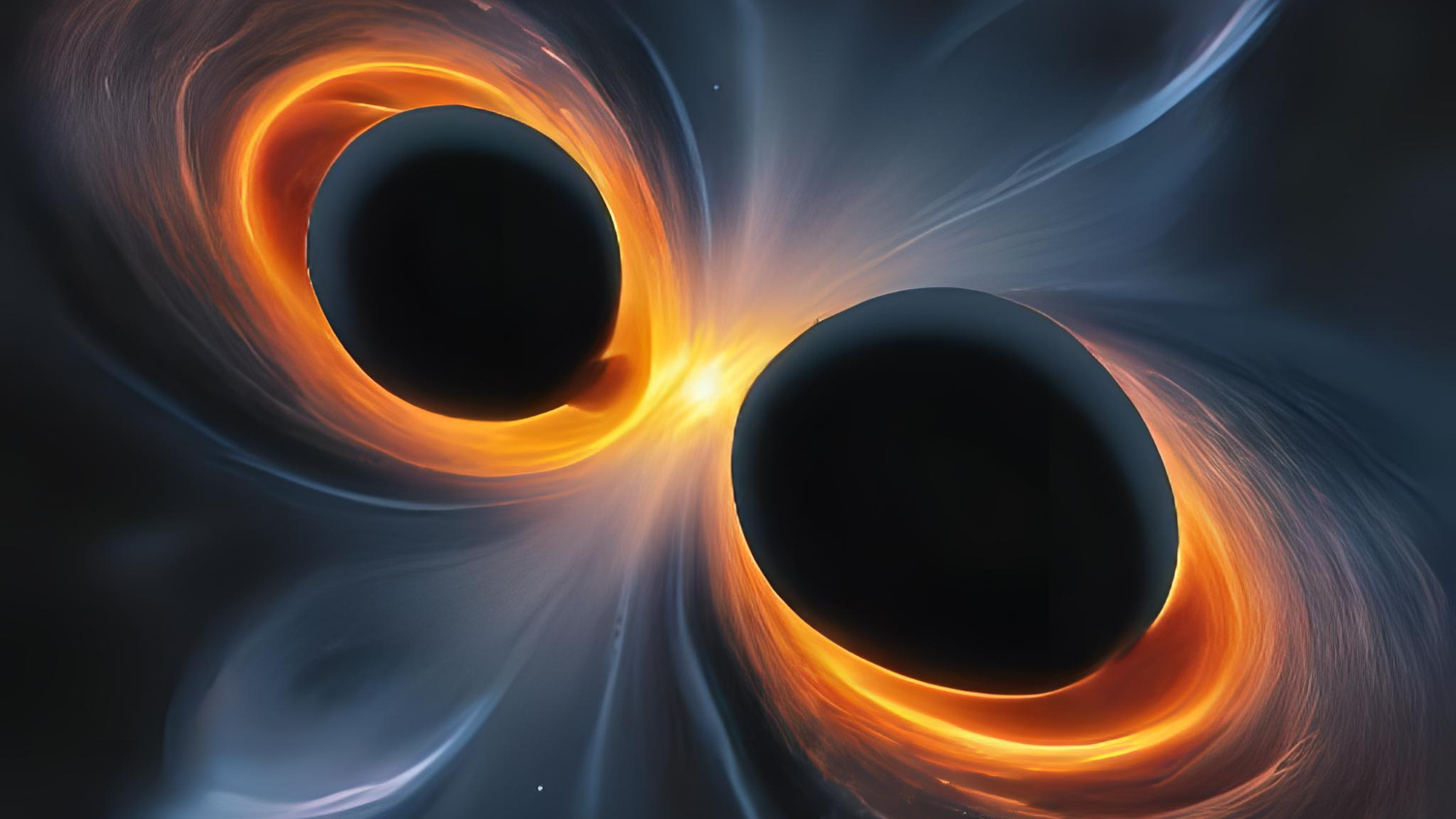
On November 23, 2023, the Laser Interferometer Gravitational-Wave Observatory (LIGO) recorded a gravitational wave signal that initially baffled the astrophysical community. Designated as GW231123, the signal captured the faint, rhythmic ripples of spacetime generated by what appeared to be an impossible cosmic collision. Standard models of stellar evolution and black hole formation dictate strict limits on the sizes of black holes born from dying stars, yet GW231123 pointed to a cataclysmic merger between a black hole roughly 140 times the mass of our sun and a companion weighing in at approximately 100 solar masses. Together, they formed a system totaling an unprecedented 240 solar masses, while also exhibiting startlingly high rotational speeds.
This apparent anomaly challenged decades of foundational astrophysics. However, a new study published on August 25 in the Astrophysical Journal Letters proposes a paradigm-shifting solution: the colossal measurements were an optical illusion. According to an international team of researchers, including scientists at the Albert Einstein Institute (AEI), the gravitational wave signal was distorted by gravitational lensing, meaning the black holes involved were actually much smaller, and therefore entirely compliant with standard physical laws.
Understanding the Impossibility of GW231123
To fully grasp why GW231123 caused such immediate consternation among physicists, it is necessary to examine the mechanisms of stellar-mass black holes. Typically, black holes formed from the gravitational collapse of massive stars are capped by theoretical boundaries known as the pair-instability mass gap. When a star reaches extreme sizes—roughly 65 to 130 times the mass of the sun—internal pair-production processes trigger catastrophic thermonuclear explosions that completely obliterate the star, leaving behind no black hole remnant.
Consequently, finding a black hole within this mass gap is exceptionally rare; finding two of them—one at 140 solar masses and another at 100 solar masses—colliding in a binary system defied contemporary evolutionary models. Furthermore, the high spin rates observed in the initial data added another layer of complexity, forcing theorists to scramble for exotic explanations involving hierarchical multiple mergers in dense stellar clusters.
Yet, the new research spearheaded by the AEI team suggests that astrophysicists may have been looking at the problem through the wrong lens—literally. Rather than forcing stellar evolution models to accommodate impossible masses, the researchers investigated whether the spacetime ripples themselves were magnified during their long journey across the universe.
The Physics of Gravitational Lensing in Spacetime
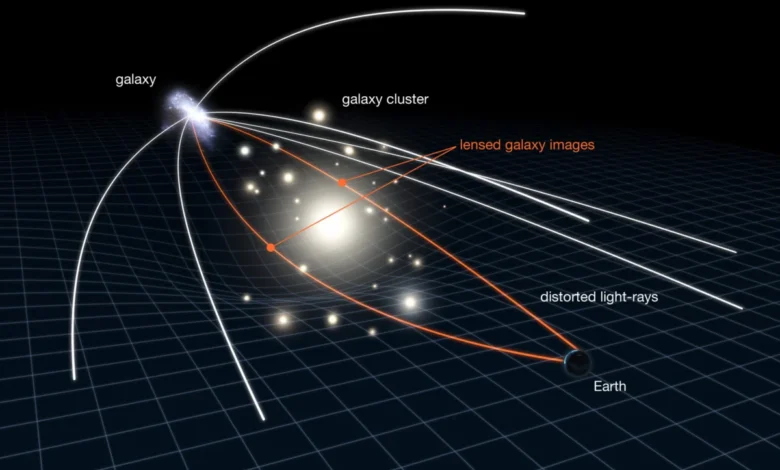
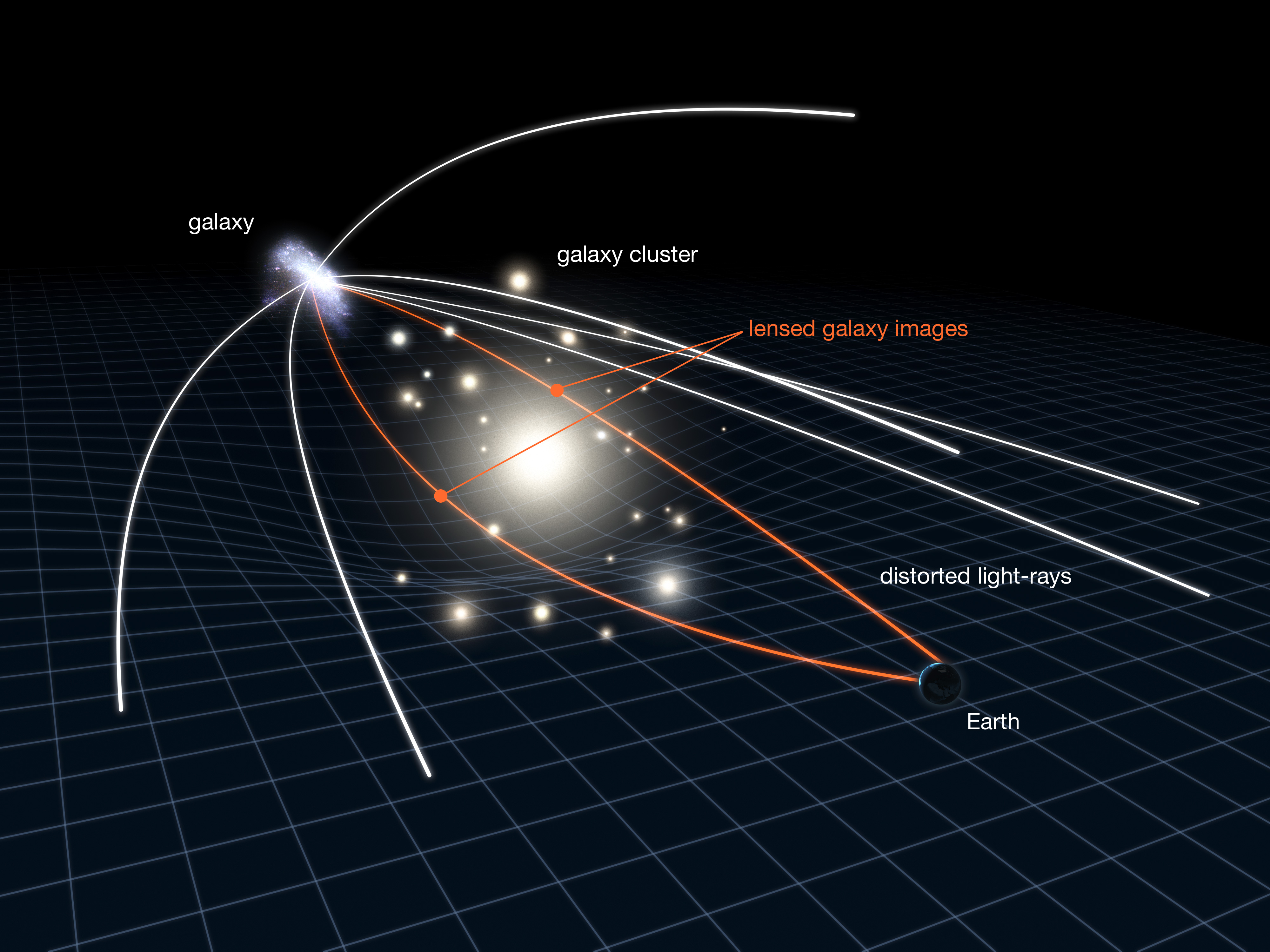
The concept underpinning this new hypothesis originates from Albert Einstein’s landmark 1915 theory of general relativity, which simultaneously predicted the existence of both gravitational waves and gravitational lensing. General relativity establishes that mass warps the four-dimensional fabric of spacetime. When light—or, as modern astrophysics has proven, gravitational waves—travels across the cosmos from a distant source, its trajectory can be bent, amplified, and distorted by massive foreground objects sitting along the line of sight.
While astronomers have routinely utilized gravitational lensing with electromagnetic radiation to observe ancient, faint galaxies that would otherwise remain invisible, applying this phenomenon to gravitational waves opens an entirely new frontier. Because gravitational waves travel as undulations through spacetime, they are subject to diffraction and interference effects when interacting with intervening massive structures.
Miguel Zumalárregui, a group leader in the Astrophysical and Cosmological Relativity Department at the Albert Einstein Institute and a co-author of the study, emphasized the unique nature of these phenomena. Like light, he noted, gravitational waves can be deflected and split into multiple paths by massive gravitational fields, yielding interference patterns that encode valuable data about the lens itself.
Building Mathematical Models for Lensing
To determine whether gravitational lensing could explain the peculiar characteristics of GW231123, the research team, which included AEI researcher Srashti Goyal, developed an advanced mathematical framework. They engineered specialized, high-performance software capable of rapidly parsing complex gravitational wave data through various lensing scenarios.
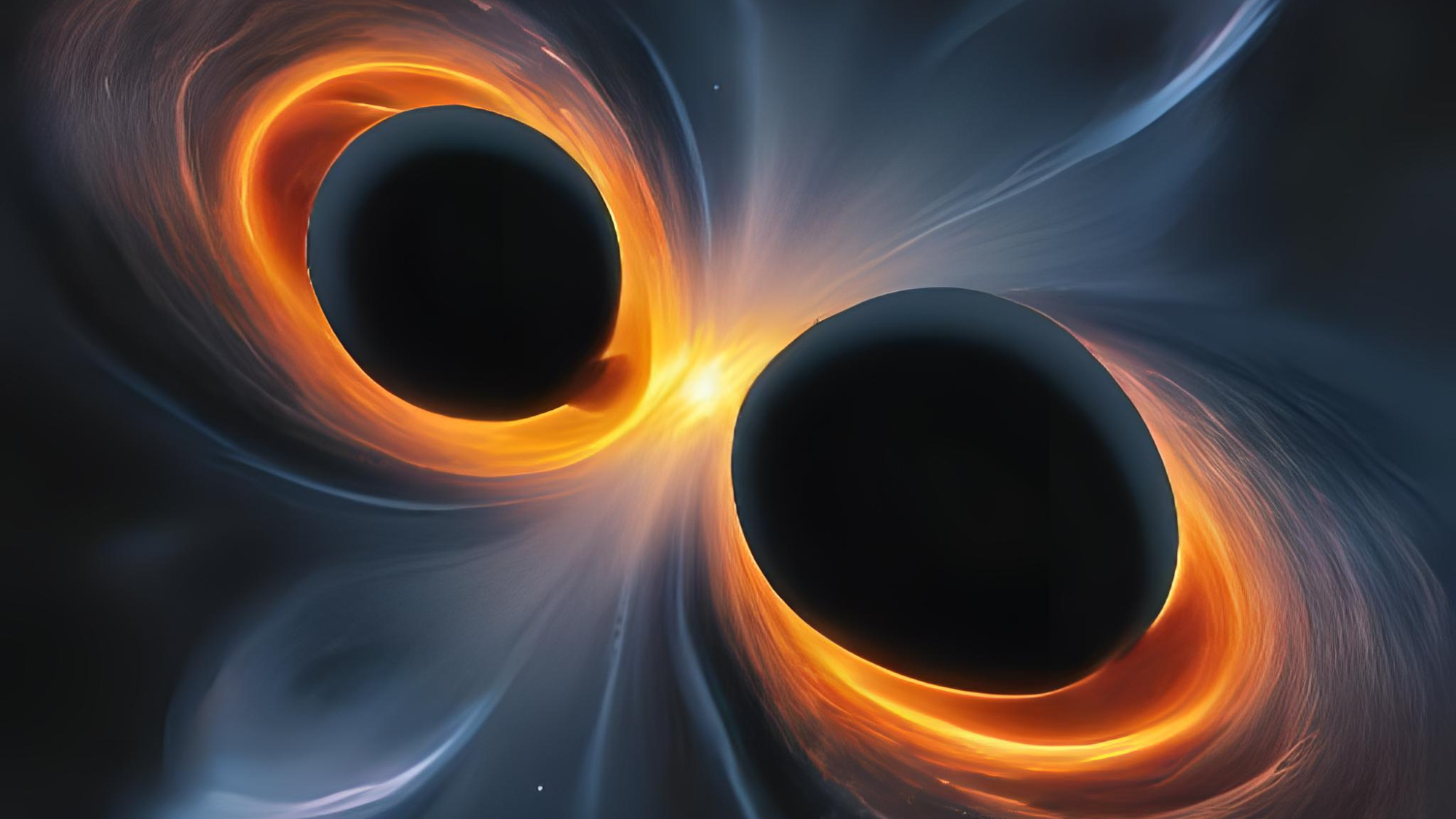
By factoring in the possibility that the signal was deflected and magnified by a foreground mass, the team recalculated the actual parameters of the binary system. Their models indicated that if the signal was distorted by a compact intermediate-mass object ranging from 190 to 850 solar masses—or alternatively, by an extended structure such as a dense globular cluster—the physical reality of the merger shifts dramatically.
Under this lensing interpretation, the true mass of the merging black hole system drops from an impossible 240 solar masses down to a much more plausible 140 solar masses. Moreover, the necessity for abnormal, high-speed spin rates vanishes entirely, bringing the event back into alignment with standard astrophysical expectations.
The Mystery of the Missing Lens
Despite the elegance of the mathematical solution, the hypothesis introduces a new cosmological mystery: the exact nature of the lensing object remains unknown. According to current observational surveys, individual compact lenses with masses between 100 and 1,000 solar masses—often referred to as intermediate-mass primordial black holes—should be exceedingly rare in the universe.
Researchers acknowledge that future empirical work will be required to determine whether such lenses can naturally form in sufficient numbers, or if the deflection was instead caused by an ensemble of lighter objects acting collectively, such as a crowded cluster of normal stars and stellar remnants.
Implications for Gravitational Wave Astronomy
At present, the scientific community cannot definitively confirm whether GW231123 represents the first undisputed detection of a gravitationally lensed gravitational wave signal. Proving this hypothesis conclusively will likely require further technological upgrades to existing detectors like LIGO, Virgo, and KAGRA, which are continually undergoing sensitivity enhancements to peer deeper into the cosmos.
Nevertheless, the publication of this study highlights the growing maturity and utility of gravitational wave astronomy. As detectors become more sensitive, researchers are increasingly equipped to dissect subtle anomalies in spacetime ripples, transforming what once looked like physical impossibilities into profound probes of the hidden architecture of the universe. Whether resolving the mystery of GW231123 ultimately confirms the existence of elusive intermediate-mass lenses or points toward new complexities in wave propagation, the research marks a critical step forward in our understanding of gravity, black holes, and the large-scale structure of space.
Related posts: