Building Autonomous Voice Agents in Python: A Comprehensive Technical Architecture for Real-Time Telephony Automation

The rapid evolution of generative artificial intelligence has fundamentally transformed how enterprises approach customer outreach, operational dispatching, and automated communication workflows. Historically, building conversational voice agents required complex, expensive integrations with legacy telephony infrastructure, proprietary interactive voice response (IVR) systems, and specialized hardware. However, a new paradigm of developer-friendly tooling has emerged, democratizing access to real-time speech processing and language modeling.
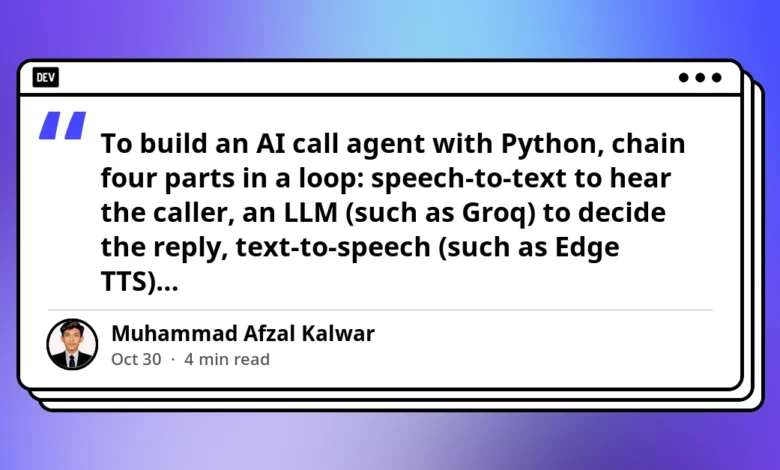
A notable development in this space is the Google Voice Dispatch Agent, an open-source Python application engineered specifically for the logistics and trucking sector. Developed by automation specialist Muhammad Afzal Kalwar, the project outlines a practical blueprint for orchestrating a real-time conversational loop using standard web automation, high-speed inference engines, and open-source audio routing tools. By chaining together speech-to-text transcription, large language models (LLMs), text-to-speech synthesis, and robust call-state detection, developers can construct sophisticated, autonomous calling systems entirely in Python.
The Technical Architecture: Core Layers of a Python AI Call Agent
At its core, an autonomous voice agent operates as a continuous, low-latency loop. When a call is initiated, the system must process auditory inputs from the human recipient, evaluate the semantic meaning of the response within milliseconds, formulate a context-aware reply, and synthesize natural-sounding speech back into the telephone line without perceptible lag.
Achieving this balance of speed and conversational fluidity requires a modular architecture. The Google Voice Dispatch Agent addresses this by dividing the runtime environment into six distinct operational layers:
- The Telephony Interface Layer: Rather than relying on traditional Session Initiation Protocol (SIP) trunking providers or expensive carrier APIs, the system utilizes a browser-driven approach. By leveraging Selenium WebDriver to control Google Voice directly inside a Google Chrome instance, the agent places and manages calls through an existing web interface.
- The Acoustic Perception Layer: To "hear" the caller, the agent captures incoming audio streams in real-time. It employs Voice Activity Detection (VAD) algorithms to isolate speech from background noise and silence, passing the resulting audio chunks to a high-speed speech-to-text engine.
- The Cognitive Processing Layer: The transcribed text is fed into a high-performance LLM, which acts as the conversational brain. The model evaluates the dialogue history against a specialized system prompt to determine the appropriate business logic and reply.
- The Vocalization Layer: Once the reply is generated, a text-to-speech engine converts the text into an audio file. This audio is then routed into the browser’s input stream using a virtual audio cable, allowing the recipient to hear the agent’s voice natively.
- The Control and Orchestration Layer: A lightweight FastAPI web console manages the overall application state, providing developers with a dashboard to monitor active calls, configure system parameters, and oversee outreach queues.
- The Data Persistence Layer: Every interaction is logged comprehensively. The system records call durations, full transcripts, audio files, and updates local customer relationship management (CRM) databases automatically upon call termination.
This end-to-end runtime flow follows a strict sequence: contacts and configuration parameters are loaded into memory, preflight diagnostic checks are executed, opening lines and voicemail audio are pre-generated to eliminate latency, the call is dialed, connection is confirmed, the conversation loop runs dynamically, and finally, audit logs are saved before a mandatory cooldown period precedes the next outreach attempt.
Step 1: Solving the Call-State Detection Problem
One of the most persistent engineering challenges in automated outbound calling is determining the precise state of the telephone line. An autonomous agent that begins speaking while a phone is still ringing, or worse, attempts to converse with an automated carrier intercept message, immediately shatters the illusion of human interaction and damages brand reputation.
To mitigate this, the Dispatch Agent implements a conservative state-gating mechanism. The system deliberately ignores early acoustic noise, stale browser DOM banners, and fluctuating indicators by enforcing a mandatory minimum ring window before any state transition can be evaluated.
import time

def wait_for_answer(page, min_ring=2, max_ring=45):
    start = time.time()
    while True:
        elapsed = time.time() - start
        state = page.detect_call_state()      # reads DOM cues
        if elapsed < min_ring:
            continue                          # ignore early noise / stale banners
        if state in ("connected", "voicemail", "ended"):
            return state
        if elapsed > max_ring:
            return "no_answer"
        time.sleep(0.25)
By polling Document Object Model (DOM) cues in the browser at quarter-second intervals, the system ensures that the agent’s opening line is triggered strictly after a genuine connection has been cryptographically or statefully confirmed. If the maximum ring threshold is breached without an answer, the system gracefully logs a "no_answer" event and terminates the attempt.
Step 2: High-Velocity Auditory Perception via Whisper
Once a human picks up the phone, the agent must rapidly capture and transcribe their spoken words. Traditional speech recognition models often introduce unacceptable latency, creating awkward pauses in conversation that signal to the recipient that they are speaking with a machine.
To achieve near-instantaneous transcription, the architecture utilizes Groq’s hosted infrastructure running OpenAI’s Whisper models (such as whisper-large-v3). Groq’s specialized Tensor Processing Unit (TPU) hardware architecture accelerates inference times dramatically, allowing multi-second audio recordings to be converted into high-accuracy text strings in a fraction of a second.
from groq import Groq
client = Groq()

def transcribe(wav_path: str) -> str:
    with open(wav_path, "rb") as f:
        r = client.audio.transcriptions.create(file=f, model="whisper-large-v3")
    return r.text
Step 3: Semantic Reasoning and Conversational Logic
With the caller’s spoken input converted to text, the system invokes a large language model to formulate a response. In operational contexts—such as trucking dispatch—ambiguity and overly verbose explanations are detrimental. The LLM must be constrained to act concisely and professionally.
Using lightweight, highly optimized models like Llama 3.1 (llama-3.1-8b-instant), developers can enforce strict behavioral guidelines through system prompts. By limiting maximum token generation and instructing the model to reply in one or two short sentences, the conversation retains a natural, human-like cadence.
SYSTEM = "You are a polite dispatch assistant. Reply in one or two short sentences."

def reply(history: list[dict]) -> str:
    r = client.chat.completions.create(
        model="llama-3.1-8b-instant",
        messages=["role": "system", "content": SYSTEM, *history],
        max_tokens=80,
    )
    return r.choices[0].message.content
Step 4: Synthetic Voice Generation and Audio Routing
The fourth component of the loop is text-to-speech (TTS) conversion. While enterprise telephony platforms often charge substantial fees per minute for synthetic voice rendering, developers can leverage modern open tools like Edge TTS, which provides high-fidelity, natural-sounding neural voices without licensing costs.
To eliminate latency during the live call, the system pre-generates fixed audio assets—such as opening greetings and standard voicemail drops—before the dialing sequence begins. Repeated phrases are cached locally.
import asyncio, edge_tts

async def speak_to_file(text: str, path: str, voice="en-US-GuyNeural"):
    await edge_tts.Communicate(text, voice).save(path)

asyncio.run(speak_to_file("Hi, this is dispatch calling about your truck.", "opening.mp3"))
Bridging the generated audio file into the telephone call requires clever software routing. By configuring a virtual audio device (such as VB-CABLE) as the primary microphone input within the Google Chrome browser instance, the pre-rendered or dynamically synthesized MP3 files are played directly into the active browser call stream, mimicking a physical microphone pickup.
Step 5: Automated Voicemail Handling and Comprehensive Logging
Outbound calling campaigns invariably encounter voicemail boxes. An effective autonomous agent must differentiate between a live human participant and an automated recording system.
The Dispatch Agent resolves this by executing an audio classification check immediately after connection confirmation, analyzing greeting patterns and audible beep signals via DOM and acoustic cues. If a voicemail box is verified, the agent bypasses the interactive conversational loop, immediately plays the pre-generated voicemail drop message, and gracefully disconnects.
To ensure operational transparency and accountability, every interaction concludes with a thorough logging procedure. Transcripts, audio recordings, timestamps, and outcome statuses are automatically compiled and pushed to a local CRM or database, enabling human supervisors to audit agent performance and review operational metrics.
Compliance, Regulatory Frameworks, and Disclosure
The deployment of autonomous AI voice agents operates within a strictly regulated legal landscape. Organizations utilizing automated dialing and artificial intelligence for outreach must navigate regional telecommunications laws, consumer protection statutes, and privacy regulations.
In the United States, automated calling systems are subject to the Telephone Consumer Protection Act (TCPA) and regulations enforced by the Federal Communications Commission (FCC), which mandate strict adherence to Do-Not-Call (DNC) registries and, in many cases, explicit prior consent. In the United Kingdom and the European Union, the Privacy and Electronic Communications Regulations (PECR) alongside the General Data Protection Regulation (GDPR) govern automated marketing and communications.
Developers and enterprise operators are strongly advised to consult legal counsel to ensure compliance. Best practices in this domain include disclosing the automated nature of the caller where required by law, maintaining robust opt-out mechanisms, honoring internal and external DNC lists, and strictly adhering to the terms of service established by underlying telephony and software providers.
Broader Implications and Industry Impact
The open-sourcing of architectures like the Google Voice Dispatch Agent highlights a broader technological shift: the commoditization of enterprise automation infrastructure. Historically, small-to-medium enterprises in industries such as logistics, field services, and sales were priced out of advanced voice automation solutions.
By utilizing accessible tools—Python, Selenium, open-source audio routing, and low-cost hosted inference providers like Groq—independent developers can now construct production-grade voice agents with minimal capital expenditure. As these technologies continue to mature, the boundary between human-operated call centers and autonomous software agents will continue to blur, fundamentally altering how businesses manage high-volume telephonic workflows.
Related posts: