Breaking Out of Tutorial Hell: A Junior DevOps Engineer’s Journey into Containerization and Practical Cloud Architecture

The modern technology landscape demands a paradigm shift in how software is deployed, scaled, and managed, pushing traditional developers and aspiring system administrators into the complex realm of DevOps. On July 8, a notable milestone in cloud engineering mentorship marked the beginning of an intensive, hands-on DevOps journey undertaken by a burgeoning engineer guided by industry professional Endah. Operating under the auspices of the CloudHer cohort, an initiative spearheaded by Women Innovating In Cloud Africa (WIICA), this educational trajectory highlights the common hurdles faced by technical beginners and underscores the profound efficacy of experiential learning over passive theoretical consumption.
Background Context of the CloudHer Initiative and DevOps Education
The transition from software development or traditional IT operations to specialized cloud infrastructure engineering is notoriously steep. Industry reports consistently highlight that containerization technologies, particularly Docker and Kubernetes, represent some of the steepest learning curves for professionals entering the DevOps domain. Programs such as CloudHer—designed specifically to bridge the gender gap and foster technical excellence within the African tech ecosystem—play a crucial catalytic role. By pairing participants with seasoned mentors, these initiatives aim to dismantle the psychological and technical barriers that often stall careers in cloud computing.
The initial phase of this particular mentorship program, spanning from late July through late August, was characterized by an apparent absence of public output. However, this silence reflected a critical preparatory phase rather than stagnation. The curriculum required intensive engagement with official technical documentation, system architecture diagrams, and foundational networking principles. This period emphasized understanding the underlying operating system abstractions and the historical motivations behind containerization before executing a single command-line instruction.
Chronology of the Learning Curve: From Theory to Execution
The empirical turning point of the mentorship occurred when the candidate abandoned exhaustive theoretical pre-study in favor of a build-first methodology. This milestone directly addresses a pervasive industry phenomenon known as "tutorial hell," wherein learners consume countless hours of video content without acquiring the practical muscle memory required to troubleshoot live systems.

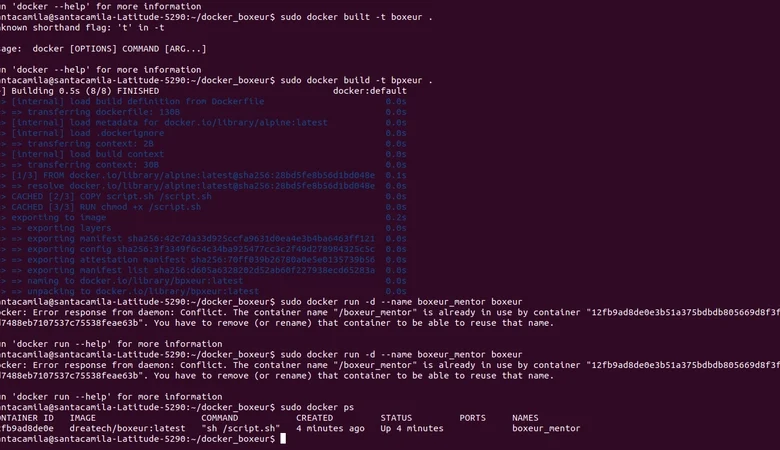
The practical phase commenced with the conceptualization and deployment of a minimal containerized project designated as "boxeur." Built upon an Alpine Linux base image, the project was designed to execute a continuous Bash script that generated and wrote system logs. This iterative approach allowed the engineer to organically encounter and dissect core Docker primitives, including images, runtime containers, network configurations, and data persistence models.
Technical Hurdles and Diagnostic Milestones
Throughout the containerization process, the engineer encountered several foundational technical obstacles that are typical of early-stage systems administration. Each obstacle served as an intensive lesson in modern software tooling and infrastructure management.
The first barrier materialized prior to Docker implementation, surfacing as a standard HTTP 403 Forbidden error during Git version control operations. This friction point necessitated moving beyond legacy username-password authentication models by generating and implementing a secure GitHub Personal Access Token. This operational shift provided practical insight into modern credential management and secure remote repository interaction.
A subsequent diagnostic challenge involved container logging mechanisms. Upon executing the docker logs boxeur command, the terminal returned a blank output. Investigation revealed a fundamental distinction between file-based logging—where an application writes directly to an internal storage file—and container-native logging, which relies exclusively on standard output (stdout) and standard error (stderr) streams. By executing docker exec boxeur_mentor cat /var/log/boxeur.log, the engineer successfully accessed the internal file system, thereby clarifying how modern container runtimes intercept and manage process output streams.
Further operational friction arose from operating system idiosyncrasies. An attempt to install the Nginx web server using the familiar Ubuntu-centric command apt-get install nginx resulted in an immediate syntax error. Because the container was built upon Alpine Linux—a security-oriented, lightweight distribution—package management required the use of Alpine’s proprietary apk utility, specifically via the command apk add --no-cache nginx. This discovery emphasized the necessity of understanding the underlying base image architecture rather than relying on rote memorization of command syntax.
Additional technical debt was incurred through minor human errors, such as a capitalization anomaly during image tagging. By attempting to publish an image to Docker Hub under the repository designation Dreatech/boxeur instead of the mandated lowercase convention dreatech/boxeur, the system encountered a cryptic DNS resolution failure: lookup Dreatech on 127.0.0.53:53: server misbehaving. Resolving this issue provided valuable context regarding the rigid naming conventions enforced by centralized container registries. Ultimately, the successful execution of docker tag boxeur:latest dreatech/boxeur:latest followed by a routine push operation validated the entire deployment pipeline.

Analysis of Mentorship Dynamics in Technical Upskilling
Industry analysts and human resource specialists in the technology sector frequently emphasize that technical mentorship transcends mere code review or instructional lecturing. In the context of the CloudHer program, Endah’s methodology relied on strategic inquiry rather than direct solution provision. By prompting the mentee to interrogate error logs, analyze terminal outputs, and independently deduce system behaviors, the mentorship model cultivated critical autonomous problem-solving capabilities.
Educational specialists note that self-efficacy—the belief in one’s ability to execute behaviors necessary to produce specific performance attainments—is the primary predictor of persistence in STEM disciplines. Structured mentorship acts as a stabilizing force during periods of cognitive overload, reassuring learners that frustration and diagnostic friction are normal components of systems engineering rather than indicators of personal incapacity.
Broader Industry Implications and Future Outlook
The successful publication of the dreatech/boxeur image to Docker Hub illustrates a broader trend in workforce development: the democratization of high-level cloud competencies through targeted, community-driven bootcamps and mentorship frameworks. As organizations globally accelerate their migration toward microservices architectures and cloud-native infrastructures, the demand for competent DevOps practitioners continues to outpace traditional academic supply chains.
Initiatives like CloudHer demonstrate that bridging the technical skills gap requires a dual approach: rigorous foundational instruction combined with psychological safety nets that encourage experimentation and failure. For aspiring engineers entering the DevOps landscape, the primary takeaway remains clear. While documentation and architectural theory provide the map, true proficiency is forged only through the deliberate, iterative execution of commands within a live terminal environment.