Dynamic Flux in the Shadow of Chariklo: New Evidence Reveals Shifting Ring Systems Around Distant Asteroids

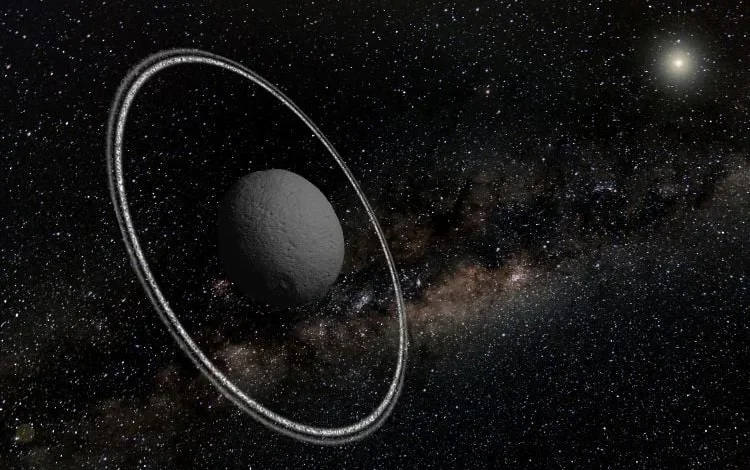
The vast architecture of our solar system is defined by more than just the iconic gas giants and the familiar rubble of the main asteroid belt. While the public imagination often gravitates toward the stable, predictable orbits of asteroids residing between Mars and Jupiter, a more chaotic and elusive population exists in the outer reaches of our neighborhood. Among these are the Centaurs—small, icy bodies characterized by unstable, intersecting orbits that weave through the gravitational influence of the outer planets. Standing at the forefront of this enigmatic class is 10199 Chariklo, a 125-kilometer-radius asteroid that has challenged long-held assumptions about the geological stability of minor solar system bodies.
Recent research published in the journal Science Advances has provided a groundbreaking look at Chariklo, revealing that its complex ring system is not a static relic of the past, but a dynamic, evolving structure. An international team of researchers has presented evidence suggesting that the asteroid’s two rings—designated C1R and C2R—are actively gaining and losing material, a discovery that challenges current models of how ring systems are maintained around smaller celestial bodies.
A Chronology of Discovery: From 1997 to the JWST Era
The scientific journey to understand Chariklo began in 1997, when the object was first identified as part of the Centaur population. For years, it remained a curiosity due to its size and distance, but it did not reach the status of a scientific anomaly until 2013. During a routine observation of a stellar occultation—a phenomenon where an object passes directly in front of a distant star, temporarily blocking its light—astronomers were shocked to detect secondary dips in the starlight. These fluctuations revealed that Chariklo was not merely a lone rock; it was surrounded by a sophisticated, narrow ring system.
This discovery was monumental, as ring systems were previously thought to be the exclusive domain of massive planets like Jupiter, Saturn, Uranus, and Neptune. The 2013 revelation prompted a decade of intense scrutiny. By 2017, a comprehensive study established a reliable baseline for the rings, mapping their dimensions and approximate composition. These observations placed the inner ring (C1R) at roughly 265 kilometers from the asteroid’s surface and the outer ring (C2R) at approximately 280 kilometers.
The most recent phase of research culminated in 2022, leveraging the unprecedented sensitivity of NASA’s James Webb Space Telescope (JWST). By comparing the 2022 data against the 2017 baseline, the international team observed a startling transformation: the inner ring’s opaqueness had surged by over 50 percent, while the outer ring’s opaqueness had plummeted by roughly 60 percent. This indicates a significant redistribution of mass, suggesting that the rings are currently undergoing a period of rapid structural evolution.
Understanding Stellar Occultation and Ring Dynamics
To grasp the significance of these findings, one must understand the methodology of stellar occultation. In essence, it acts as a high-precision shadow-casting technique. As Chariklo moves across the celestial sphere, it blocks the light of a background star. By timing the duration and intensity of the light’s dimming, astronomers can construct a high-resolution profile of the object’s silhouette.
When the object possesses rings, those rings cast their own miniature shadows. The "opaqueness" mentioned in the study refers to the optical depth of these rings—essentially, how much light is blocked as it passes through the particulate matter orbiting the asteroid. A 50 percent increase in opaqueness for the inner ring implies a higher density of debris, potentially resulting from material falling inward from the outer ring or a collision-related replenishment of particles. Conversely, the decrease in the outer ring’s opacity suggests a dissipation of material, either through gravitational shedding or collisions that alter the orbital paths of the constituent particles.
This process is fundamentally different from the transit method used to detect exoplanets. While the transit method looks for a small object (a planet) blocking a large light source (a star), stellar occultation utilizes the star as a "backlight" to reveal the fine structure of a foreground object that would otherwise be too small or dark to image directly. The success of the 2022 JWST observations highlights the telescope’s unique ability to perform these measurements in the infrared spectrum, providing data quality that was previously unattainable with ground-based facilities.
Theoretical Implications and Scientific Analysis
The discovery of shifting rings around a minor body presents a conundrum for orbital mechanics. Historically, ring systems around planets are kept in place by "shepherd moons"—small satellites that use their gravity to confine ring material into narrow, stable bands. However, Chariklo lacks such large, distinct shepherds, raising questions about how these rings persist at all.
One prevailing theory is that the rings are comprised of water ice and other volatiles that are constantly being replenished by cryovolcanic activity or the disintegration of smaller, orbiting fragments. The rapid changes observed by the research team suggest that the system is far from equilibrium. The study notes that the physical origin of these changes remains an open question: are we witnessing a seasonal shift in the material, a result of the asteroid’s rotation, or perhaps a localized collision that has triggered a cascade of debris movement?
The research team stated in their report, "The unexpected changes detected in Chariklo’s rings point to dynamical behavior that had remained entirely hidden until now. Whether these changes primarily reflect temporal evolution, wavelength-dependent opacity, or a combination of both, their physical origin remains an open question." This statement underscores the importance of this study as a foundational document for future planetary science. It serves as a reminder that even "minor" bodies possess complex, time-dependent environments that can provide clues about the formation and early history of our solar system.
Broader Impact on Solar System Science
The implications of the Chariklo study extend beyond the asteroid itself. By observing these changes, scientists are gaining insight into the lifecycle of ring systems. It is possible that ring systems are a common, though fleeting, feature of minor bodies, appearing and disappearing over timescales that are short relative to the age of the solar system.
Furthermore, this study validates the use of JWST for high-cadence solar system monitoring. By dedicating observation time to transient events like occultations, the astronomical community can now track the evolution of objects in the outer solar system with a level of detail that allows for the construction of dynamic physical models rather than static snapshots.
The ongoing study of Chariklo also informs our understanding of the Kuiper Belt and the scattered disc. These regions are populated by millions of objects similar in composition to Chariklo. If ring systems are indeed a common feature among these bodies, it suggests that the environment of the outer solar system is much "messier" and more active than previously theorized. This activity plays a critical role in the distribution of water and organic compounds, as material shed from these rings may eventually be deposited onto the asteroid’s surface or ejected into the surrounding space.
Looking Toward Future Observations
As the international scientific community continues to analyze the 2022 JWST data, plans for future observations are already being drafted. To confirm whether the ring changes follow a cyclical pattern, researchers require long-term, sustained monitoring. Each future occultation represents a data point in a much larger, multi-decadal study.
The potential for future discovery is significant. Should researchers identify a regular frequency in the increase and decrease of ring opacity, it would provide a definitive timeline for the "life and death" of these rings. Furthermore, advancements in orbital modeling will likely allow astronomers to simulate the gravitational interplay between the asteroid’s shape, its rotation, and the particulate matter in its rings.
In conclusion, Chariklo serves as a vital laboratory for understanding the physics of small, icy bodies. While the asteroid itself is only a small fraction of the mass of the major planets, its ring system offers a window into the chaotic processes that govern the outer solar system. The discovery that these rings are not merely decorative, but are instead active and shifting, changes our fundamental understanding of these distant travelers. As technology continues to evolve, the ability to observe such minute details across the vast expanse of space remains one of the most promising frontiers in modern astrophysics. The quest to understand Chariklo is a testament to the persistent curiosity of the scientific community and the invaluable power of looking up at the night sky with ever-sharper eyes.
Related posts: